

What Conservative Underwriting Actually Means in Multifamily Investing
Most multifamily deals look reasonable when presented in a spreadsheet.
Income grows, expenses are controlled, and the projected outcome appears straightforward. On paper, it’s not difficult to make a deal look attractive.
The difference is usually not the model itself. It’s the assumptions behind it.
Underwriting is often described as a technical process, something built on formulas and projections. But in practice, it reflects how an operator thinks. What they choose to assume, what they choose to question, and how they account for uncertainty all shape the outcome long before a property is ever purchased.
That’s where the idea of conservative underwriting comes in.
It is not a different model or a more complex version of the same analysis. It is a discipline. It shows up in how expectations are set, how risk is evaluated, and how decisions are made when information is incomplete, which it almost always is.
This article is not a guide to building underwriting models. It’s a look at how conservative underwriting is applied in real-world decision-making, and why it matters when evaluating multifamily opportunities.
Because in the end, underwriting is not about predicting what will happen. It’s about understanding what could happen and deciding how much room there is if things don’t go exactly as planned.
What Is Underwriting in Multifamily Real Estate?
Underwriting is the process of evaluating a property before deciding whether it makes sense to acquire it.
That evaluation is built on a set of assumptions. These typically include how the property will perform over time, how it will be financed, and what it may be worth at some point in the future. Income, expenses, occupancy, and exit conditions are all part of that picture.
It can be helpful to think of underwriting not as a prediction, but as a structured way of asking questions.
What happens if rents grow more slowly than expected?
What happens if expenses increase faster than planned?
What happens if market conditions are different at exit than they are today?
The goal is not to arrive at a single “correct” outcome. In reality, there isn’t one. The goal is to understand a range of possible outcomes and how sensitive the deal is to changes in the underlying assumptions.
This is where underwriting becomes less about math and more about judgment.
Two operators can review the same property, use similar data, and still reach different conclusions. The difference often comes down to how each one interprets uncertainty, how they weigh risk, and how much margin they require before moving forward.
That’s why understanding underwriting at a high level can be useful, even for investors who are not building models themselves. It provides a lens for evaluating how a deal has been put together and what assumptions it depends on.
And it sets the stage for a more important question, which is not just how a deal works on paper, but how it holds up when those assumptions are tested.
Why “Conservative” Underwriting Matters

At a glance, many multifamily deals can appear similar. The structure is familiar, the projections follow a pattern, and the outputs often look reasonable.
But small changes in assumptions can lead to very different outcomes.
A modest adjustment in rent growth, a slight increase in expenses, or a different exit condition can materially change how a deal performs on paper. This is why underwriting is not just about building a model. It’s about how those inputs are chosen.
For investors reviewing opportunities, this distinction matters more than the projected returns themselves.
A deal built on optimistic assumptions may look compelling initially, but can be more sensitive to changes in market conditions or execution. A deal built on more measured assumptions may appear less aggressive on paper but may rely less on specific outcomes to perform as expected.
This is where the idea of conservative underwriting becomes relevant. It reflects a preference for durability over precision and for flexibility over optimization.
In practice, that often means focusing on questions like:
How dependent is this deal on rent growth to succeed?
What happens if expenses increase faster than expected?
How sensitive are the returns to exit conditions?
Is there room to adjust if conditions change?
These are not questions that eliminate risk. Every real estate investment involves uncertainty, including:
Market risk, where broader economic conditions shift
Interest rate risk, which can affect financing and valuations
Operational risk, tied to execution at the property level
Liquidity risk, particularly around the timing of a sale
Conservative underwriting does not remove these factors. It is a way of acknowledging them early and incorporating them into how a deal is evaluated.
For many investors, especially those who have experienced volatility in other asset classes, the focus is less on maximizing projected outcomes and more on understanding how a deal behaves when conditions are less favorable than expected.
That shift in focus is what separates underwriting as a technical exercise from underwriting as a disciplined approach to decision-making.
What Conservative Underwriting Actually Means in Practice
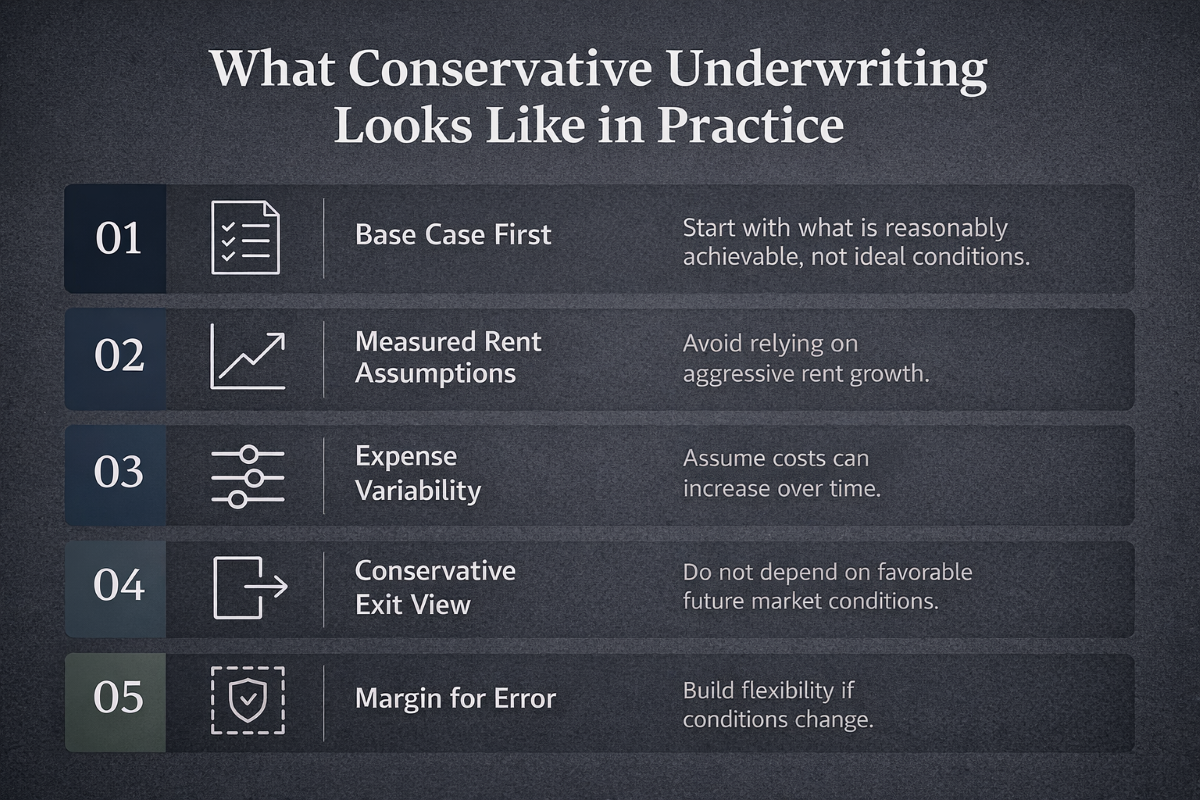
Conservative underwriting is often described in broad terms, but in practice, it shows up in a series of small, consistent decisions. It is less about being pessimistic and more about being deliberate in how assumptions are set.
The goal is not to make a deal look worse. It is to avoid relying on conditions that may not materialize.
1. Starting With a Base Case, Not a Best Case
Every deal has a range of possible outcomes. Conservative underwriting begins with what is reasonably achievable, not what is possible under ideal conditions.
This means avoiding assumptions that depend on perfect execution or favorable timing. A best-case scenario may still exist in the model, but it is not what the decision is built on. The focus stays on whether the deal works under more typical conditions, where some variables inevitably fall short of expectations.
2. Using Measured Rent Growth Assumptions
Rent growth is one of the most sensitive inputs in any underwriting model. Even small increases can significantly change projected outcomes.
A more conservative approach recognizes that rent growth is influenced by factors outside the operator’s control, including supply, affordability, and local demand. Instead of relying on aggressive increases to justify the deal, the emphasis is on whether the property remains viable under more moderate assumptions.
3. Accounting for Expense Variability
Expenses are often treated as stable in projections, but in practice, they tend to move over time. Insurance, taxes, maintenance, and payroll rarely follow a straight line.
Conservative underwriting reflects this by allowing for variability rather than assuming stability. It avoids relying on cost reductions to drive performance and instead focuses on how the property performs if expenses trend upward, as they often do over longer hold periods.
4. Being Cautious With Exit Assumptions
The exit is one of the least predictable parts of any real estate investment. Market conditions at the time of sale can look very different from those at acquisition.
Because of this uncertainty, conservative underwriting avoids assuming more favorable conditions in the future. It focuses instead on understanding how the deal performs if the exit environment is neutral or less favorable, rather than relying on market improvements to drive the outcome.
5. Maintaining Margin for Error
Even with careful analysis, not everything will go according to plan. There are always variables that cannot be fully controlled or anticipated.
Conservative underwriting builds in room for that uncertainty. This might show up in how the deal is structured, how leverage is used, or how cash flow is evaluated. The intention is not to eliminate risk, which isn’t possible, but to allow for adjustment if conditions change.
Taken together, these decisions reflect a consistent mindset. The focus is not on producing the most attractive projection, but on understanding how the deal behaves when assumptions are tested.
That distinction becomes clearer when compared with a more aggressive approach to underwriting.
Conservative vs. Aggressive Underwriting
The difference between conservative and aggressive underwriting is not always obvious at first glance. Both can be presented in clean models, both can appear well-structured, and both may show reasonable projected outcomes.
The distinction comes down to how assumptions are set and how much those assumptions are asked to carry.
Aggressive underwriting tends to lean on favorable conditions. It often assumes stronger rent growth, stable or improving expense ratios, and cooperative market conditions at exit. In these cases, the deal may work well if those assumptions hold, but it may be more sensitive if they do not.
Conservative underwriting approaches those same variables with more restraint. Instead of asking the deal to perform under ideal conditions, it evaluates whether the investment can remain viable under more typical or less predictable scenarios.
A simple way to think about the difference is in terms of dependency.
Aggressive underwriting often depends on multiple things going right at the same time.
Conservative underwriting tries to reduce that dependency wherever possible.
This difference shows up across several areas of a deal.
Rent assumptions, for example, may be treated as a primary driver in a more aggressive model, where projected increases play a central role in making the numbers work. In a more conservative approach, rent growth may still be considered, but the deal is less reliant on it to achieve a reasonable outcome.
Expenses are another area where the contrast becomes clear. Aggressive underwriting may assume stability or operational efficiencies that improve margins over time. Conservative underwriting is more likely to account for the reality that costs can rise and that not all efficiencies are immediate or guaranteed.
Exit assumptions often highlight the difference most clearly. An aggressive model may rely on favorable future market conditions to support valuation at sale. A conservative model, by contrast, tends to assume that future conditions may be less predictable and evaluates the deal accordingly.
It is important to note that neither approach guarantees a specific outcome. Both operate under uncertainty, and both can be impacted by factors outside the operator’s control.
The distinction is in how that uncertainty is handled.
Conservative underwriting does not attempt to eliminate risk. It attempts to understand it, limit reliance on favorable conditions, and build a structure that can adapt if those conditions change.
Where Investors Should Pay Attention
Most investors are not building underwriting models themselves, and they don’t need to. But understanding what drives the model can make a meaningful difference when evaluating an opportunity.
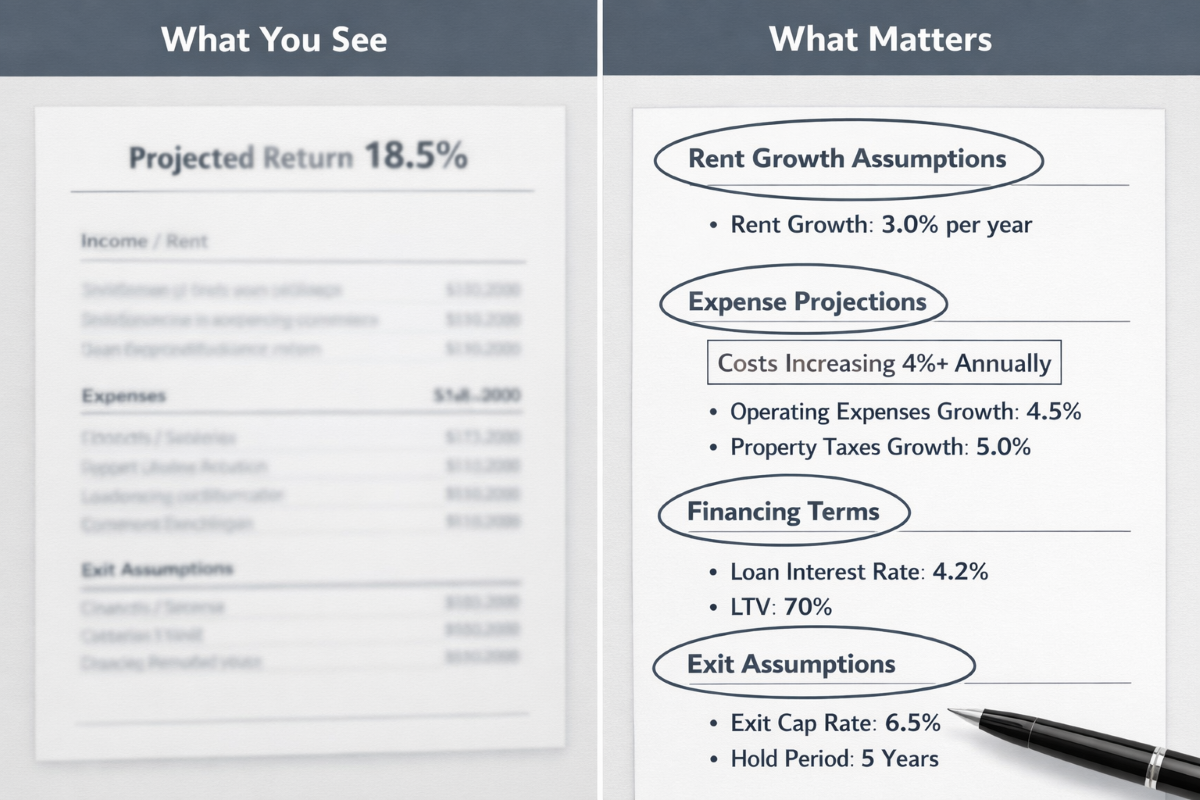
At a high level, underwriting is shaped by a small number of key assumptions. These assumptions influence how a deal is presented and how it may perform under different conditions. Reviewing them doesn’t require technical expertise, but it does require looking past the headline numbers.
There are a few areas that tend to carry the most weight.
1. Income and Rent Assumptions
Rent projections are often one of the primary drivers of a deal’s performance. Even modest changes can significantly affect the outcome on paper.
When reviewing this, it helps to consider:
How much of the projected performance depends on rent increases
Whether those increases are gradual or front-loaded
What market conditions would need to hold for those assumptions to play out
The goal is not to challenge every number, but to understand how much the deal relies on future growth.
2. Expense Assumptions
Expenses are sometimes treated as stable, but in practice, they tend to move over time. Insurance, taxes, and maintenance costs can all shift in ways that are difficult to predict precisely.
A useful way to think about this is:
Are expenses being held flat or growing over time?
Is there acknowledgment that certain costs may increase unpredictably?
Even small differences in expense assumptions can change how a deal performs, especially over longer hold periods.
3. Financing Structure
The structure of the debt can influence how flexible a deal is when conditions change. Interest rates, loan terms, and timing all play a role.
Rather than focusing on technical details, it helps to ask:
Does the deal depend on specific financing conditions to work?
Is there flexibility if the financing environment changes?
Financing can either add stability or introduce additional sensitivity, depending on how it is structured.
4. Exit Assumptions
The eventual sale of the property is one of the least predictable elements of any deal. Future market conditions are uncertain, and small changes can affect valuation.
When reviewing exit assumptions, consider:
What conditions are being assumed at the time of sale
How much the projected outcome depends on those conditions
A deal that relies heavily on a specific exit environment may carry more uncertainty than one that allows for a range of outcomes.
None of these areas needs to be analyzed in isolation or with precision. The goal is not to rebuild the model, but to understand what it depends on.
Even a simple review of these core assumptions can provide a clearer picture of how the deal has been structured and how it might respond if conditions don’t unfold exactly as expected.
Common Red Flags in Multifamily Underwriting

Not every underwriting assumption will be perfect, and that’s expected. Real estate deals are built on estimates, and some level of uncertainty is always present.
That said, certain patterns can indicate when a deal may be more sensitive to change than it initially appears. These are not definitive signals on their own, but they can provide useful context when evaluating how a deal has been structured.
One of the more common patterns is when a deal appears to rely on multiple things going right at the same time. This might include steady rent increases, stable expenses, smooth execution of renovations, and cooperative financing conditions. Each of these assumptions may be reasonable on its own, but when they are all required for the projections to hold, the margin for error becomes limited. In these cases, the outcome is more dependent on alignment than resilience.
Another area to pay attention to is how risk is discussed. Underwriting materials often focus on projections, but the absence of risk-related context can be just as meaningful as the numbers themselves. When potential challenges are not acknowledged, or when there is little discussion of variability in assumptions, it can make it harder to understand how the deal might perform under less favorable conditions. All investments involve risk, even when it is not emphasized.
It is also worth noting when projections appear overly simplified. While clarity is important, real-world operations tend to involve variability. When expenses are shown as flat over time, or income is projected to grow steadily without interruption, it may indicate that the model is not fully reflecting how the property will behave in practice. This does not necessarily mean the deal is flawed, but it may suggest that certain dynamics have been smoothed over for presentation.
Finally, some deals rely more heavily on future market conditions than others. This can show up in assumptions that depend on continued rent growth, improving valuations at exit, or favorable economic trends over time. Since these factors are largely outside the operator’s control, a deal that depends on them may carry additional uncertainty compared to one that allows for a wider range of outcomes.
It is important to approach these observations with balance. Not every deal that includes one of these characteristics will underperform, and not every conservative-looking deal will perform as expected. The purpose of identifying red flags is not to draw immediate conclusions, but to better understand where a deal may be more exposed to change.
Over time, patterns like these can help investors build a clearer sense of how different opportunities are structured and how different operators approach uncertainty.
How We Think About Conservative Underwriting
Conservative underwriting is often discussed in terms of inputs and assumptions, but at its core, it reflects a broader approach to decision-making. It is less about any single variable and more about how the entire deal is evaluated in the context of uncertainty.
At Greener Path Capital, the focus is not on producing the most optimistic projection. It is on understanding what needs to be true for a deal to work and how much flexibility exists if conditions change.
That starts with clarity around assumptions. Every model requires inputs, but those inputs are treated as variables, not outcomes. Income, expenses, financing, and exit conditions are all subject to change, and the underwriting process is built with that in mind. The goal is to understand how sensitive the deal is to those changes rather than to present a single expected result.
There is also an emphasis on downside awareness. Before focusing on potential upside, attention is given to what could go wrong and how the deal might perform under less favorable conditions. This includes looking at how the property would operate if rent growth is slower than anticipated, if expenses increase more than expected, or if market conditions at exit are less supportive.
Structure plays a role as well. Conservative underwriting is reflected in how deals are put together, not just how they are modeled. This includes maintaining flexibility where possible, avoiding reliance on any single assumption, and allowing for multiple paths to a viable outcome. The intent is to create room to adapt, rather than requiring a specific scenario to unfold.
Alignment is another part of the approach. When the general partnership invests alongside its investors, the underwriting process tends to reflect a shared perspective on risk and responsibility. The focus shifts from presenting an attractive projection to making decisions that can be supported over the life of the investment.
Equally important is how this information is communicated. Conservative underwriting is not just about internal analysis, but about explaining clearly what is known, what is assumed, and where uncertainty exists. This allows investors to evaluate opportunities with a clearer understanding of how the deal has been structured and what it depends on.
This approach does not eliminate risk, and it does not ensure a specific outcome. What it aims to do is create a more grounded starting point, where decisions are made with a clear view of both the potential and the uncertainty involved.
Risk Is Always Present Even With Conservative Assumptions
It can be easy to associate the word “conservative” with safety. In practice, that’s not what it means.
All real estate investments involve risk, regardless of how they are underwritten. Conservative assumptions do not remove uncertainty. They are simply one way of approaching it with more awareness and restraint.
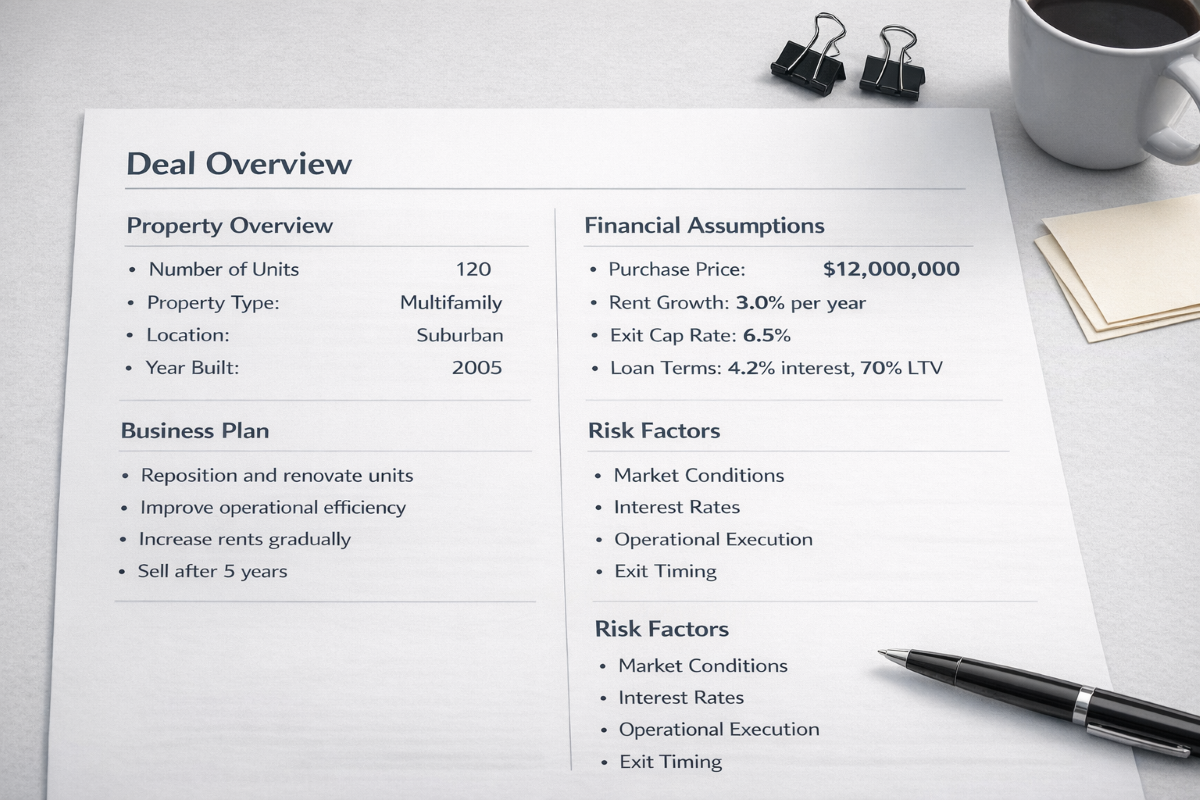
Over time, several types of risk can influence how a multifamily investment performs:
Market risk changes in local demand, supply, or broader economic conditions
Interest rate risk shifts that affect financing costs and property valuations
Operational risk execution at the property level, including renovations, leasing, and management
Liquidity risk the timing and conditions under which a property can be sold
None of these factors can be fully controlled or predicted in advance.
Conservative underwriting attempts to account for this by asking a different set of questions early in the process:
What happens if rent growth is slower than expected?
What happens if expenses increase more than planned?
What happens if the exit environment is less favorable?
These are not worst-case scenarios. They are part of understanding how the deal behaves outside of ideal conditions.
It is also important to recognize what underwriting does not do.
It does not guarantee outcomes
It does not eliminate downside
It does not ensure that projections will be realized
It provides a structured way to evaluate assumptions and think through uncertainty, but actual results will depend on how conditions evolve over time.
For that reason, underwriting is best viewed as a starting point. It helps frame the opportunity and clarify what the deal depends on, but it should be considered alongside an understanding that risk remains present throughout the life of the investment.
The Real Objective: Staying Power
It is easy to evaluate a deal based on how it looks at the beginning. The projections are clear, the plan is defined, and the expected outcome is outlined.
But real estate investments are not decided at the starting line. They unfold over time.
During that time, conditions change. Markets shift, expenses move, timelines extend, and not every assumption plays out exactly as expected. In that environment, the question becomes less about how the deal looked initially and more about how well it can adapt.
This is where the idea of staying power becomes important.
Conservative underwriting is not designed to maximize projections on paper. It is intended to support a deal that can continue to operate when conditions are less predictable than planned.
That often means:
Avoiding reliance on a single outcome to drive success
Allowing for variability in operations and timelines
Structuring the deal so it can adjust rather than react
In practice, staying power shows up in how much flexibility exists within the deal.
Can the property continue to operate if rent growth slows?
Is there room to manage through higher expenses?
Can the business plan adjust if market conditions shift?
These are not theoretical concerns. They are part of how real estate operates over multi-year hold periods.
A deal that requires specific conditions to succeed may look strong in a model, but can become constrained if those conditions change. A deal with more flexibility may appear more measured at the outset, but can be better positioned to navigate variability over time.
This does not mean that outcomes will be uniform or predictable. It simply reflects a different objective.
Instead of asking, “What does this deal look like if everything goes right?” the focus shifts to, “Can this deal continue to work if things do not go exactly as planned?”
That shift in perspective is often what conservative underwriting is trying to support.
Over Time, This Is What Tends to Matter
Underwriting is often treated as a technical exercise, but in practice, it is a reflection of how decisions are made under uncertainty.
The numbers themselves are only part of the picture. What matters more is how those numbers are constructed, what assumptions they rely on, and how much flexibility exists if those assumptions don’t hold.
Conservative underwriting does not attempt to predict the future with precision. It recognizes that outcomes can vary and that not all variables are within an operator’s control. The focus, instead, is on building a clear understanding of what a deal depends on and how it may perform across a range of conditions.
For investors, this shifts the lens from “How strong do the projections look?” to “What needs to be true for this to work?”
That distinction can change how opportunities are evaluated.
A deal is not defined solely by its projected outcome, but by how it behaves when those projections are tested. The assumptions, the structure, and the level of discipline behind them all play a role in that process.
Over time, understanding how underwriting is approached can provide a clearer sense of how an operator thinks, how they manage uncertainty, and how they treat capital.
And in many cases, that understanding matters as much as the deal itself.


