

The Problem With Relying Too Heavily on W-2 Income: Why High Income Is Not the Same as Wealth
You finish the year at $300,000 in total compensation.
Base salary. Commission. Bonus.
Your 401(k) is funded. The brokerage account received another contribution. Cash reserves look healthy. The mortgage is current. From the outside, the financial picture looks strong.
Now remove one thing from that picture: Next year’s paycheck.
How much of your progress keeps moving?
For many high-income medical sales professionals, nearly every new dollar of wealth still begins in the same place: the employer.
The retirement contribution comes from earned income. The brokerage contribution comes from earned income. The cash reserve gets replenished by earned income.
The next private investment, real estate allocation, or major purchase may also depend on another strong compensation year.
That is the concentration problem.
Your accounts may be spread across several institutions and investments, but the capital feeding them can still come from one economic engine.
In medical sales, that engine can be powerful. It can also have more moving parts than the number on your W-2 suggests.
A territory can be redrawn. A quota can move. A compensation plan can change. A product can lose momentum. A merger can reshape a sales organization. A strong commission year can be followed by an average one.
Your skill matters. Your relationships matter. Your track record matters. But you do not control every variable that determines what lands in your paycheck.
That is why high income and wealth should be measured differently.
Form W-2 reports employee compensation such as wages and bonuses, and IRS guidance also treats commissions as employee compensation.
That tells you what you earned.
It does not tell you how much financial flexibility you have built outside your ability to keep earning it.
A useful question is not: “How much did I make this year?”
It is: “If my compensation changed next year, how much of my wealth-building plan would keep working?”
That is the question this article will answer.
High Income Can Hide a Concentration Problem

Suppose you earn $300,000 in total compensation.
After taxes, benefits, household spending, retirement contributions, and other obligations, you have a defined amount left each year to save or invest.
That surplus might fund:
Your brokerage account
Additional retirement savings
Cash reserves
A future real estate investment
A private investment
College savings
A larger down payment
Other long-term financial goals
Now look at the source. Most of that new capital may still depend on one thing:
Your ability to produce another strong year at work. That is where high income can hide concentration.
You can have six different accounts and still have one primary wealth-building engine.
A 401(k), brokerage account, savings account, and real estate investment may look diversified when viewed separately. But if almost every new contribution depends on salary and commissions from the same career, your broader financial system can still be highly dependent on earned income.
Traditional diversification focuses on spreading investments across different assets and exposures to reduce concentration risk. Investor.gov also notes that simply owning multiple funds does not necessarily create diversification if the underlying holdings remain narrowly focused or overlap.
The same logic is useful when you step back from the investment statement and look at the entire household balance sheet.
Consider this example.
A medical sales professional earns $300,000 and directs $50,000 a year toward long-term investments beyond normal retirement contributions.
If compensation falls enough that the $50,000 disappears, what happens?
The existing investments do not necessarily disappear. But the engine adding new capital to them slows down immediately. That matters because wealth building is not only about what you already own.
It is also about how reliably you can continue adding capital over the next 10, 15, or 20 years.
This is why the better question is not: “How many investments do I own?”
It is: “How many parts of my financial plan can continue making progress without another strong W-2 year?”
That is a much harder number to hide behind.
In Medical Sales, Your Income Has More Variables Than Your W-2 Shows

A W-2 shows what you earned.
It does not show everything that had to go right for you to earn it.
In medical sales, compensation can depend on a long chain of variables:
Territory quality
Quota design
Product demand
Formulary or account access
Commission structure
Leadership decisions
Organizational changes
Mergers or acquisitions
Product launches or slowdowns
Your own health and ability to keep performing
Some of those factors are within your control. Some are not.
That distinction matters. You may be excellent at your job and still see compensation change because a territory is redrawn, a product loses momentum, a quota moves, or a company restructures.
A strong year can also reset expectations.
If you earn $325,000 after several strong quarters, that number can start to feel normal. The household budget adjusts. Investment contributions rise. New commitments get added.
Then the next year comes in at $250,000. That is still a high income.
But if your financial plan was built around $325,000 continuing, the difference is not theoretical. It shows up in how much you can save, how much you can invest, and how much flexibility you have.
This is why future compensation should not be treated like a fixed asset.
Your experience, relationships, and sales ability may be durable. Your exact income is not guaranteed to be.
For a high-income professional, the practical question is:
How much of my financial plan assumes that my best earning years will keep repeating?
That is where career success can quietly become financial concentration.
The Number That Matters Is Not What You Earn. It Is What Your Income Builds.
Two medical sales professionals can earn the same $300,000 and end up in very different financial positions.
The difference is not the paycheck. It is what happens after the paycheck arrives.
Consider two hypothetical professionals.
Professional A
Earns $300,000.
A strong commission year leads to a larger mortgage, more expensive travel, higher recurring expenses, and a lifestyle built around that income continuing.
They contribute to retirement accounts and maintain a brokerage account, but most new investing still depends on the next bonus or commission check.
If compensation drops, investing slows first. The income is high. The financial system is still heavily dependent on earning more.
Professional B
Also earns $300,000.
They maintain liquidity for near-term needs and direct part of their surplus income toward long-term assets on a consistent basis.
Those assets might include retirement accounts, public-market investments, real estate exposure, private investments, or other holdings appropriate to their broader financial plan.
A lower-income year would still affect how much new capital they can invest.
But more of the money earned in previous years has already been converted into assets that exist outside the next compensation cycle.
That is the distinction. This example does not assume Professional B earns higher investment returns or has chosen a better portfolio.
It shows a different financial structure.
One person is primarily using income to support the present. The other is also using part of that income to build assets for the future.
For high earners, that is a more useful way to measure progress. Not: “How high did my compensation get?”
But: “How much of what I earned is now working outside my paycheck?”
Income gives you capacity.
What you build with that capacity determines whether each strong earning year leaves you less dependent on the next one.
Three Signs Your Financial Plan May Be Too Dependent on W-2 Income
W-2 dependence usually does not show up as one obvious problem.
It shows up in how the rest of your financial system reacts when income changes.
Here are three practical signs to look for.
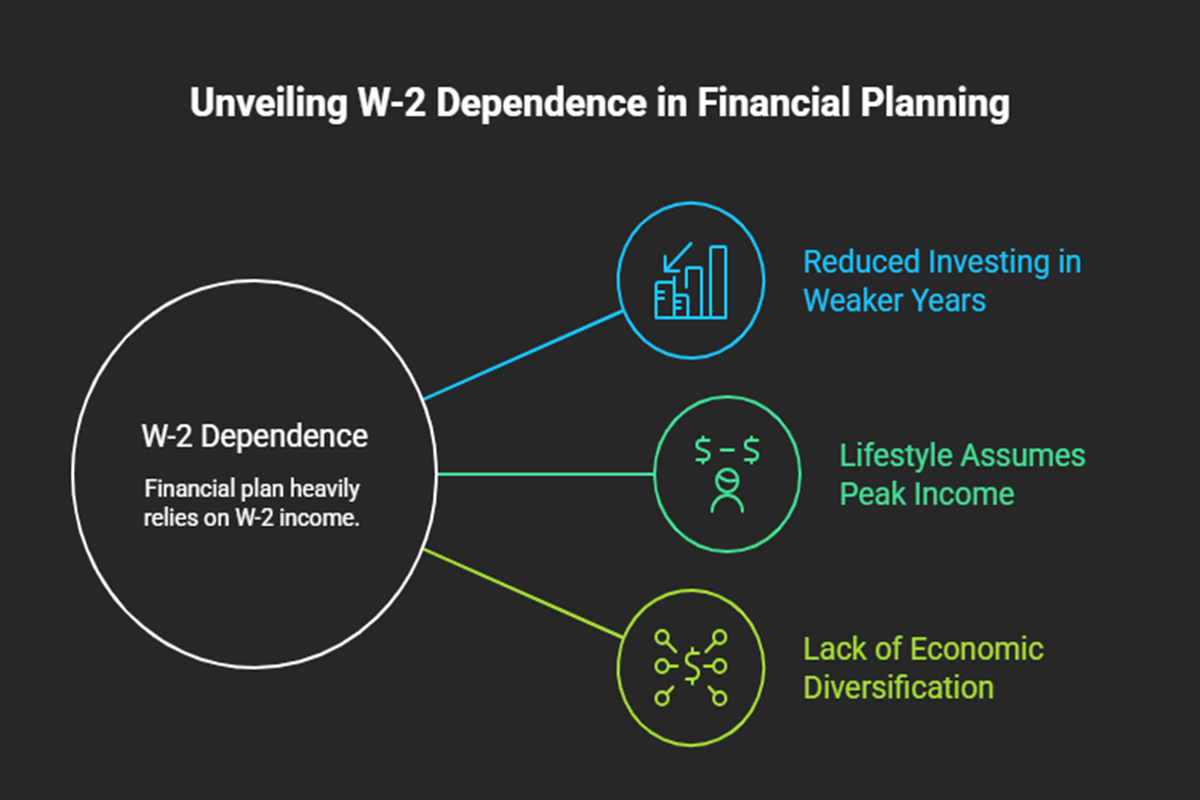
1. A Weaker Compensation Year Would Stop Most New Investing
If your investing plan works only when commissions stay near their recent highs, that is useful information.
Suppose you normally invest $50,000 beyond your retirement plan.
If a softer year reduces that amount to $5,000 or zero, your long-term progress is still closely tied to current earnings.
That does not erase the assets you already own. It does show how dependent future asset building remains on the next compensation cycle.
2. Your Fixed Lifestyle Assumes Peak Income Will Continue
The more recurring obligations you add during strong earning years, the more income you need just to maintain the baseline.
Mortgage.
Tuition.
Vehicle payments.
Childcare.
Travel commitments.
Memberships.
Other recurring expenses.
The important number is not whether you can afford those costs during a strong year.
It is how much compensation your household needs every year before you can continue saving and investing at the pace you want.
If your lifestyle absorbs most of the difference between an average year and a great year, higher earnings may not create much additional financial flexibility.
3. You Own Multiple Investments, but They Do Not Change the Source of Your Financial Progress
Several accounts can create the appearance of diversification.
But account count is not the same as economic diversification.
A 401(k), IRA, and brokerage account may all hold similar public-market exposure. Employer stock can add another layer of concentration if both your paycheck and part of your portfolio depend on the same company.
Investor.gov specifically notes that owning multiple funds does not automatically mean an investor is diversified if those funds hold similar investments. (investor.gov)
The same question should be asked across the broader financial picture:
What would still be adding value, producing income, or supporting long-term goals if my W-2 compensation changed?
You do not need every part of your financial life to operate independently from your career. But you should know which parts do and which parts do not.
That is the difference between assuming you are diversified and actually understanding where the concentration sits.
What Reducing W-2 Dependence Actually Looks Like
Reducing W-2 dependence is not about replacing your salary with a second full-time job. It is about building a financial structure that can absorb more than one kind of outcome.
That starts with four practical areas.
Protect Liquidity
Some money needs to stay accessible.
If too much capital is tied up in long-term or illiquid investments, a temporary drop in compensation can create pressure at exactly the wrong time.
For a high-income professional, liquidity is not idle money.
It is what gives you room to handle a weaker commission year, an unexpected expense, or a career transition without being forced to sell an investment or change plans under pressure.
The right level is personal. The principle is not. Know which capital must remain available before committing money elsewhere.
Keep Permanent Obligations From Chasing Peak Income
A $325,000 year can support more than a $250,000 year.
That does not mean every expense should be built around the higher number.
The more fixed obligations that depend on peak compensation, the less flexibility you keep when income normalizes.
A useful metric is your household’s annual fixed-cost requirement.
If that number keeps rising every time compensation rises, then higher income may be improving lifestyle faster than it is improving resilience.
Convert Surplus Income Into Assets Intentionally
Once liquidity and near-term obligations are accounted for, surplus income can be directed toward assets that fit the broader financial plan.
That may include retirement accounts, public-market investments, real estate exposure, private investments, business interests, or other assets.
The point is not to own everything. The point is to know what each dollar is being asked to do.
Is it for liquidity?
Long-term growth?
Income?
Diversification?
A future purchase?
Capital preservation?
Without a clear role, investing can become a collection of unrelated decisions made whenever a bonus lands.
Evaluate What Each New Investment Actually Adds
Before adding another investment, look beyond the account name.
Ask:
What is the source of potential return?
What risks come with it?
How liquid is it?
How long could the capital be tied up?
Who controls the investment decisions?
What fees are involved?
Does it add a genuinely different exposure, or repeat what I already own?
Private investments deserve the same scrutiny.
They may provide access to different assets or strategies, but they can also involve illiquidity, manager risk, execution risk, fees, and the possible loss of capital.
The goal is not to make W-2 income irrelevant.
The goal is to make sure every strong earning year leaves you with more than a memory of a good commission check.
It should leave behind assets, liquidity, and a broader financial base.
Where Private Markets May Fit, and Where They Do Not
Private markets can add exposures that are not available through a standard brokerage account.
That may include private real estate, private debt, private equity, or other strategies managed outside public exchanges.
For a high-income professional, the appeal is usually not “higher returns.”
It is access to different assets, different managers, different deal structures, and potentially different sources of return.
But private does not automatically mean diversified.
It does not automatically mean lower risk. And it does not automatically mean better.
A private real estate fund may still be concentrated by geography, property type, leverage, or sponsor.
A private debt fund may depend heavily on underwriting quality, borrower performance, credit conditions, and manager discipline.
A private equity strategy may involve long holding periods, limited liquidity, and significant execution risk.
That is why the useful question is not: “Should I add private investments?”
It is: “What would this investment add that I do not already have?”
That answer should include more than potential upside.
It should include:
Source of return
Liquidity limits
Manager risk
Fees
Leverage
Time horizon
Downside scenarios
Reporting
Exit or repayment structure
How the investment fits with existing exposures
For someone trying to reduce dependence on W-2 income, private markets may be one part of the conversation.
They are not the solution by default.
The value comes from understanding the role an investment could play, the risks required to pursue that role, and whether it actually broadens the financial structure you already have.
Before You Add Another Investment, Measure Your W-2 Dependence
A high income gives you room to build. The question is whether each strong earning year leaves you less dependent on the next one.
Before adding another investment, measure the structure you already have.
Look at:
How much of your household cash flow depends on employment income
How much of your annual investing stops if compensation drops
How much of your lifestyle is tied to peak earnings
How much liquidity you can access without selling long-term investments
Whether your investments actually add different economic exposures
How much employer or industry concentration already exists
Which financial goals still require another strong commission year to stay on track
Those answers tell you more than the number on your W-2. They show how much flexibility you have built around it.
A strong career can remain an important part of the plan. The objective is not to make your paycheck irrelevant. It is to make sure your entire financial future is not waiting for the next one.
Not Sure How Dependent Your Financial Plan Is on Your W-2?

You do not need to have the answer before starting the conversation.
If you are earning well but wondering how much of your long-term financial progress still depends on the next salary, bonus, or commission check, that is worth examining.
A conversation can help you think through what you already own, where concentration may exist, and what questions deserve attention before you evaluate another investment.
Have a question? Start a conversation with Greener Path Capital.


