

What Makes Some Real Estate Asset Classes More Durable Than Others?
A real estate asset class can perform well for years and still face challenges when conditions change.
Investors have seen this play out across different property types. Office buildings, retail centers, apartment communities, hotels, and other real estate assets have all experienced periods of strength and periods of pressure. In some cases, demand shifted. In others, financing conditions changed. Sometimes operating costs rose faster than expected. The reasons vary, but the lesson is consistent.
The question is not simply which asset class has performed well recently.
A more useful question is: What makes a real estate asset class durable over time?
Many discussions about real estate focus on potential returns, market trends, or the latest investment opportunity. Those factors may be important, but they do not tell the full story. An asset class that attracts attention during one period may face different challenges during another.
Durability is often influenced by a combination of factors. Demand patterns matter. Operational requirements matter. Financing conditions matter. The ability to adapt when circumstances change matters as well.
Understanding these characteristics can help investors evaluate opportunities more thoughtfully, regardless of which asset class happens to be attracting interest at a given moment.
In this article, we'll examine the factors that may contribute to durability across real estate asset classes and explore a practical framework for comparing different types of real estate investments.
What Is a Real Estate Asset Class?
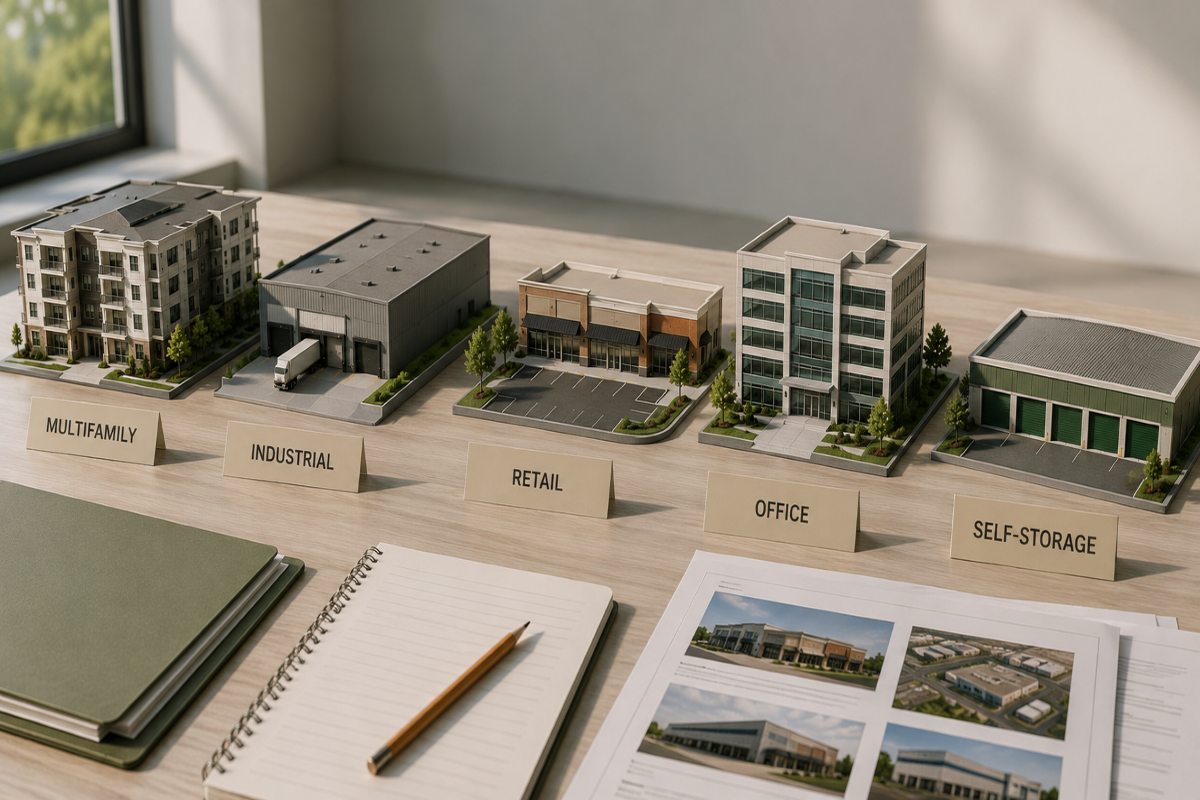
A real estate asset class is a category of property that shares similar characteristics, uses, and operating dynamics. These categories help investors, lenders, operators, and market participants compare opportunities that may have different risk profiles, income patterns, and management requirements.
Common real estate asset classes include multifamily housing, office buildings, retail centers, industrial properties, hospitality assets, self-storage facilities, and various specialty property types. While each category falls under the broader umbrella of real estate, the factors that influence performance can vary significantly from one asset class to another.
For example, an apartment community and a hotel both provide places for people to stay, but they operate very differently. Apartment leases often span months or years, while hotel occupancy can change daily. Similarly, a self-storage facility may require a different level of operational involvement than a retail shopping center or an office building.
Because of these differences, investors often evaluate asset classes through multiple lenses, including demand drivers, tenant behavior, operating complexity, financing considerations, and long-term market trends.
It is also important to distinguish between an asset class and an individual investment opportunity. Two properties may belong to the same asset class yet produce very different outcomes depending on factors such as location, management, capital structure, market conditions, and execution.
This distinction matters because asset class selection is only one part of the evaluation process. Understanding how a particular property is operated and how its risks are managed can be just as important as understanding the category it belongs to.
Before comparing different real estate asset classes, it helps to understand why durability matters and which characteristics may influence an asset's ability to navigate changing conditions over time.
Why Durability Matters When Comparing Real Estate Asset Classes

When investors compare real estate opportunities, it is natural to focus on recent performance, market activity, or projected outcomes. While those factors can provide useful information, they may not fully explain how an asset is likely to behave when conditions become less favorable.
Durability is important because real estate investments often span multiple years. During that time, markets can change, interest rates can rise or fall, operating expenses can increase, and tenant demand can shift. An asset that appears attractive under one set of conditions may face different challenges under another.
This does not mean durable assets are immune to risk. Every real estate asset class carries risk, including market risk, financing risk, operational risk, and execution risk. The question is not whether risk exists. The question is how an asset responds when pressure is applied.
For example, some property types may benefit from demand drivers tied to everyday needs. Others may depend more heavily on discretionary consumer spending or business expansion. Neither characteristic is inherently good or bad, but they can influence how an asset performs under different economic conditions.
Durability also affects the range of options available to owners and operators. Properties with stable demand and broad tenant appeal may provide greater flexibility when responding to market changes. Properties that rely on a narrower customer base or a more specialized operating model may require a different approach.
Financing considerations can play a role as well. Real estate is often purchased using debt, which means changes in borrowing costs, lender requirements, or capital markets can influence investment outcomes. Asset classes that maintain strong lender interest across market cycles may face different financing dynamics than those that experience greater volatility.
Operational complexity is another factor worth considering. Some assets require intensive daily management, while others may operate with fewer moving parts. In many cases, the quality of execution can have a significant impact on performance regardless of the asset class itself.
This is why experienced investors often look beyond labels such as multifamily, office, retail, or self-storage. The category matters, but understanding the characteristics that support long-term demand, operational stability, and adaptability often provides a more complete picture.
Before comparing individual asset classes, it helps to identify the specific factors that may contribute to durability. Those factors provide a more useful framework than simply asking which property type has performed well recently.
The Main Factors That Influence Durability
Not all real estate asset classes respond to changing conditions in the same way. However, many of the characteristics that contribute to durability are surprisingly consistent across property types.

Rather than focusing solely on the category of property, investors often evaluate the underlying factors that support long-term performance. These factors do not eliminate risk, but they can provide a framework for understanding how different assets may respond to market, operational, and financial pressures.
Demand Drivers
One of the most important questions is what drives demand for the property.
Some assets serve needs that people encounter regularly, such as housing, logistics, or business operations. Others depend more heavily on discretionary spending, tourism activity, or changing consumer preferences.
Demand can rise and fall in any asset class, but understanding what creates demand in the first place helps investors evaluate how sensitive an asset may be to changing economic conditions.
Tenant Depth and Diversity
The size and diversity of the potential tenant pool can also influence durability.
An asset with a broad range of potential tenants may have more flexibility when vacancies occur. By contrast, properties that depend on a smaller or more specialized group of users may face different leasing challenges if demand softens.
This does not make one approach inherently better than another. It simply highlights the importance of understanding who the property serves and how easily demand can be replaced if circumstances change.
Income Consistency
Real estate investments often rely on income generated by tenants or customers. The structure and predictability of that income can vary significantly across asset classes.
Lease length, occupancy patterns, renewal behavior, and customer turnover all influence how revenue is generated. Some properties may produce relatively stable cash flow over longer periods, while others may experience more frequent fluctuations due to shorter-term occupancy or seasonal demand patterns.
Understanding how income is generated can provide insight into how an asset may perform under different operating conditions.
Operational Complexity
Operations matter more than many investors initially realize.
Every property requires management, maintenance, oversight, and decision-making. However, the complexity of those responsibilities can differ substantially from one asset class to another.
Some properties operate with relatively straightforward management requirements. Others depend on extensive staffing, customer service functions, marketing efforts, or specialized operational expertise.
As operational complexity increases, execution often becomes a larger driver of outcomes. Strong operations can help support performance, while poor execution can create challenges regardless of the asset class involved.
Financing Sensitivity
Most real estate investments involve some level of debt financing. As a result, changes in interest rates, lending standards, and capital market conditions can affect investment performance.
Certain asset classes may attract a broader range of financing sources, while others may experience greater sensitivity to changing lending environments.
Because financing conditions can change over the life of an investment, understanding how an asset depends on access to capital is an important part of evaluating durability.
Expense Predictability
Revenue is only one side of the equation. Operating expenses also play an important role.
Property taxes, insurance costs, maintenance expenses, utilities, payroll, and capital expenditures can all affect the financial performance of a property. Some expenses are relatively predictable, while others may fluctuate due to market conditions or operational requirements.
Assets with significant exposure to rapidly changing expenses may require more active management and contingency planning.
Adaptability and Exit Flexibility
Markets evolve over time.
Population trends shift. Consumer behavior changes. New technologies emerge. Economic conditions fluctuate.
As a result, it can be helpful to consider how adaptable a property may be if conditions change. Investors often evaluate whether a property can continue serving demand under different circumstances and whether multiple exit strategies may be available if the original business plan needs adjustment.
The ability to adapt does not guarantee success, but flexibility can provide additional options when navigating uncertainty.
Taken together, these factors provide a more useful way to think about durability than focusing on asset class labels alone. They help explain why two properties in different categories may share similar strengths, and why two properties in the same category can perform very differently depending on how they are operated and managed.
With these factors in mind, we can now build a practical framework for comparing real estate asset classes more thoughtfully.
A Framework for Thinking About Durability
The factors discussed above are useful on their own, but they become even more valuable when viewed through a consistent framework.
When evaluating a real estate asset class, many investors focus on what the property is. Experienced operators often spend just as much time evaluating how the property functions under different conditions.
The goal is not to predict the future. Markets are too complex for that. Instead, the goal is to understand the characteristics that may influence how an asset responds when conditions change.
The following questions can provide a practical framework for evaluating durability across different real estate asset classes.
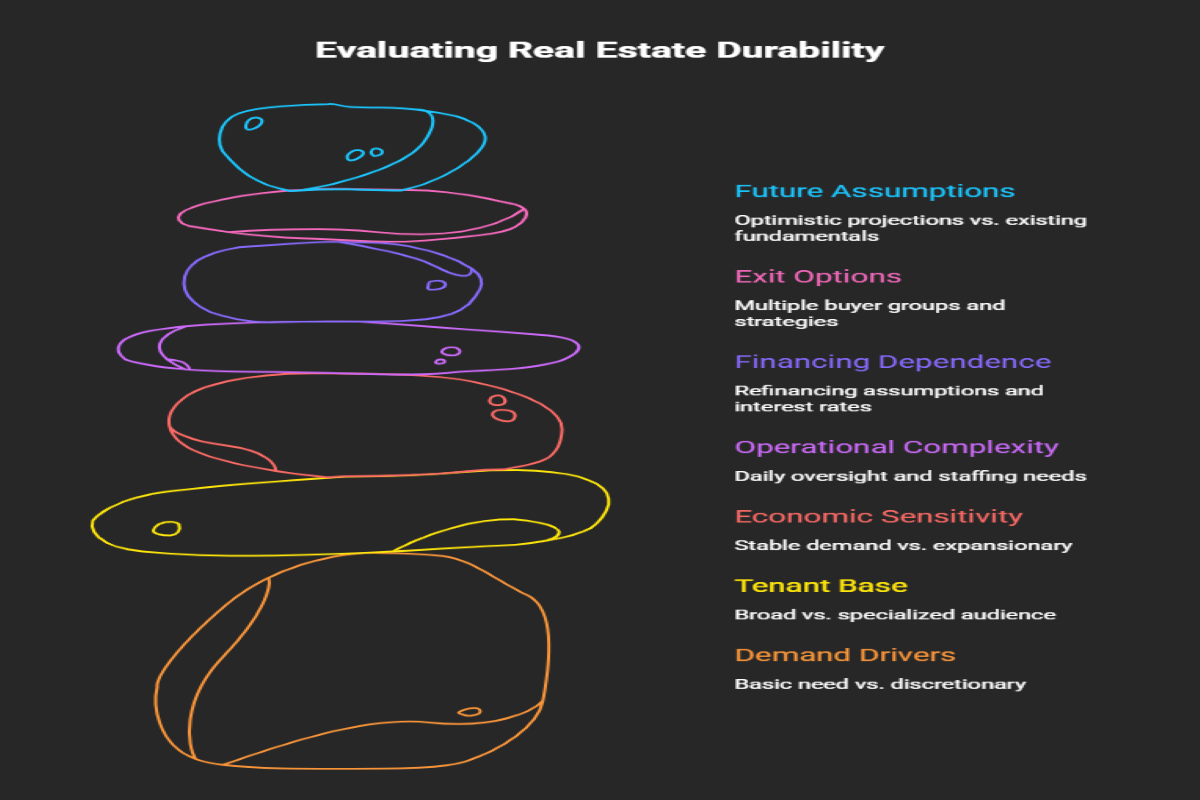
1. Is Demand Driven by a Basic Need or a Discretionary Choice?
One of the first questions to consider is what motivates people to use the property.
Housing, logistics infrastructure, healthcare services, and business operations may be supported by different demand drivers than hospitality, entertainment, or certain retail uses.
Demand exists in every asset class, but the nature of that demand can influence how resilient occupancy and revenue remain during periods of economic change.
Understanding why tenants or customers choose a property often provides valuable context beyond occupancy statistics alone.
2. How Broad Is the Potential Tenant Base?
The larger the pool of potential users, the more flexibility an owner may have when vacancies occur.
For example, some properties can serve a wide range of tenants across multiple industries, income levels, or customer segments. Others are designed for more specialized uses that may appeal to a narrower audience.
A broad tenant base does not eliminate leasing risk, but it can create additional options when market conditions shift.
3. How Sensitive Is Demand to Economic Conditions?
Every asset class experiences some level of economic sensitivity.
The question is how quickly demand may respond to changes in consumer spending, employment, business activity, or broader economic trends.
Some assets may experience relatively stable demand during periods of uncertainty. Others may be more closely tied to expansionary environments where spending and growth play a larger role.
Evaluating this relationship can help investors better understand the assumptions supporting an investment.
4. How Complex Are the Operations?
Operational complexity is often overlooked when comparing asset classes.
A property may appear attractive on paper, but the operational requirements needed to achieve expected results can vary significantly.
Questions worth considering include:
How much daily oversight is required?
How dependent is performance on staffing?
Does success require specialized expertise?
How much variability exists in day-to-day operations?
In many cases, operational complexity can have a greater influence on outcomes than the asset class itself.
5. How Dependent Is Performance on Financing Conditions?
Real estate is frequently financed with debt, making capital markets an important consideration.
Some business plans depend heavily on refinancing assumptions, interest rate environments, or readily available financing. Others may be structured with greater flexibility if lending conditions become less favorable.
This does not make one approach right or wrong. It simply highlights the importance of understanding how financing assumptions influence the overall investment strategy.
6. How Flexible Are the Exit Options?
Conditions can change over the life of an investment.
When they do, flexibility becomes important.
Investors may evaluate whether a property appeals to multiple buyer groups, supports different operating strategies, or offers alternative paths if the original plan requires adjustment.
Greater flexibility does not guarantee a positive outcome, but it can provide additional options when navigating uncertainty.
7. How Much Depends on Future Assumptions?
Perhaps the most important question is how much of the investment thesis depends on future events occurring as planned.
Many real estate investments involve assumptions about occupancy, expenses, rent growth, financing, or operational improvements. Those assumptions are a normal part of underwriting.
However, experienced investors often distinguish between outcomes that depend heavily on future projections and outcomes supported by existing fundamentals.
The more an investment depends on optimistic assumptions, the more important it becomes to understand the risks if those assumptions do not materialize.
A More Useful Question
When investors ask which real estate asset class is best, they often receive a different answer depending on market conditions, economic cycles, or personal preferences.
A more useful question is:
Which characteristics support durability, and how does this asset perform against those characteristics?
That shift in thinking moves the conversation away from trends and toward analysis. It encourages a deeper understanding of demand, operations, financing, and risk, which are often more important than the asset class label itself.
With this framework in place, we can now compare how common real estate asset classes differ across these durability factors.
How Common Real Estate Asset Classes Compare Across Durability Factors
Each real estate asset class has its own demand drivers, operating requirements, and risk considerations. Comparing them through a durability lens can help investors move beyond simple labels and think more clearly about how each property type may behave under different conditions.
This section is not meant to rank asset classes. A strong investment can exist in a more complex asset class, and a weak investment can exist in a category that appears stable on the surface. The point is to understand the trade-offs.
Multifamily
Multifamily properties include apartment communities and other residential rental housing. Demand is often tied to the basic need for housing, which can make multifamily an important category for many real estate investors to understand.
That said, multifamily durability still depends on the details. Local job growth, rent affordability, property management, renovation execution, insurance costs, taxes, and financing structure all matter. A well-located apartment community with disciplined management may have very different risk characteristics than a property with deferred maintenance, aggressive rent assumptions, or weak local demand.
For investors, multifamily is often evaluated through occupancy, rent collections, resident retention, expense control, and the operator’s ability to manage the property over time.
Industrial
Industrial properties include warehouses, distribution centers, manufacturing facilities, and logistics-related assets. Demand may be influenced by supply chains, e-commerce, manufacturing activity, transportation access, and business expansion.
Some industrial properties may benefit from long leases and business-to-business tenant relationships. However, industrial assets can also be sensitive to tenant concentration, building specialization, location, and changes in supply-demand balance.
A property designed for a broad range of users may offer different flexibility than a highly specialized facility built for one tenant or use case.
Retail
Retail properties include shopping centers, single-tenant retail buildings, neighborhood centers, and mixed-use retail spaces. Demand is closely tied to consumer behavior, local demographics, tenant quality, and the role a property plays in its surrounding community.
Not all retail is the same. A grocery-anchored center serving daily needs may have different demand characteristics than a property dependent on discretionary spending or destination shopping.
Retail durability often depends on tenant mix, location, lease structure, foot traffic, and the property’s ability to remain useful as consumer habits change.
Office
Office properties include traditional office buildings, medical office space, and other workplaces. This asset class has faced significant scrutiny in recent years as work patterns, tenant preferences, and space usage have changed.
Office durability can vary widely. Some properties may struggle with reduced demand or changing tenant requirements, while others may remain useful because of location, tenant quality, specialized use, or limited competing supply.
For office investments, investors often evaluate lease duration, tenant credit, occupancy trends, capital expenditure needs, and the likelihood that the building can continue meeting market expectations.
Hospitality
Hospitality assets include hotels, resorts, extended-stay properties, and other short-term lodging businesses. These assets often have shorter revenue cycles because occupancy and pricing can change daily.
That flexibility can create opportunity in certain markets, but it also introduces operational complexity. Hospitality performance may depend on travel demand, consumer spending, labor availability, brand strength, local competition, and management quality.
Because of this, hospitality is often more operationally intensive than many other real estate categories. Investors evaluating hospitality assets typically need to pay close attention to management capability, expense control, and demand volatility.
Self-Storage
Self-storage facilities provide space for individuals and businesses to store belongings, inventory, or equipment. Demand may come from life transitions, moving activity, downsizing, business storage needs, or local population growth.
Self-storage can have relatively straightforward physical infrastructure compared with some property types, but performance still depends on location, pricing, occupancy management, competition, and customer acquisition.
Because leases are often short-term, operators may have pricing flexibility. At the same time, shorter-term customer behavior can make performance more sensitive to local competition and demand shifts.
Specialty Real Estate Assets
Specialty real estate assets can include manufactured housing communities, RV parks, student housing, senior housing, marinas, data centers, healthcare properties, and other niche property types.
These assets often require a more specific evaluation because their demand drivers and operations can differ substantially. Some may be supported by strong demographic or lifestyle trends. Others may depend on specialized management, regulatory knowledge, seasonality, or narrow tenant demand.
Specialty assets are not automatically more or less durable than traditional categories. Their durability depends on the specific property type, market, operating model, and assumptions behind the investment.
The Main Takeaway
The asset class label provides a starting point, but it should not be the entire analysis.
A multifamily property, industrial building, retail center, office asset, hotel, self-storage facility, or specialty property can all carry different forms of risk. Durability depends on how demand, operations, financing, expenses, and adaptability work together within a specific opportunity.
That is why investors are usually better served by asking better questions rather than relying on broad assumptions about which asset class is attractive at a given moment.
Why Popularity Does Not Always Equal Durability

Real estate trends have a way of capturing attention.
A particular asset class may receive increased interest because of strong recent performance, favorable market conditions, demographic shifts, technological changes, or growing investor demand. As more capital flows into a sector, discussions about that asset class often become more common.
There is nothing inherently wrong with investor interest. In many cases, increased attention reflects legitimate changes in market conditions or emerging opportunities. The challenge is that popularity and durability are not the same thing.
Popularity is often influenced by what has happened recently.
Durability is more closely tied to the characteristics that support long-term demand, operational performance, financing flexibility, and adaptability over time.
For example, an asset class may experience strong occupancy growth, rising valuations, or increased transaction activity during a particular period. Those trends may be supported by sound fundamentals, or they may be influenced by conditions that prove temporary. Distinguishing between the two is an important part of the evaluation process.
This is one reason experienced investors often spend as much time examining assumptions as they do examining outcomes.
Questions worth asking include:
What factors are driving current demand?
Are those factors likely to remain in place over time?
What risks could affect future performance?
How dependent is the investment thesis on continued market momentum?
How would the asset perform if conditions become less favorable?
These questions help shift the conversation away from headlines and toward fundamentals.
History offers many examples of asset classes moving in and out of favor. Economic conditions change. Consumer behavior evolves. Financing environments tighten and loosen. New supply enters markets. Tenant preferences shift.
The asset classes that attract the most attention today may not be the same ones attracting attention several years from now.
That does not mean investors should avoid popular sectors. It simply means that popularity alone is rarely a sufficient reason to pursue an investment opportunity.
A more durable approach is to evaluate the underlying drivers of demand, the quality of operations, the assumptions supporting the business plan, and the risks that could affect future outcomes.
When investors focus on those factors, they are often better positioned to evaluate opportunities based on substance rather than sentiment.
The goal is not to predict which asset class will become popular next.
The goal is to understand what supports durability regardless of where investor attention happens to be focused today.
Why Operations Still Matter
Asset class is important, but it is not enough on its own.
A property may belong to a category with strong demand drivers and still underperform if it is poorly managed. The reverse can also be true. A more complex asset may perform better than expected when the operator understands the market, manages expenses carefully, and executes the business plan with discipline.
Operations affect nearly every part of a real estate investment. They influence resident or tenant experience, occupancy, maintenance costs, capital improvements, reporting, vendor oversight, and day-to-day decision-making. Over time, small operational decisions can compound into meaningful differences in performance.
This is especially important in value-add real estate. Improving a property is rarely just a matter of completing renovations. It also requires careful budgeting, realistic timelines, responsive management, and a clear understanding of what the market can actually support.
Operational discipline also helps investors understand risk more clearly. A thoughtful operator should be able to explain not only what they intend to do, but what could go wrong and how they plan to respond if conditions change.
For passive investors, this means the evaluation should not stop at the asset class. It should also include the operator’s experience, communication practices, underwriting discipline, and ability to manage through uncertainty.
A durable asset class can be weakened by poor execution.
A disciplined operator can help protect an investment thesis by focusing on fundamentals, responding early to issues, and avoiding assumptions that depend too heavily on ideal conditions.
That is why operations remain one of the most important parts of real estate investing. The property type sets the stage, but execution often determines how well the plan holds up over time.
Questions Investors Can Ask Before Evaluating an Opportunity
A useful durability framework should lead to better questions.
Before evaluating any real estate opportunity, investors may want to look beyond the asset class name and review the assumptions behind the investment. This can help separate surface-level appeal from the details that may influence long-term performance.
Questions to consider include:
What demand drivers support this property type?
How broad is the tenant or customer base?
What assumptions are being made about rent growth, occupancy, expenses, and financing?
What risks could affect the business plan?
How experienced is the operator with this asset class and market?
What happens if the original timeline changes?
How much of the plan depends on future market conditions?
What information is included in the offering documents?
How clearly does the operator communicate both opportunity and risk?
These questions do not remove uncertainty. They help investors evaluate it more clearly.
A real estate opportunity should be reviewed through the full picture: the asset class, the specific property, the market, the financing structure, the operator, and the risks involved.
That kind of review takes more effort than comparing projected outcomes, but it usually gives investors a better understanding of what they are actually evaluating.
Final Thoughts

Real estate asset classes can be useful categories, but they should not replace careful analysis.
A more thoughtful evaluation looks at the factors behind the label: demand, tenant depth, income consistency, expenses, financing, operations, adaptability, and risk. These details help investors understand how an opportunity may respond when market conditions change.
No asset class is free from risk. Multifamily, industrial, retail, office, hospitality, self-storage, and specialty real estate each come with different trade-offs. The goal is not to find a perfect category. The goal is to understand the assumptions behind each opportunity and evaluate whether those assumptions are reasonable.
Durability is rarely the result of one factor. It usually comes from the combination of a sound asset, a realistic business plan, disciplined operations, and clear communication.
When evaluating any real estate opportunity, review the assumptions, risks, operator experience, and offering documents carefully before making an investment decision.


