

Real Estate Fund of Funds Explained for High-Income Healthcare Professionals
High Income Does Not Create More Time
A demanding healthcare career can produce a high income while leaving little room for another demanding responsibility.
Between patient care, clinical schedules, leadership duties, travel, documentation, and family commitments, many healthcare professionals have limited time to study private real estate. Reviewing an individual opportunity may require examining the sponsor, market, property type, business plan, financing structure, fees, assumptions, potential conflicts, liquidity restrictions, and exit strategy.
That creates a practical tension. You may want to understand investment options outside the public markets, but you may not have the time or interest to evaluate every private real estate opportunity independently.
A real estate fund of funds is one structure that may address part of this challenge. Rather than placing capital directly into a single property or investment vehicle, a fund of funds generally allocates capital across multiple underlying funds, syndications, or real estate opportunities. A manager is responsible for selecting and monitoring those underlying investments according to the fund’s stated strategy.
This additional management layer may simplify access and reduce the number of separate decisions an investor must make. It does not remove the need for due diligence. It also does not guarantee diversification, reduce the possibility of loss, or make the underlying investments suitable for every investor.
The structure can introduce additional fees, manager-selection risk, limited liquidity, less direct control, and exposure to the risks carried by each underlying investment. Investors should understand these trade-offs before deciding whether the structure fits their goals, risk tolerance, liquidity needs, and time horizon.
This guide explains how a real estate fund of funds works, what the manager does, where potential benefits and risks may arise, and what questions investors should ask before considering participation.
What Is a Real Estate Fund of Funds?
A fund of funds is an investment vehicle that pools capital from multiple investors and places that capital into other investment funds or vehicles. Instead of selecting and managing each underlying asset directly, investors participate through a fund whose manager chooses and oversees a group of underlying investments.
In real estate, those underlying investments may include private real estate funds, syndications, joint ventures, or other property-focused vehicles. The exact structure depends on the fund’s governing documents and investment strategy.
A simplified capital path may look like this:
Investor → real estate fund of funds → underlying investment vehicles → real estate assets
This distinction matters because an investor in a fund of funds generally owns an interest in the fund-of-funds entity. The investor does not necessarily hold direct ownership in each apartment community, office property, industrial building, or other asset held through the underlying vehicles.
The fund-of-funds manager decides how capital will be allocated according to the fund’s stated criteria. That may involve evaluating sponsors, reviewing business plans, comparing markets, examining financing structures, monitoring concentration, and tracking the performance of the underlying investments.
The structure can give investors one entry point into several investments. However, the number of underlying holdings does not automatically determine how diversified the fund is. Several investments may still share the same property type, geography, sponsor, lending conditions, or economic risks.
A fund of funds can also create more than one layer of costs. Investors may pay fees and expenses at the fund-of-funds level while indirectly bearing fees charged by the underlying funds or investment vehicles. The SEC highlights this layered-fee issue in its general explanation of fund-of-funds structures.
For that reason, investors should look beyond the label. They should understand what the fund may invest in, how managers select underlying opportunities, which fees apply, how conflicts are handled, how long capital may remain committed, and what risks exist at both levels of the structure.
A fund of funds is therefore best understood as an additional investment and management layer. It may organize access to multiple opportunities, but it does not guarantee returns, reduce risk by itself, or remove the need for careful review.
How Does a Real Estate Fund of Funds Work?
A real estate fund of funds sits between the investor and the underlying real estate investments.
Instead of reviewing and investing in several separate opportunities, an investor contributes capital to one fund. The fund manager then allocates that capital across a selected group of underlying funds, syndications, joint ventures, or other real estate investment vehicles, depending on the fund’s stated strategy.
The basic structure may look like this:
Investor → fund of funds → underlying investment vehicles → real estate assets
Each layer has a different role.
The investor evaluates the fund-of-funds manager, the overall strategy, the fees, the risks, the expected holding period, and the governing documents. The fund-of-funds manager evaluates and selects the underlying investments. The sponsors or operators of those underlying investments manage the individual properties and execute their business plans.
For example, a fund of funds may allocate capital across several multifamily opportunities managed by different sponsors. Another may invest across multiple property types, markets, or strategies. The actual level of variety depends on the fund’s mandate and the investments it ultimately selects.
Once capital is deployed, the fund-of-funds manager typically monitors the underlying investments, collects reports, reviews performance updates, tracks material changes, and communicates information to investors. The exact responsibilities, decision rights, and reporting standards can vary significantly from one fund to another.
Distributions from the underlying investments, when available, generally flow back to the fund of funds before reaching its investors. The timing and amount of any distributions depend on the performance of the underlying assets, financing conditions, operating results, reserve requirements, fees, and the terms of each investment. Distributions are not guaranteed.
The structure may reduce the number of separate investments an individual investor must administer. It can also create additional complexity. Investors may have less visibility into individual properties, less direct control over allocation decisions, multiple layers of fees, and exposure to both the fund-of-funds manager and the underlying sponsors.
Before participating, investors should understand how capital is selected, deployed, monitored, and returned. They should also review how fees are charged, how conflicts are handled, what reporting they will receive, what liquidity restrictions apply, and what happens if an underlying investment underperforms.
Why Healthcare Professionals May Explore This Structure

Healthcare professionals often face an unusual financial reality. Their income may be strong, but their available time can remain limited.
Physicians, dentists, executives, medical sales professionals, and other high-income healthcare workers may spend long days managing patients, teams, travel, documentation, or changing schedules. That can make it difficult to review multiple private real estate opportunities in detail.
A fund-of-funds structure may appeal to some investors because it places part of the selection and monitoring process with a dedicated manager. Instead of evaluating every underlying sponsor and opportunity separately, the investor evaluates the fund’s strategy, manager, process, fees, risks, and governing documents.
This can reduce the number of individual investment decisions an investor must manage. It may also provide access to several underlying opportunities through one investment vehicle, depending on the fund’s structure and actual allocations.
Those features come with trade-offs.
Delegating investment selection means giving the fund manager significant influence over where capital is placed. Investors may have limited control over individual allocations and may not be able to opt out of a specific underlying investment. They are also exposed to the quality of the manager’s judgment, monitoring process, and portfolio construction decisions.
The structure may introduce additional fees and reporting complexity. Capital may remain committed for years, and early withdrawals may be restricted or unavailable. The underlying properties can also face market, financing, vacancy, sponsor, execution, and exit risks.
For these reasons, a demanding schedule or high income does not make a fund of funds appropriate by itself. Professional background, compensation, or accreditation status cannot determine suitability.
Investors should evaluate whether the structure aligns with their broader goals, risk tolerance, liquidity needs, time horizon, and ability to understand the offering. They should also review the fund documents carefully and consult qualified legal, tax, and financial professionals when appropriate.
For some healthcare professionals, the main question is not whether the structure is more convenient. It is whether the manager, strategy, costs, risks, and underlying investments are understandable enough to support an informed decision.
What Does the Fund-of-Funds Manager Do?
The fund-of-funds manager is responsible for turning a broad investment strategy into a portfolio of underlying real estate opportunities.
That work usually begins before any capital is allocated. The manager may review sponsors, operators, markets, business plans, debt structures, fees, assumptions, reporting practices, and potential conflicts. The purpose is to determine whether an opportunity fits the fund’s stated criteria.
Sponsor review can include experience, past execution, communication standards, team structure, alignment, and how previous challenges were handled. Property-level review may include the asset type, location, operating plan, financing terms, projected timeline, and the assumptions supporting the business plan.
A manager may also compare opportunities against one another. One investment may appear attractive on its own but create too much exposure to a specific sponsor, market, property type, lending structure, or economic risk when viewed as part of the full portfolio.
After an investment is selected, the manager’s role shifts toward monitoring.
That may involve collecting updates from underlying sponsors, reviewing financial and operating reports, tracking material changes, monitoring business-plan milestones, and communicating relevant information to fund investors. The manager may also follow how each investment affects portfolio concentration, expected liquidity, and capital needs.
The fund documents should explain how much discretion the manager has, which decisions require investor approval, and how conflicts of interest are handled. Investors should also understand whether the manager can change allocation priorities, reserve capital, delay deployment, or invest alongside affiliated parties.
This additional oversight may help organize the review and monitoring process. It does not guarantee that the manager will select successful investments or identify every risk. Due diligence can reduce blind spots, but it cannot remove sponsor risk, market risk, financing risk, execution risk, or the possibility of losing capital.
For that reason, investors should evaluate the manager with the same care they would apply to an individual real estate sponsor. Relevant questions include how opportunities are sourced, which standards are used, who performs the analysis, how decisions are documented, how conflicts are disclosed, and what happens when an underlying investment moves away from its original plan.
The value of a fund-of-funds manager depends less on the number of opportunities reviewed and more on the quality, consistency, transparency, and discipline of the process used to select and monitor them.
Does a Fund of Funds Automatically Provide Diversification?

A fund of funds may hold several underlying investments, but the number of holdings alone does not determine whether the portfolio is meaningfully diversified.
Diversification depends on what those investments actually own and how their risks overlap.
For example, a fund may invest in five separate multifamily opportunities. On paper, that appears broader than investing in one property. However, the portfolio may still be concentrated if those properties operate in similar markets, depend on comparable renovation plans, use similar debt structures, or face the same economic pressures.
Investors should look beyond the number of funds, sponsors, or properties and examine several forms of concentration:
Property type
Geographic market
Sponsor or operator
Business-plan strategy
Tenant or customer base
Debt structure and maturity schedule
Interest-rate exposure
Expected exit timing
Economic and regulatory conditions
A portfolio containing several investments can still experience broad pressure when those investments respond to the same risk. Rising borrowing costs, weaker demand, refinancing challenges, or declining property values may affect multiple holdings at the same time.
The opposite can also occur. A smaller number of carefully selected investments may differ meaningfully across markets, operators, financing structures, and business plans. The important question is not simply, “How many investments are included?” It is, “Which risks are shared across them?”
Diversification may help limit the effect of one investment on the overall portfolio, depending on the allocations and performance of the other holdings. It does not prevent losses or guarantee more stable results. It can also make the portfolio harder to evaluate because investors must understand risks at both the fund-of-funds level and the underlying-investment level.
Before participating, investors should review how the manager defines concentration, sets allocation limits, evaluates overlapping risks, and monitors changes over time. They should also ask whether one sponsor, market, property type, or strategy could represent a significant portion of the portfolio.
A fund of funds should therefore be evaluated based on its actual construction, not its label. Multiple holdings can broaden exposure, but only careful review can show whether they represent distinct sources of risk or several versions of the same one.
Fees, Costs, and Compensation

A real estate fund of funds can include costs at more than one level.
The first layer may sit at the fund-of-funds level. Depending on the structure, this can include management fees, organizational expenses, administrative costs, legal and accounting expenses, or performance-based compensation.
The second layer may sit within the underlying funds, syndications, or investment vehicles. Those investments may charge their own management fees, acquisition fees, financing fees, asset-management fees, disposition fees, carried interest, or other forms of compensation.
This creates what is often called a layered-fee structure.
The presence of multiple fee layers does not automatically make a fund unattractive. It does mean investors should understand what each fee pays for, when it is charged, how it affects cash flow, and whether compensation could influence investment selection.
A manager may provide sourcing, due diligence, portfolio construction, monitoring, reporting, and investor communication. Those services can require significant time and resources. The key question is whether the fee structure is clear, proportionate, and aligned with the responsibilities being performed.
Investors should review several areas closely:
Which fees are charged by the fund of funds
Which fees are charged by the underlying investments
Whether fees are based on committed capital, invested capital, net asset value, or another measure
Whether performance compensation applies
Whether affiliated parties receive compensation
Whether fees can change
How expenses are allocated
Whether the same service is compensated at more than one level
Fees can reduce the amount of capital that remains invested and can affect the investor’s net result. Even when the underlying investments perform as planned, total costs may materially influence what reaches the investor.
Investors should not rely on a headline fee alone. They should review the full offering documents, fee tables, operating agreements, and related disclosures to understand the complete economic arrangement.
Clear compensation terms can help investors evaluate alignment and potential conflicts. They do not remove investment risk, and lower fees do not necessarily indicate a better opportunity. The structure, strategy, management quality, risk profile, and total costs should be considered together.
Risks and Limitations

A real estate fund of funds adds an extra layer of management, but it also adds an extra layer of risk.
Investors are exposed to the decisions made by the fund-of-funds manager and to the performance of the underlying sponsors, operators, properties, markets, and financing structures. Problems at either level can affect results.
One major risk is manager selection. The fund-of-funds manager may choose underlying investments that underperform, rely on weak assumptions, create too much concentration, or fail to respond effectively when conditions change. A disciplined process can reduce blind spots, but it cannot guarantee good decisions.
Underlying sponsor and operator risk also matters. Even if the fund-of-funds manager performs careful due diligence, a sponsor may struggle with execution, communication, cost control, financing, leasing, construction, or property operations. Those challenges can delay distributions, reduce value, or lead to losses.
Liquidity is another key limitation. Private real estate funds often require investors to commit capital for several years. Early withdrawals may be restricted, unavailable, or subject to manager approval. Investors should assume that committed capital may remain illiquid for the full investment period.
Financing risk can affect multiple holdings at once. Rising interest rates, tighter lending standards, refinancing pressure, or loan maturity issues can weaken business plans that depend on debt. These risks may be more significant when several underlying investments use similar financing structures.
Market and property-level risks also remain. Vacancy, slower rent growth, unexpected expenses, construction delays, regulatory changes, insurance costs, local economic weakness, and lower property values can all affect performance.
A fund of funds may also provide less direct visibility into individual assets. Investors often receive reporting through the fund-of-funds manager rather than directly from each underlying sponsor. This can make it harder to assess specific property-level issues in real time.
Other risks may include:
Layered fees that reduce net returns
Conflicts of interest
Delayed reporting
Valuation uncertainty
Concentration across similar markets or strategies
Tax or regulatory changes
Delayed exits
Capital calls or additional funding needs, when permitted by the documents
Investors should review the offering materials carefully to understand how risks are disclosed, monitored, and communicated. They should also examine what happens when an underlying investment misses its targets, requires more capital, or extends beyond its expected timeline.
No structure removes the possibility of loss. A fund of funds may organize access and oversight, but investors still need to understand the manager, the portfolio, the fees, the liquidity limits, and the underlying risks before making a decision.
Fund of Funds vs. Direct Real Estate Syndication
A fund of funds and a direct real estate syndication can both provide exposure to private real estate, but they place different responsibilities on the investor.
In a direct syndication, the investor typically commits capital to one specific opportunity. That may involve a single property, a defined portfolio, or one business plan led by a particular sponsor. The investor reviews that sponsor, market, financing structure, fees, assumptions, risks, and exit strategy before deciding whether to participate.
In a fund of funds, the investor commits capital to a manager who selects multiple underlying investment vehicles according to a stated strategy. The investor evaluates the fund-of-funds manager and the overall structure rather than making a separate decision on every underlying opportunity.
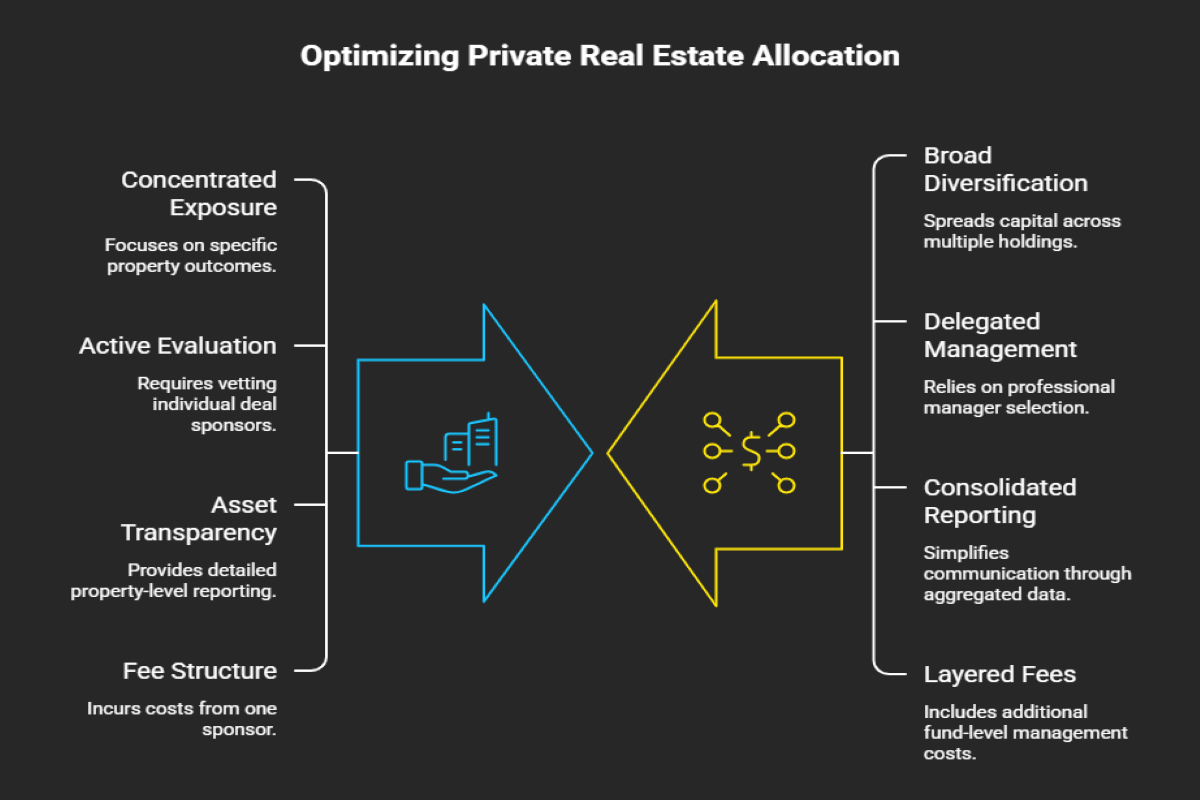
The main differences usually appear in several areas.
Investment Scope
A direct syndication generally creates more concentrated exposure to one sponsor, property, portfolio, or business plan.
A fund of funds may spread capital across multiple underlying investments. That may broaden exposure, but only if the holdings differ meaningfully across sponsors, markets, property types, financing structures, or strategies.
Investor Decision Burden
A direct syndication requires the investor to evaluate each opportunity separately.
A fund of funds delegates part of that selection process to the manager. This may reduce the number of individual decisions, but it also means the investor has less control over the final allocations.
Visibility and Control
Direct syndication investors may receive more detailed information about one specific asset or portfolio.
Fund-of-funds investors may receive more consolidated reporting. That can simplify communication, but it may provide less direct visibility into individual property-level issues.
Fees
Direct syndications can include sponsor, acquisition, management, financing, disposition, and performance-related fees.
A fund of funds may include those underlying fees plus an additional layer of management, administration, expenses, or performance compensation at the fund-of-funds level.
Risk
A direct syndication can be more exposed to the outcome of one business plan.
A fund of funds can spread risk across several holdings, but it also introduces manager-selection risk, layered fees, overlapping exposure, reporting complexity, and reliance on multiple sponsors.
Neither structure is automatically better, safer, or more suitable. Each has different trade-offs in concentration, control, cost, transparency, administration, and liquidity.
Investors should compare the structures based on what they own, who makes decisions, which fees apply, how risks overlap, how reporting works, and how long capital may remain committed.
Questions to Ask Before Investing
A fund-of-funds structure can simplify how an investor accesses multiple real estate opportunities, but the structure still requires careful review.
The right questions should focus on what the fund owns, how decisions are made, how much the structure costs, and where the main risks sit.
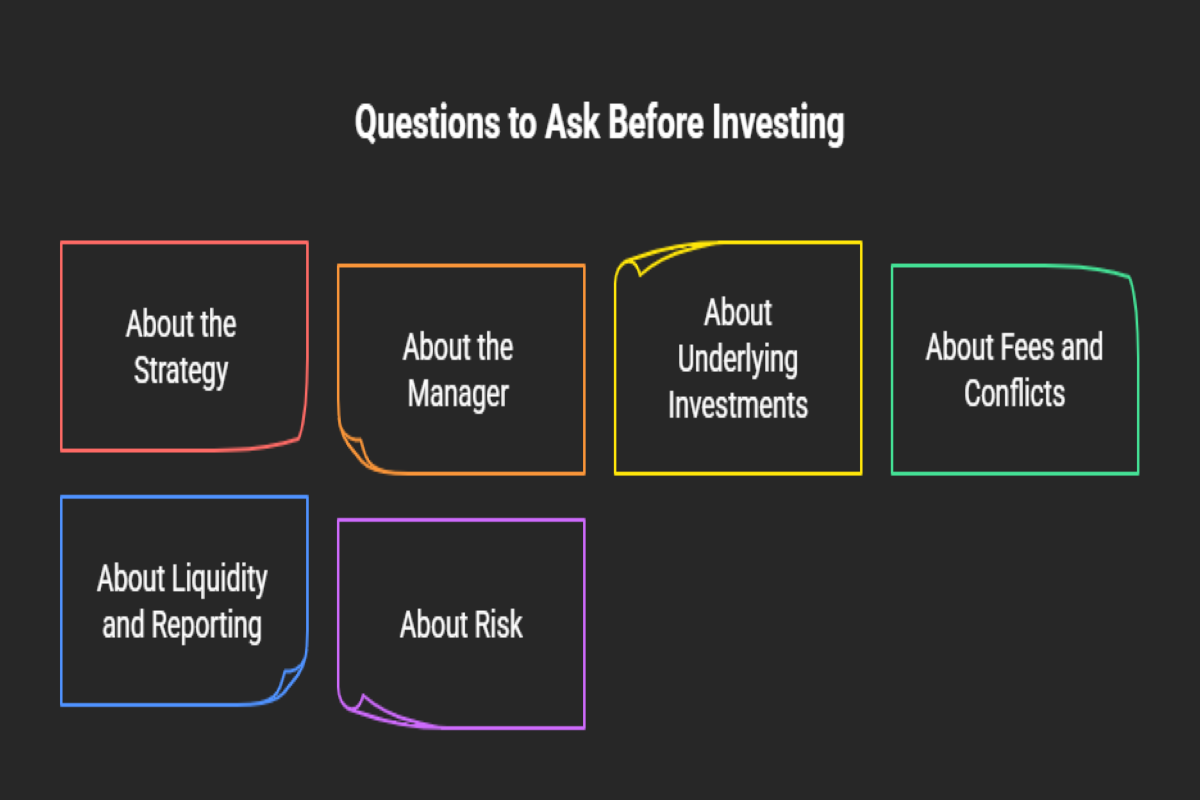
About the Strategy
What types of underlying investments can the fund make?
Are there limits by sponsor, market, property type, strategy, or debt structure?
How concentrated can the portfolio become?
Can the manager change the strategy after capital is committed?
About the Manager
Who makes the investment decisions?
What experience does the team have in evaluating real estate sponsors and operators?
How are decisions documented?
How does the manager monitor investments after capital is deployed?
What happens when an underlying investment falls behind its original plan?
About the Underlying Investments
How are sponsors and operators reviewed?
Which business-plan assumptions receive the most scrutiny?
How are financing, liquidity, and exit risks evaluated?
Will investors receive information about each underlying opportunity?
Could multiple holdings share the same market or economic risks?
About Fees and Conflicts
Which fees apply at the fund-of-funds level?
Which fees apply to the underlying investments?
Are affiliated parties compensated?
How are conflicts of interest disclosed and managed?
Could the manager receive compensation that influences investment selection?
About Liquidity and Reporting
How long is the capital expected to remain committed?
Are withdrawals, transfers, or redemptions permitted?
How often will investors receive reports?
Will reports include property-level information or only consolidated results?
What happens if an underlying investment requires more time or additional capital?
About Risk
What conditions could cause the strategy to underperform?
How does the manager evaluate downside scenarios?
Could one sponsor, property type, or financing structure have an outsized effect on the fund?
What protections exist if reporting is delayed or an underlying sponsor stops communicating?
What is the possible impact of losing part or all of the invested capital?
Clear answers do not remove risk. They help investors determine whether they understand the structure well enough to evaluate it responsibly.
Prospective investors should review the governing and offering documents carefully and consult qualified legal, tax, or financial professionals when appropriate.
Final Perspective
A real estate fund of funds can create one entry point into several underlying real estate investments. For busy professionals, that structure may reduce the number of separate opportunities they need to evaluate and monitor.
The trade-off is delegation.
Investors rely on the fund-of-funds manager to select sponsors, compare opportunities, manage allocations, monitor performance, and communicate material developments. That can simplify administration, but it also introduces manager-selection risk, layered fees, reduced control, limited liquidity, and exposure to the risks carried by each underlying investment.
The structure should not be evaluated by its label alone.
Investors should examine what the fund can own, how concentrated it may become, how decisions are made, which fees apply, how conflicts are handled, what reporting is provided, and how long capital may remain committed. They should also understand that diversification, distributions, appreciation, tax treatment, and investment outcomes are never guaranteed.
A demanding healthcare career may make delegated oversight appealing. It does not replace informed review.
The strongest decision starts with understanding the structure, the people responsible for managing it, and the risks that could affect the outcome.
This article is for educational purposes only and should not be interpreted as a recommendation to invest. Prospective investors should review all offering documents and consult qualified legal, tax, and financial professionals before making an investment decision.


