

The Problem With Trying to Become a Landlord When You Already Have a Demanding Career
You can earn a strong income, build a successful career, and still feel like your wealth-building strategy is missing something.
For many medical sales professionals and other high-income earners, real estate eventually enters the conversation. Maybe a colleague owns a few rentals. Maybe you have heard people talk about cash flow, appreciation, or building wealth outside the stock market. On paper, buying rental property can seem like the obvious next step.
Then you start looking at what becoming a landlord actually requires.
Finding the right property is only the beginning. You may need to evaluate financing, understand a local market, screen tenants, coordinate repairs, manage contractors, monitor expenses, handle vacancies, and make decisions when something goes wrong. Hiring a property manager can reduce some of that work, but it does not remove your responsibility as the owner.
That can create a difficult mismatch when your career already demands most of your attention.
If your days are filled with hospital visits, physician meetings, procedures, travel, follow-ups, quotas, and family responsibilities, adding another operation to manage may not feel like passive investing. It may feel like taking on a second job.
That does not mean rental properties are a bad investment. Direct ownership can make sense for investors who want control, enjoy managing real estate, and have the time and expertise to do it well.
But becoming a landlord is only one way to invest in real estate.
Busy professionals can also gain real estate exposure through structures that place more of the operational responsibility in the hands of professional managers. Those options range from publicly traded real estate investments to private funds, real estate debt strategies, and fund-of-funds structures that allocate capital across multiple underlying investment managers.
Each approach comes with different levels of control, responsibility, liquidity, fees, diversification, and risk. So the better question isn't simply, "Should I buy a rental property?" It's asking what type of real estate investment actually fits the way you want to build wealth, use your time, and manage risk. Understanding that distinction helps you evaluate real estate as an investor without assuming you also need to become a landlord.
Why Real Estate Attracts Busy, High-Income Professionals

For many high-income professionals, interest in real estate starts with a simple realization: earning more does not automatically mean building more wealth.
A strong salary or commission income can create financial opportunity, but it can also create a sense of dependence on the next quarter, the next bonus, or the next compensation plan. Medical sales professionals often experience this more clearly than most because income can be strong while still being closely tied to performance, territory changes, product cycles, and employer decisions.
That is one reason real estate becomes appealing.
Investors may be drawn to real estate because it can provide exposure to assets that behave differently from a traditional stock and bond portfolio. Depending on the structure, real estate investments may also offer potential income, long-term appreciation, and access to strategies that are not directly tied to public markets.
For a busy professional, the appeal is often broader than owning property itself.
The real goal may be to create a more intentional wealth-building strategy. That can mean putting capital to work outside a retirement account, reducing reliance on earned income over time, or building a portfolio with more than one source of potential return.
There is also a psychological shift that happens as income grows.
Early in a career, the focus is often on earning more. Later, the question becomes what to do with that income once it arrives. Saving more matters, but many professionals eventually want to understand how their capital can work in a more deliberate way.
Real estate enters that conversation because it offers multiple ways to participate.
You can buy property directly. You can invest through professionally managed structures. You can gain exposure through equity or debt. You can participate in a single opportunity or through a broader portfolio.
That flexibility is important because the right investment approach is rarely determined by income alone.
Time, risk tolerance, liquidity needs, desired control, investment knowledge, and long-term goals all matter.
For a professional with a demanding career, the question is therefore not simply whether real estate belongs in the portfolio.
The more useful question is which form of real estate investing fits the way you actually live and work.
Being a Real Estate Investor and Being a Landlord Are Not the Same Thing
One of the most important distinctions for busy professionals is that investing in real estate does not automatically mean owning and managing rental property yourself.
Direct ownership is only one structure.
You can gain real estate exposure through several different approaches, including professionally managed properties, publicly traded real estate investment trusts, private real estate funds, private debt strategies, and fund-of-funds structures.
The difference comes down to two separate decisions: where your capital is invested and how much operational responsibility you want to take on personally.
Direct rental ownership gives you more control over the property. You choose the asset, decide how it is financed, select the management approach, and participate directly in major operating decisions.
That control comes with responsibility.
You still need to evaluate the property, understand the market, oversee management, monitor expenses, make capital decisions, and respond when the investment does not perform as expected.
Other real estate structures shift more of that responsibility to professional managers.
In those cases, your role becomes more focused on evaluating the investment structure, the manager, the strategy, the fees, the risks, and how the investment fits within your broader portfolio.
That does not make the investment risk-free or completely hands-off.
It simply changes the type of work required from you.
This distinction matters because many high-income professionals are interested in real estate for its potential role in a long-term wealth-building strategy, but they are not necessarily interested in operating property.
You may want real estate exposure without managing tenants. You may want potential income without coordinating repairs. You may want access to private real estate without learning how to underwrite every individual property yourself.
Thinking about real estate this way creates a better starting point.
Instead of asking, “Do I want to own rental property?” you can ask, “How much control, responsibility, and involvement do I actually want from my real estate investments?”
That question makes it easier to compare direct ownership with more passive structures based on fit, rather than assuming one approach is automatically better than another
What Being a Landlord Actually Requires
Buying a rental property is only the beginning.
Once you own the property, you also take on responsibility for the decisions that keep it operating. Some investors handle that work themselves. Others hire a property manager. Either way, someone still needs to oversee the asset, monitor performance, and make decisions when problems come up.
For a busy professional, that ongoing responsibility can be the part that is easiest to underestimate.
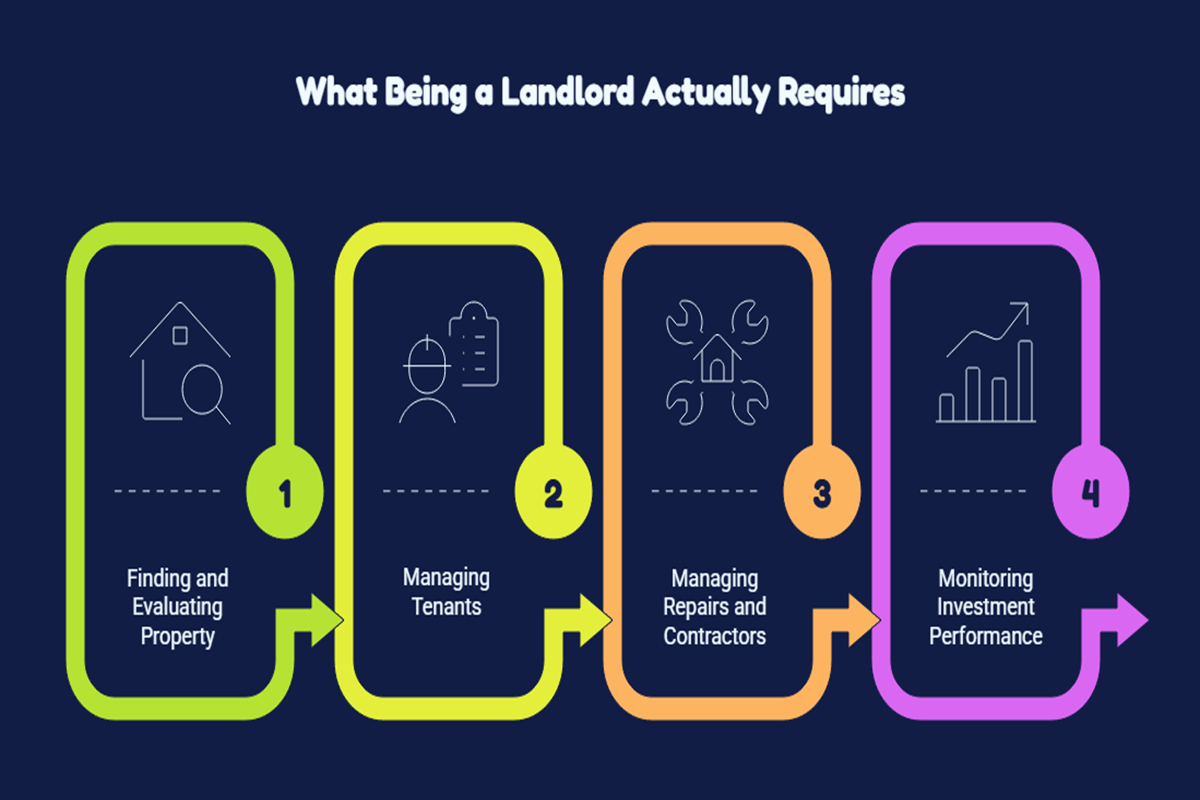
Finding and Evaluating the Right Property
Before you ever collect rent, you need to find a property that makes sense as an investment.
That can involve researching the local market, comparing properties, reviewing financing options, estimating expenses, evaluating rent potential, understanding insurance and taxes, and assessing the condition of the property.
You also need to think through what could go wrong.
What happens if repairs are higher than expected? What if rents do not grow as projected? What if the property sits vacant longer than planned?
Good investing starts before the purchase. That means the due diligence process itself takes time and attention.
Managing Tenants
Once the property is occupied, tenant management becomes part of the investment.
That can include screening applicants, signing leases, answering questions, handling late payments, managing turnover, addressing complaints, and resolving disputes.
Even with a strong property manager, the owner may still need to approve certain decisions or step in when a situation becomes more serious.
For someone whose workday is already full of meetings, travel, physician conversations, hospital visits, or procedure coverage, tenant issues can create another layer of responsibility outside normal working hours.
Managing Repairs and Contractors
Properties need maintenance. Sometimes the issue is small. Sometimes it is not.
A leaking pipe, HVAC failure, roof problem, electrical issue, or damaged unit can require quick decisions. You may need to compare contractor bids, approve repairs, review invoices, and decide whether the expense should come from reserves or current cash flow.
Hiring a property manager can reduce your direct involvement, but it does not remove the economic impact of those decisions.
You still own the asset. You still bear the cost.
Monitoring the Property as an Investment
A rental property should be managed as an investment, not simply as a piece of real estate.
That means tracking income, expenses, occupancy, insurance, property taxes, financing costs, capital improvements, reserves, and overall performance.
You may also need to evaluate whether rents should change, whether refinancing makes sense, whether improvements are worth the cost, or whether the property should eventually be sold.
These are not necessarily daily tasks, but they still require attention.
Making Decisions When Your Career Is Already Demanding
This is where the real trade-off becomes clear.
A rental property does not care that you have an important meeting tomorrow.
A contractor issue does not wait until your travel schedule clears.
A tenant problem does not automatically happen during convenient hours.
That does not mean direct ownership is a bad strategy. Many investors enjoy the control and responsibility that come with owning property directly.
But it does mean that direct ownership should be evaluated honestly.
If your career already demands most of your time and attention, the real question is whether you want your investment strategy to create another set of operational responsibilities on top of everything else you are already managing.
The Hidden Cost of DIY Real Estate Is Your Attention

When people evaluate a rental property, they usually focus on the financial numbers.
Purchase price. Financing. Rent. Expenses. Cash flow. Potential appreciation.
Those numbers matter. But for a busy professional, there is another cost that is harder to measure: attention.
Every investment requires some level of decision-making. With direct real estate ownership, that responsibility can extend well beyond the initial purchase.
You may need to review repair estimates, respond to property management questions, evaluate insurance changes, approve capital improvements, monitor vacancies, and decide how to handle unexpected expenses.
None of those tasks may seem overwhelming on their own.
The problem is that they compete for the same limited attention you are already using in your career and personal life.
Time Is Only Part of the Equation
A rental property might require only a few hours of your time in a normal month.
But hours alone do not tell the full story.
There is a difference between spending two scheduled hours reviewing an investment and being responsible for an issue that can appear at any time.
For a medical sales professional, that distinction matters.
Your schedule may already include hospital visits, case coverage, travel, physician meetings, follow-ups, quota pressure, and family responsibilities. Even when a property does not demand much physical time, knowing that another decision may land on your plate can create an additional layer of mental responsibility.
That is why the true cost of an investment should include more than money and hours.
It should also include attention.
Your Expertise Has an Opportunity Cost
There is another question worth considering: where does your time create the most value?
A successful medical sales professional has spent years developing industry knowledge, relationships, communication skills, and professional expertise.
Becoming a capable real estate operator requires a different set of skills.
You may need to learn local markets, financing, leasing, property management, construction, contractor oversight, accounting, and real estate underwriting.
There is nothing wrong with developing those skills if you enjoy the work and want direct control.
But learning them still has a cost.
Every evening spent evaluating properties, coordinating repairs, or solving operational problems is time that cannot be spent elsewhere.
That could mean less time with family, less attention available for your career, or simply less room to recover from an already demanding schedule.
The Question Is Not Whether You Can Do It
Many high-performing professionals can manage rental properties successfully.
The more useful question is whether they want to.
If you already manage complex relationships, deadlines, travel, and performance expectations at work, adding property operations may be completely manageable. It may also be something you genuinely enjoy.
For someone else, the same responsibility may create unnecessary friction.
This is why real estate investing should be evaluated based on fit rather than status.
Owning several rental properties may look like progress. But if those properties consume time and attention you would rather use elsewhere, the structure may not support the broader life you are trying to build.
Asking if personally managing real estate is the best use of your limited time and attention outside your career and family helps clarify your true priorities. While there isn't a universal answer, asking this question early helps you choose an investment structure that fits your life instead of forcing your life to fit the investment.
When Direct Rental Ownership Can Still Make Sense
Direct rental ownership can still make sense if you want control and are willing to take on the responsibility that comes with it.
You may prefer direct ownership if you want to choose the property, market, financing, management approach, and eventual exit yourself. Some investors also enjoy the operational side of real estate and want to build expertise in areas like leasing, property management, renovations, and local market analysis.
The key question is whether you have the time and interest to manage that responsibility well. Even with a property manager, you still need to review performance, approve major expenses, monitor the team, and make decisions when conditions change. Direct ownership can also create greater concentration because a meaningful amount of capital gets tied to a single property or market.
For investors who value control, enjoy real estate operations, and have the capacity to stay involved, that trade-off can be worthwhile. However, for someone mainly looking for real estate exposure without adding another operational responsibility, a more passive structure is usually a better fit to evaluate.
What Is Passive Real Estate Investing?
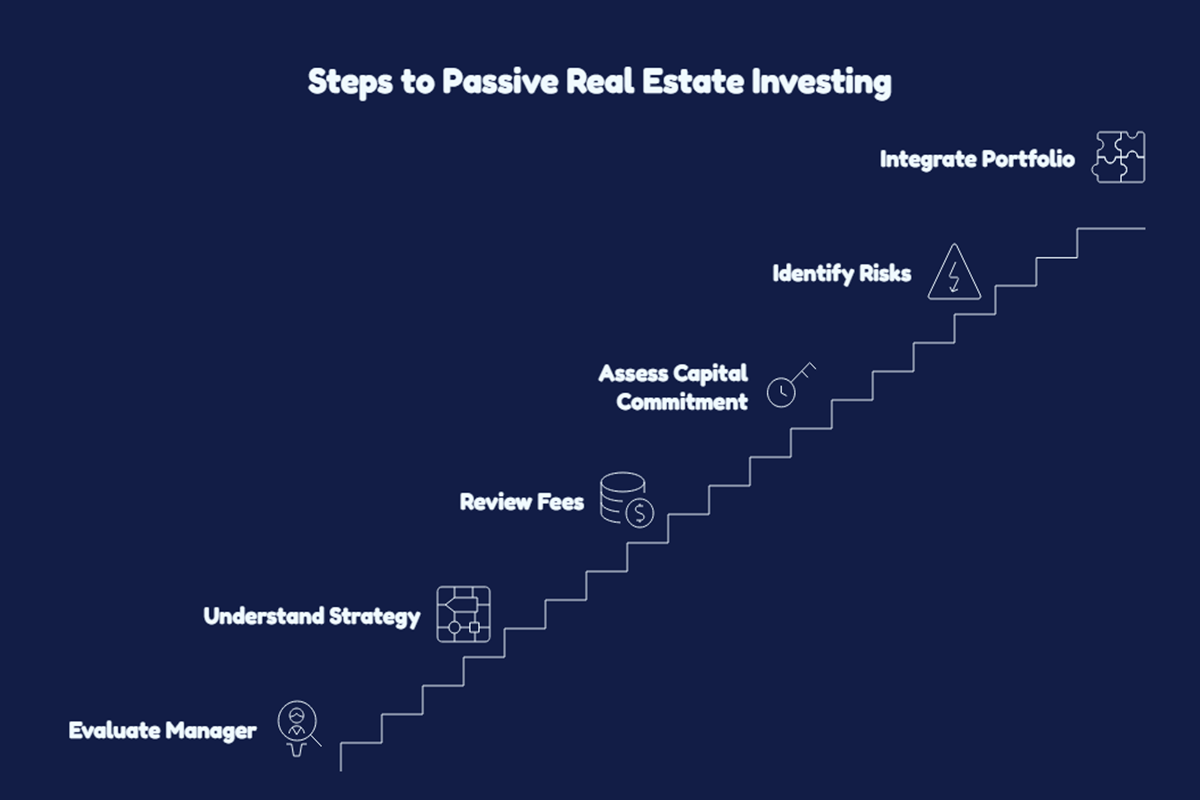
Passive real estate investing means gaining exposure to real estate while another person or organization handles most of the day-to-day operations.
Instead of managing tenants, repairs, leasing, and contractors yourself, your role is primarily to evaluate the investment.
That may mean reviewing:
Who manages the investment
How the strategy works
What fees apply
How long your capital may be committed
What risks could affect performance
How the investment fits within your broader portfolio
Passive investing can take several forms, including professionally managed properties, syndications, private real estate funds, private debt strategies, and fund-of-funds structures.
The important point is that passive does not mean effortless or risk-free.
You may spend less time on property operations, but you are relying more heavily on the judgment and execution of the manager. Private investments may also involve limited liquidity, manager risk, financing risk, and the possibility of losing capital.
So the work doesn't disappear.
It shifts from managing property to evaluating the people, structure, strategy, and risks behind the investment.
How Can You Invest in Real Estate Without Becoming a Landlord?
Direct ownership is only one way to invest in real estate.
If you want exposure without personally managing tenants, repairs, contractors, or property operations, several alternatives may be worth evaluating.
Professionally Managed Rental Property
You can own property directly while hiring a property manager to handle much of the day-to-day work.
This reduces your involvement, but you still remain responsible for major decisions, expenses, and overall performance.
Publicly Traded REITs
Real estate investment trusts, or REITs, let investors gain real estate exposure through publicly traded securities.
They generally offer more liquidity than private investments, but their prices can still move with public market conditions.
Real Estate Syndications
A syndication pools capital from multiple investors into a specific property or strategy.
The sponsor usually handles operations, while passive investors focus on evaluating the sponsor, business plan, fees, risks, and expected hold period.
Private Real Estate Funds
Private funds may invest across multiple properties or strategies rather than a single asset.
This can provide broader exposure, but investors still need to understand the fund manager, strategy, fees, liquidity limits, and risks.
Private Real Estate Debt
Investors can also participate through lending strategies rather than property ownership.
These investments involve a different risk profile, with greater emphasis on borrower quality, collateral, loan structure, and repayment risk.
Fund-of-Funds Structures
A fund of funds invests in other private funds rather than primarily investing in individual properties.
The manager may select underlying funds, evaluate sponsors, allocate capital, and monitor the broader portfolio.
This can reduce the need to research and manage multiple fund relationships independently, but it can also introduce additional fees, complexity, manager risk, and limited liquidity.
The important point is simple:
Moving away from direct ownership does not remove the need for due diligence.
Moving away from direct ownership does not remove the need for due diligence, it simply changes what you evaluate. Instead of asking only whether a property looks attractive, you need to evaluate the manager, strategy, structure, fees, risks, and the role the investment plays within your broader portfolio.
The Next Problem: Passive Investing Still Requires Investment Decisions
Passive real estate reduces the operational burden of owning property directly, but it introduces a different set of responsibilities around capital allocation. You still need to evaluate several critical factors before deploying your funds:
Which sponsor or fund manager do you trust?
How does the strategy work?
What are the fees?
How concentrated is the investment?
What risks matter most?
How long could your capital be tied up?
How does this investment fit with the rest of your portfolio?
For a busy professional, researching multiple sponsors, comparing funds, and monitoring several separate investments can quickly become its own challenge. That is where portfolio structure starts to matter, as some investors prefer an approach where manager selection, allocation, and ongoing monitoring occur at the portfolio level.
What Is a Real Estate Fund of Funds?
A real estate fund of funds is an investment vehicle that allocates capital to other investment funds rather than primarily investing directly in individual properties. Instead of choosing one property or one sponsor, the fund-of-funds manager selects and monitors a group of underlying funds. Those funds may focus on different strategies, managers, or segments of the private real estate market.
For the investor, participating through a fund of funds simplifies the entire process. Rather than researching and tracking several separate fund relationships independently, you participate through one structure while the fund-of-funds manager handles portfolio construction, manager selection, and ongoing oversight. The trade-off is that you give up some direct control and may face additional layers of fees, complexity, and illiquidity.
The true value of a fund of funds is not that it removes risk, but that it changes where the responsibility sits. Instead of managing property or selecting every underlying fund yourself, you evaluate the fund-of-funds manager, the portfolio strategy, the underlying managers, the fee structure, and the risks across the entire portfolio.
Want to Talk Through Your Options?

If you are exploring passive real estate or private-market investing and want to better understand how different structures may fit your goals, give Greener Path Capital a call.
We can walk through the questions you are considering, explain how our fund-of-funds approach works, and help you understand what to evaluate before making any investment decision.
Every investment carries risk, and the right approach depends on your goals, liquidity needs, time horizon, and broader financial situation.
Discover Passive Real Estate Options for Busy Professionals


