

What Questions to Ask Before Investing in a Private Real Estate Opportunity
Projected cash flows, target returns, and a polished investment deck can make a private real estate opportunity look straightforward while making important risks easier to overlook.
Those projections are only the starting point.
Before committing capital, you need to understand what assumptions drive the projected results, who is responsible for executing the business plan, and what could cause actual performance to differ from the model.
That does not mean you need to become a real estate operator or rebuild the underwriting yourself. It means knowing which parts of the opportunity deserve closer review before you make a decision.
Real estate syndication due diligence helps you evaluate the sponsor, assumptions, financing, property, market, fees, risks, legal structure, and exit strategy behind an opportunity rather than relying on projected returns alone.
The goal is not to eliminate risk. Private real estate investments involve risk, including limited liquidity and the potential loss of capital. The goal is to understand how the opportunity is expected to work, where the main risks sit, and whether the investment fits your financial situation, objectives, time horizon, and tolerance for risk.
This guide walks through the questions investors can use to evaluate a private real estate opportunity and explains what the answers can reveal about the people, assumptions, structure, and risks behind the investment.
What Is Due Diligence in a Private Real Estate Investment?

Due diligence is the process of investigating an investment opportunity before committing capital. In a private real estate investment, that means looking beyond the projected returns to understand the sponsor, property, market, financing, business plan, fees, risks, legal structure, and assumptions behind the deal.
For a passive investor, the goal is not to independently operate the property or recreate every calculation. The goal is to understand how the investment is expected to work and determine where additional questions or professional review may be necessary.
A strong due diligence process combines quantitative information, such as financial projections and loan terms, with qualitative factors, such as the sponsor’s experience, communication practices, and ability to execute the business plan. Current due diligence frameworks similarly emphasize reviewing both the financial and operational sides of an opportunity.
Due diligence cannot eliminate investment risk. It can, however, help you identify assumptions, tradeoffs, and potential concerns before your capital is committed.
1. Who Is Sponsoring the Investment?
The sponsor is the person or company responsible for identifying the opportunity, structuring the investment, overseeing the business plan, and making key decisions throughout the life of the deal.
That role matters because the property alone does not determine the outcome. Even a property with solid occupancy, income, or market fundamentals can underperform if the sponsor lacks the operational experience to execute the business plan effectively.
Start by reviewing the sponsor’s relevant track record. Look at the types of properties they have invested in, the markets they have operated in, how long they have been active, and whether their prior experience matches the strategy being presented.
Useful questions include:
How many similar investments has the sponsor completed?
How have prior investments performed compared with the original projections?
Has the sponsor managed through difficult market conditions or an underperforming property?
Who is responsible for acquisitions, asset management, operations, and investor communication?
Is the sponsor investing its own capital alongside investors?
Past performance does not guarantee future results, so the goal is not to find a flawless history. The more useful question is whether the sponsor can explain both successful and difficult outcomes clearly.
Pay attention to how they discuss setbacks. A sponsor who can explain what went wrong, what decisions were made, and how they responded can give you more insight into their judgment than a presentation focused only on successful exits.
2. What Is the Investment Thesis?
Every private real estate opportunity should have a clear reason the investment is expected to create value. Before focusing on projected returns, make sure you understand that reason in plain language.
Ask:
Why is this property considered an attractive opportunity?
What specifically is expected to improve its value or cash flow?
What must happen for the business plan to succeed?
Which parts of the plan depend on the sponsor’s execution?
Which parts depend on broader market conditions?
For example, an investment may depend on renovating units, increasing occupancy, raising rents, reducing operating costs, or eventually selling the property at a higher value. Each of those assumptions introduces a different type of execution or market risk.
A useful test is whether you can explain the investment thesis yourself after reviewing the offering.
If the opportunity only makes sense when described through a long list of projections, technical terms, or optimistic assumptions, that is a reason to investigate further.
You should be able to answer a simple question:
Why is this investment expected to work, and what would need to go right for that outcome to happen?
3. What Assumptions Are Behind the Projected Returns?
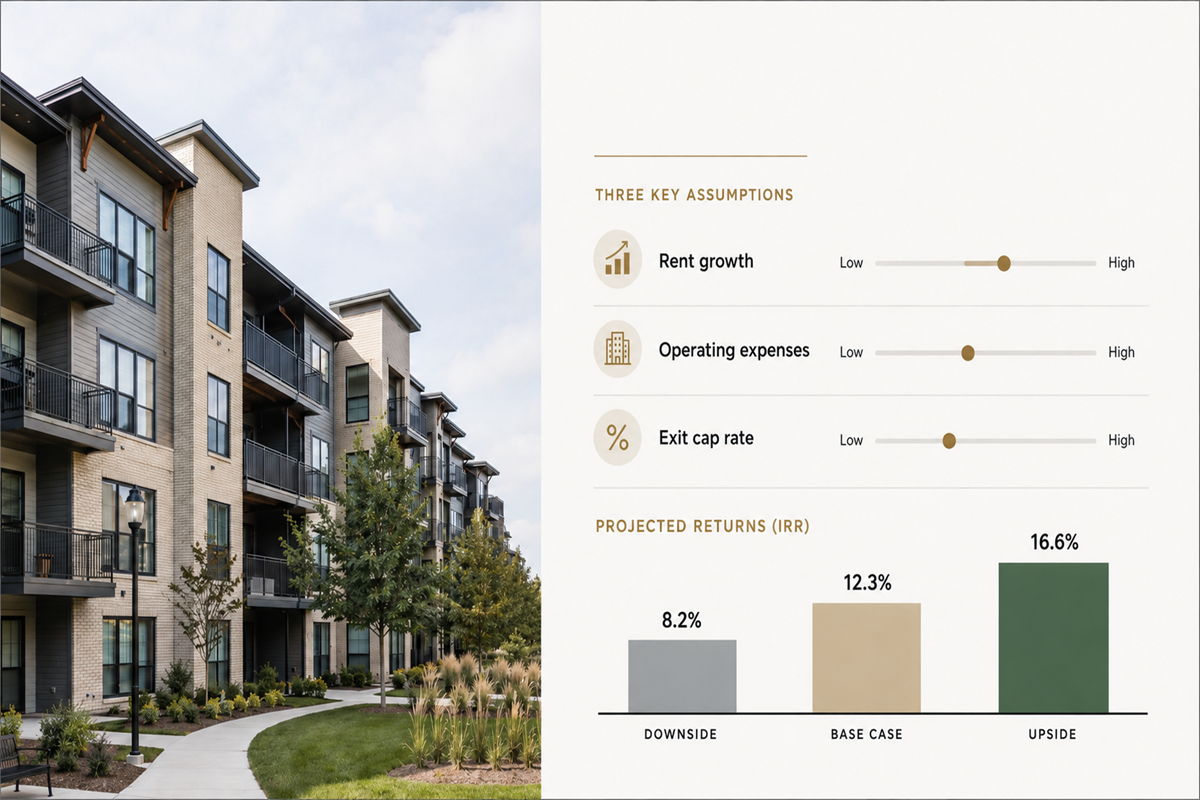
Projected returns can help you compare opportunities, but they are estimates built on assumptions. To evaluate the projection, you need to understand what the financial model expects to happen along the way.
Look beyond the target IRR, equity multiple, or cash flow and ask:
What rent or revenue growth is assumed?
What occupancy level does the model expect?
How are operating expenses projected to change?
What renovation costs and timelines are built into the plan?
What capital expenditures may be required?
What exit cap rate is assumed when the property is sold?
How sensitive are the projected returns to changes in these assumptions?
For example, a projection may depend on rents increasing while operating expenses remain relatively controlled. If rent growth slows or expenses rise faster than expected, the actual outcome could differ materially from the model.
Exit assumptions deserve particular attention. A projected sale price several years into the future depends on conditions that cannot be known today. Understanding the assumed exit cap rate and how different exit scenarios affect the investment can provide a clearer picture of that uncertainty.
The key question is not simply, “What return is projected?”
It is, “What needs to happen for that projected return to become possible?”
Projected returns are not guarantees. Treat the model as a tool for understanding the investment thesis, its assumptions, and its sensitivity to changing conditions rather than as a prediction of the final result.
4. How Is the Property Being Financed?
Financing can materially change the risk profile of a private real estate investment. Two properties with similar operating performance can produce very different investor outcomes depending on how much debt is used and how that debt is structured.
Ask:
How much leverage is being used?
Is the interest rate fixed or floating?
When does the loan mature?
Are there extension options?
Does the loan term align with the expected business plan and hold period?
What happens if refinancing becomes more expensive or difficult?
Are there debt-service requirements or other loan conditions that could affect the investment?
A higher level of leverage can increase potential returns when the investment performs well, but it can also reduce the margin for error when income falls, expenses rise, or property values decline.
Floating-rate debt deserves additional attention because borrowing costs can change over time. Even with interest-rate protections in place, investors should understand how higher financing costs could affect cash flow and the overall business plan.
The goal is to understand whether the financing supports the investment strategy or introduces additional pressure if market conditions change.
A useful question to keep in mind is:
Does the debt structure give the investment enough flexibility if the original plan takes longer than expected?
5. What Could Cause the Business Plan to Underperform?
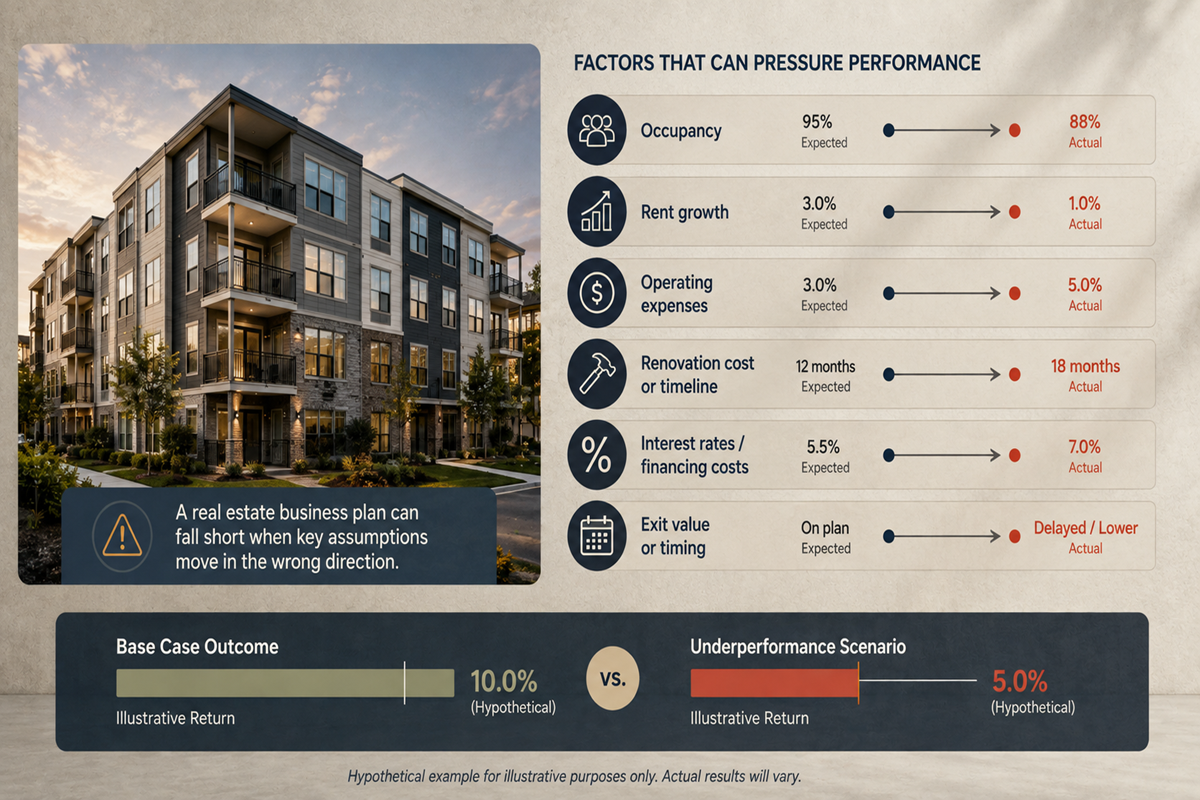
A strong investment review should consider more than the upside case. You also need to understand what could cause the business plan to fall short of expectations and how sensitive the investment is to those changes.
Ask:
What happens if occupancy falls below projections?
What if rent growth is slower than expected?
How would higher operating expenses affect cash flow?
What happens if renovations cost more or take longer?
How would higher interest rates or tighter credit conditions affect the plan?
What happens if the property cannot be sold at the expected value or within the expected timeframe?
These questions help shift the conversation from projected performance to resilience.
For example, a deal may still perform reasonably well if rent growth slows slightly. A different deal may depend on several aggressive assumptions working at the same time. Those are very different risk profiles, even if the headline return projections look similar.
The goal is not to imagine every possible problem. It is to identify the assumptions that matter most and understand how the investment may respond when reality is less favorable than the original model.
A useful question is:
Which assumptions have the greatest impact on investor outcomes if they do not go according to plan?
6. What Do You Know About the Property and Market?

Even a well-structured investment can struggle if the property or market does not support the business plan. That makes property-level and market-level due diligence essential.
Ask:
What has the property’s historical occupancy and operating performance looked like?
What major repairs or capital improvements are expected?
How does the property compare with nearby competitors?
Is new supply entering the market?
What are the area’s major employment and population trends?
How could property taxes, insurance, or other operating costs change?
Are there physical or operational issues that could affect future performance?
The key is to understand whether the assumptions in the investment model are supported by what is happening on the ground.
For example, projected rent growth may look reasonable in isolation. But if several competing properties are being delivered nearby, that growth could become harder to achieve. The same applies to expenses. Rising insurance costs, taxes, or maintenance needs can pressure cash flow even when revenue remains stable.
A useful question is:
Does the local market and the condition of the property support the business plan, or does the investment depend on conditions becoming more favorable than they are today?
7. How Are the Sponsor and Investors Economically Aligned?

Alignment matters because the sponsor and investors may earn money in different ways and at different points in the investment.
Before investing, understand how the sponsor is compensated and whether its economic interests remain connected to investor outcomes.
Ask:
Is the sponsor investing its own capital in the deal?
How much of its compensation comes from fees?
How much depends on the investment’s performance?
How are distributions shared between investors and the sponsor?
Is there a preferred return, promote, or other waterfall structure?
Are there incentives that could encourage the sponsor to refinance, sell, or hold the property?
Co-investment can be one sign of alignment, but it should not be treated as proof that every incentive is perfectly matched.
The full compensation structure matters more.
For example, a sponsor may invest alongside investors while also receiving acquisition, asset management, or disposition fees. Those fees may be reasonable, but investors should understand when they are paid and whether they depend on the investment performing well.
The practical goal is to understand how the sponsor benefits throughout the life of the deal.
A useful question is:
If the investment performs below expectations, how do the sponsor’s economics change compared with mine?
8. What Fees Will the Investment Pay?
Fees affect investor returns, so you should understand what the investment pays, who receives those fees, and when they are charged.
Depending on the structure, fees may include:
Acquisition fees
Asset management fees
Property management fees
Construction or renovation management fees
Financing or refinancing fees
Disposition fees
The presence of fees does not automatically make an investment unattractive. Sponsors perform work throughout the life of a deal, and compensation structures vary.
What matters is transparency.
Ask whether each fee is clearly disclosed, whether it is tied to a specific service, and whether it is paid regardless of investment performance.
You should also look at fees together rather than one at a time. A single fee may seem reasonable in isolation, but the combined structure can have a more meaningful effect on investor economics.
A useful question is:
What does the sponsor get paid for, when do they get paid, and how does that compensation affect the return available to investors?
9. What Is the Hold Period and Exit Strategy?

A private real estate investment usually has an expected hold period, but that timeline is not guaranteed. Market conditions, financing, property performance, and buyer demand can all affect when an investment is actually sold or refinanced.
Ask:
What is the expected hold period?
What assumptions support that timeline?
What is the planned exit strategy?
What sale price or exit cap rate is being assumed?
What happens if market conditions are unfavorable when the expected exit date arrives?
Could the property be held longer?
Is refinancing a realistic alternative?
Are there multiple exit paths if the original plan becomes less attractive?
The exit strategy matters because investor returns often depend heavily on what happens at the end of the investment, not only on the cash flow generated during the hold period.
A five-year hold, for example, should be treated as an estimate rather than a fixed deadline. If the property cannot be sold on acceptable terms at that point, extending the hold may be more prudent than forcing an exit.
A useful question is:
If the original exit plan is no longer attractive, what options does the sponsor have?
10. What Rights Do Investors Have?
Private real estate investments are governed by legal documents that define what investors own, what the sponsor can do, and what rights investors have throughout the life of the deal.
Before investing, review the offering documents carefully and understand provisions related to:
Voting rights
Distribution rules
Capital calls
Transfer restrictions
Sponsor authority
Reporting obligations
Potential conflicts of interest
Conditions for removing or replacing a manager
What happens if additional capital is needed
Documents such as the private placement memorandum, operating agreement, and subscription agreement may contain important details that do not appear in the investment presentation.
For example, an investor may assume certain major decisions require approval when the operating agreement gives the sponsor broad discretion. That does not automatically make the structure inappropriate, but it is something the investor should understand before committing capital.
The goal is not to interpret complex legal language on your own. If a provision is unclear or materially affects your rights, consider reviewing it with a qualified attorney or adviser.
A useful question is:
What rights do I actually have once my capital is committed, and where are those rights documented?
11. How Will the Sponsor Communicate After You Invest?
Due diligence should not stop at what happens before you invest. Once capital is committed, the quality of communication can determine how clearly you understand what is happening with the investment.
Ask:
How often should investors expect updates?
What information is typically included?
Who is responsible for investor communication?
How are distributions, property performance, and material changes explained?
What happens if the business plan falls behind expectations?
How can investors raise questions between scheduled updates?
Regular communication does not mean every update will be positive. In fact, difficult periods are when clear communication matters most.
If occupancy drops, financing changes, expenses rise, or the business plan takes longer than expected, investors should understand what changed, why it matters, and what the sponsor is doing in response.
Before investing, consider reviewing examples of previous investor updates when they are available. This can give you a better sense of how the sponsor communicates both routine information and unexpected developments.
A useful question is:
If something does not go according to plan, will I receive enough information to understand what is happening and how the sponsor is responding?
12. Does This Opportunity Fit Your Own Financial Situation?
A well-structured investment can still be a poor fit for a particular investor. Due diligence should include the opportunity itself and your ability to live with its risks, timeline, and liquidity constraints.
Consider:
How long can you reasonably leave the capital invested?
Could you handle a delayed distribution or longer hold period?
How concentrated would this investment make your overall portfolio?
Are you comfortable with the possibility of losing some or all of the capital invested?
Do you understand how the investment may affect your tax, legal, and financial situation?
Have you reviewed the opportunity with the appropriate professional advisers when needed?
Private real estate investments are generally less liquid than publicly traded investments. You may not be able to sell your interest quickly if your circumstances change.
That makes your own time horizon and liquidity needs just as important as the property, sponsor, and projected returns.
The goal is not to decide whether private real estate is broadly “good” or “bad.” It is to determine whether a specific opportunity fits your objectives, risk tolerance, liquidity needs, and broader financial circumstances.
A useful question is:
If this capital remains invested longer than expected or the investment underperforms, would I still be comfortable with the decision?
A Simple Framework for Evaluating the Answers
A due diligence checklist is useful, but the quality of your decision depends on what you do with the answers.
As you review each part of an opportunity, use five questions:
1. Is the answer clear?
If the sponsor cannot explain an important part of the investment in understandable terms, that may be a reason to ask for more detail.
2. Is the answer supported?
Look for documents, operating history, market data, loan terms, financial statements, or other evidence that supports the explanation.
3. Is this a fact or an assumption?
Some information is known today. Other information, such as future rent growth, refinancing conditions, or exit value, depends on assumptions. Keep the distinction clear.
4. What happens if the assumption is wrong?
You do not need to model every possible outcome. Focus on the assumptions that could materially change the investment if they do not hold.
5. Does the answer create another question?
Good due diligence often leads to follow-up questions. That is not a problem. It is part of understanding the opportunity.
For a busy professional, the goal is not to know every detail about real estate. It is to understand the sponsor, structure, assumptions, risks, and trade-offs well enough to know where deeper investigation is warranted.
Frequently Asked Questions
What is real estate syndication due diligence?
Real estate syndication due diligence is the process of evaluating a private real estate investment before committing capital. It typically includes reviewing the sponsor, property, market, business plan, financing, projected assumptions, fees, legal structure, risks, investor rights, and exit strategy.
The purpose is not to eliminate risk. It is to understand how the investment is expected to work, what could cause it to underperform, and which areas deserve further review.
What documents should you review before investing in a real estate syndication?
Depending on the structure, investors may receive documents such as a private placement memorandum, operating agreement, subscription agreement, financial projections, property information, and other offering materials.
These documents may explain investor rights, fees, risks, distributions, sponsor authority, transfer restrictions, and other terms that may not appear in a presentation or summary.
If important provisions are unclear, consider reviewing them with a qualified legal, tax, or financial professional.
What should you ask a real estate sponsor?
Useful questions should cover the sponsor’s relevant experience, prior investments, business plan, financing strategy, assumptions, fees, risk management, communication practices, alignment with investors, and approach to difficult market conditions.
The goal is not only to hear the answers. Pay attention to whether the sponsor can support those answers and explain both strengths and risks clearly.
What are common risks of private real estate investments?
Risks can include market changes, vacancy, operating expenses, interest rates, leverage, refinancing, construction or renovation delays, sponsor execution, illiquidity, and unfavorable conditions at the time of sale.
Different opportunities carry different combinations of these risks. Investors should review the specific offering documents and evaluate whether the investment fits their own objectives, time horizon, liquidity needs, and tolerance for risk.
Final Thoughts: Better Questions Lead to Better Understanding

Private real estate opportunities can be complex, but your due diligence process does not need to be.
Start with the areas that matter most: the sponsor, investment thesis, assumptions, financing, property, market, fees, risks, legal structure, communication, and exit strategy.
Then keep asking a simple question:
What would I need to understand before I could make an informed decision?
That mindset matters more than memorizing dozens of technical questions.
The goal is not certainty. No investment can offer that. The goal is clarity about how the opportunity works, where the risks sit, what assumptions drive the outcome, and whether the investment fits your own financial circumstances.
Greener Path Capital’s approach to investor education is built around that principle: understanding before action, transparency before persuasion, and disciplined review before capital is committed.
If you are exploring private real estate and want to better understand how to evaluate an opportunity, the next step can simply be a conversation.
Schedule an investor introduction call to discuss the questions you are working through and learn more about how Greener Path Capital approaches private-market due diligence.


