
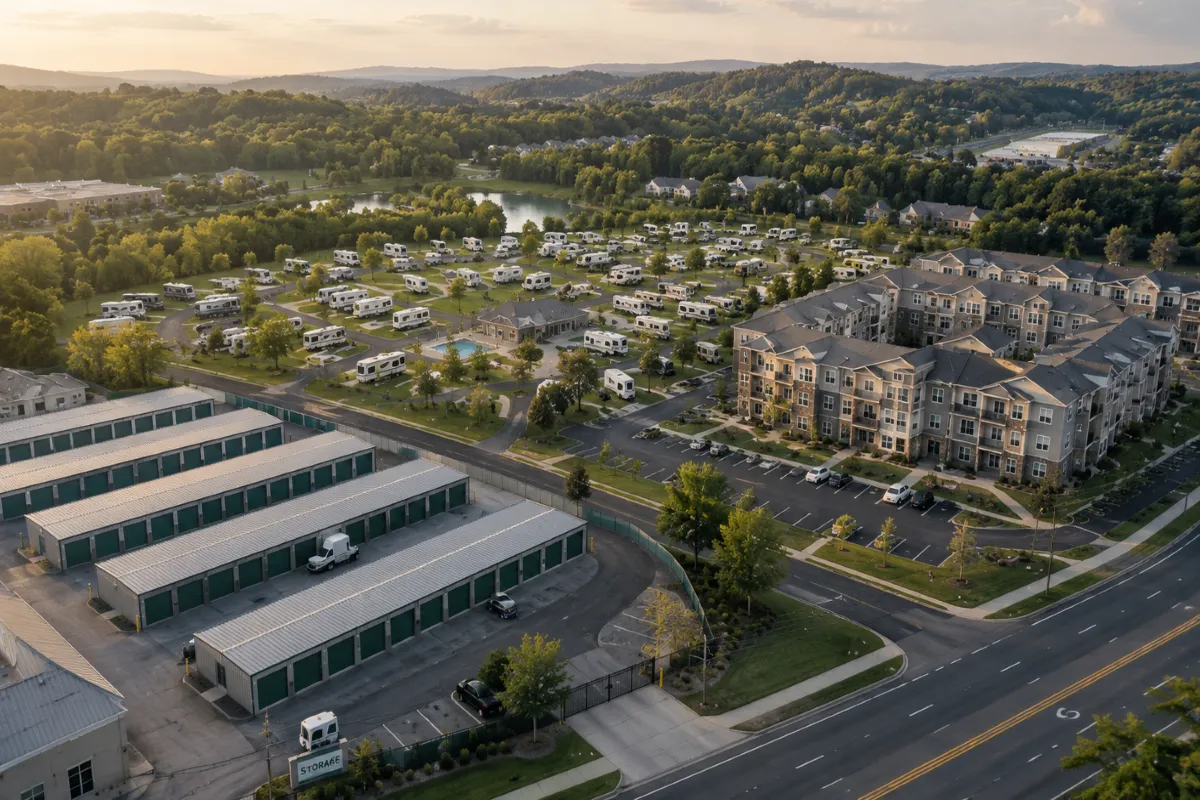
What Makes Self-Storage, RV Parks, and Similar Assets Appealing to Investors?
Many investors have spent the last several years reevaluating how they think about real estate exposure.
Changes in interest rates, pressure in certain commercial property sectors, and broader market volatility have led some investors to pay closer attention to asset classes outside traditional office, retail, and large institutional multifamily properties. That growing interest has brought additional attention to self-storage facilities, RV parks, manufactured housing communities, and other operational real estate assets.
Part of the interest comes from how these properties operate. In some cases, they may offer flexible pricing structures, lower tenant improvement costs, or operational efficiencies that differ from more traditional commercial assets. Certain investors are also drawn to property types where operational improvements can influence performance over time, rather than relying entirely on market appreciation.
At the same time, these assets are not inherently simple or low risk. Outcomes can vary significantly depending on local market conditions, financing structure, management quality, supply dynamics, and purchase discipline. Increased investor attention has also created more competition in some sectors, which can affect pricing and underwriting assumptions.
For many investors, the appeal is less about chasing trends and more about understanding how different property types behave across changing market environments. Self-storage, RV parks, and similar assets each come with distinct operational characteristics, risks, and potential advantages that warrant careful evaluation.
In this article, we’ll look at why these asset classes continue to attract investor attention, how they differ operationally from traditional commercial real estate, and what experienced investors often evaluate when assessing opportunities in these sectors.
What Are Alternative Real Estate Assets?

When people think about real estate investing, they usually think first about familiar property types like single-family housing, apartment communities, office buildings, or retail centers. Alternative real estate assets sit outside those more traditional categories.
The term “alternative real estate” is broad, but it often includes property types such as:
Self-storage facilities,
RV parks,
Manufactured housing communities,
Mobile home parks,
Marinas,
Small-bay industrial properties,
Student housing,
Senior housing,
and other operationally focused assets.
These properties are grouped together not because they function identically, but because they tend to operate differently from conventional commercial real estate.
In many cases, operational execution plays a larger role in performance than large-scale redevelopment or speculative appreciation. Revenue management, occupancy strategy, customer retention, expense control, and local market positioning can all materially influence outcomes over time.
Self-storage is one example. Unlike traditional apartment properties, storage tenants typically require fewer physical improvements between occupancies, and rental pricing can often adjust more frequently based on local demand conditions. RV parks operate differently again, with performance sometimes influenced by regional travel patterns, seasonality, local tourism demand, or longer-term affordable housing trends.
Manufactured housing communities represent another category that has received increased attention in recent years. Some investors view these communities as operational businesses as much as real estate assets, where long-term management quality and infrastructure maintenance matter as much as location alone.
At the same time, these sectors are not interchangeable, and each comes with its own operational considerations and risks. Some require intensive management oversight. Others can face zoning constraints, infrastructure costs, local political pressure, or supply challenges that differ significantly from traditional multifamily properties.
That distinction matters because “alternative” does not automatically mean better, safer, or more resilient. It simply reflects that these assets behave differently and may respond differently to economic conditions, demographic shifts, financing environments, and operational decisions.
For many investors, understanding those differences is the reason these sectors have become a larger part of broader real estate conversations in recent years.
Why Investors Are Looking Beyond Traditional Asset Classes
Investor interest in alternative real estate assets has grown alongside broader changes in the economic and financing environment.
Over the past several years, many traditional asset classes have faced new forms of pressure. Office properties in some markets continue adjusting to remote and hybrid work trends. Certain retail assets remain sensitive to changes in consumer behavior and e-commerce competition. At the same time, higher interest rates have affected financing costs across nearly every area of commercial real estate.
As a result, some investors have started evaluating property types that operate under different demand drivers and business models.
Part of that shift is tied to diversification. Investors often look across multiple asset classes to understand how different property types may respond during changing market conditions. Assets like self-storage, RV parks, and manufactured housing communities can sometimes behave differently than office buildings or large retail centers because their tenant demand is influenced by different economic and demographic factors.
Another reason these sectors attract attention is operational flexibility. Certain alternative assets allow operators to adjust pricing, manage occupancy, or improve operations incrementally over time. In some cases, investors view that operational component as an important factor when evaluating long-term risk and opportunity.
Demographic trends have also contributed to increased interest in some sectors. Population migration patterns, affordability pressures, lifestyle changes, and domestic travel trends have all influenced investor attention toward certain property types over the last decade. Manufactured housing communities, for example, are sometimes discussed within the context of affordable housing shortages in various regions. RV parks have seen increased visibility alongside growth in domestic travel and flexible living arrangements.
Importantly, increased investor attention does not necessarily mean an asset class is underpriced or low risk. In some sectors, growing demand from investors has increased competition and compressed returns, particularly in markets where pricing assumptions became more aggressive over time.
That dynamic is one reason experienced operators often focus less on broad asset labels and more on fundamentals:
local supply and demand,
purchase basis,
operational execution,
financing structure,
and downside protection.
In practice, two properties within the same asset class can produce very different outcomes depending on those factors.
For many investors, the broader appeal of alternative real estate is not that these assets eliminate risk. It is that they may provide exposure to different operational models, tenant behaviors, and economic drivers than traditional commercial property sectors.
Why Self-Storage Continues to Draw Attention
Self-storage has been part of the commercial real estate landscape for decades, but it has received increased investor attention in recent years because of how the business model operates relative to many traditional property types.

One reason is operational simplicity. Compared to office or retail properties, self-storage facilities often have lower tenant improvement costs, fewer ongoing customization demands, and smaller individual lease footprints. When a tenant vacates a unit, turnover costs may be lower than those associated with residential or commercial space renovations.
Another factor investors often evaluate is pricing flexibility. Many self-storage operators can adjust rental rates more frequently than traditional annual apartment or commercial leases. In certain market environments, that flexibility may help operators respond more quickly to changes in demand, occupancy, or local competition.
Demand patterns also tend to come from multiple sources rather than a single tenant profile. Customers may use storage during relocations, downsizing, divorce, military deployment, small business expansion, inheritance situations, or life transitions that create temporary or long-term storage needs. Because those demand drivers are varied, some investors view the sector as less dependent on any one economic trend alone.
Technology and operational improvements have also changed the sector over time. Online reservations, automated access systems, centralized management platforms, and dynamic pricing tools have allowed some operators to improve efficiency and customer acquisition processes. In fragmented markets, investors sometimes look for opportunities where operational systems can be improved over time.
That said, self-storage is not immune to risk or market cycles.
Increased investor interest has led to substantial new development in some markets, which can create oversupply concerns and pressure occupancy or rental growth assumptions. Facilities in highly competitive areas may struggle if too many projects enter the market simultaneously.
Location quality also matters significantly. A well-performing facility is often closely tied to local population density, visibility, accessibility, housing turnover trends, and nearby competition. Two facilities within the same metropolitan area can perform very differently depending on those factors.
Management execution is another important variable. While self-storage may appear operationally simple on the surface, poorly managed facilities can experience weak occupancy, pricing inefficiencies, deferred maintenance issues, or customer retention problems that materially affect performance.
For many investors, the appeal of self-storage is not based on the assumption that the sector always outperforms other real estate categories. Rather, it is often viewed as a property type with operational characteristics that differ from traditional commercial assets and may warrant consideration within a broader real estate strategy.
Why RV Parks Have Gained Investor Interest
RV parks have attracted increased investor attention over the past several years, though the reasons vary depending on the type of property, market, and operating strategy involved.

Part of the interest has been tied to broader affordability trends. In some regions, RV parks and manufactured housing communities are viewed as part of the larger conversation around lower-cost living alternatives, workforce housing pressures, and flexible lifestyle preferences. Other properties cater more heavily to tourism, recreation, or seasonal travel demand.
That distinction matters because RV parks are not a single, uniform asset class.
Some operate primarily as short-term hospitality businesses tied to vacation travel and tourism cycles. Others function more like long-term residential communities with stable monthly tenants. Certain properties combine both models, creating different operational considerations depending on occupancy mix, seasonality, and local demand drivers.
For investors, one area of interest is often the operational component of these properties. In some cases, parks may have opportunities for infrastructure improvements, utility optimization, occupancy management, amenity upgrades, or revised pricing structures that can influence long-term performance. Similar to other operational real estate assets, management quality can materially affect outcomes.
Supply constraints have also contributed to investor attention in some markets. Zoning restrictions, land-use limitations, infrastructure requirements, and community opposition can make new RV park development difficult in certain areas. Some investors view those barriers as potentially supportive of long-term demand dynamics where existing parks are already established.
At the same time, RV parks can involve operational complexities that differ significantly from more traditional multifamily assets.
Infrastructure maintenance may be substantial depending on the age and condition of the property. Utilities, roads, septic systems, electrical capacity, and drainage systems often require ongoing oversight and capital planning. Parks with short-term occupancy models may also operate more like hospitality businesses, requiring customer service systems, marketing efforts, reservation management, and seasonal staffing considerations.
Revenue can also fluctuate based on geography and demand patterns. Parks tied heavily to tourism or seasonal travel may experience more variable occupancy depending on weather conditions, fuel costs, regional tourism trends, or broader economic slowdowns.
Financing availability can vary as well. Some lenders approach RV parks differently than conventional multifamily properties, particularly when income is heavily seasonal or operational records are inconsistent.
For many investors, the sector’s appeal comes less from broad narratives and more from careful market-level analysis. Location, infrastructure condition, tenant profile, operational capability, and local supply dynamics often matter more than the asset label itself.
As with any operational real estate business, outcomes tend to depend heavily on purchase discipline, management execution, and the ability to navigate changing market conditions over time.
The Common Thread: Operational Real Estate With Multiple Levers
Although self-storage facilities, RV parks, manufactured housing communities, and similar assets operate differently from one another, many investors are drawn to a common characteristic they share: operational influence.
In traditional real estate discussions, performance is sometimes framed primarily around location and market appreciation. Operational real estate assets add another layer to that equation. Day-to-day management decisions, pricing strategy, occupancy management, expense controls, customer experience, and capital planning can all materially influence long-term outcomes.
That operational component is one reason some investors spend significant time evaluating the quality and discipline of operators, not just the asset itself.
In self-storage, for example, operational improvements may involve revenue management systems, marketing optimization, occupancy strategy, or automation technology. In RV parks, operational considerations might include infrastructure maintenance planning, utility management, reservation systems, tenant mix, or seasonal occupancy balancing.
Manufactured housing communities often involve another operational layer entirely, where infrastructure oversight, resident retention, and long-term community management can meaningfully affect stability and operating performance over time.
These types of assets are sometimes referred to as “operational real estate” because the underlying business operations can play a larger role than passive rent collection alone.
That does not necessarily make them easier to manage. In many cases, the opposite is true.
Operational assets can require:
stronger management systems,
more active oversight,
deeper local market knowledge,
and more disciplined execution than investors initially expect.
Small operational inefficiencies can compound over time. Deferred maintenance, poor customer communication, weak expense controls, inconsistent pricing strategy, or inadequate staffing can materially affect occupancy, reputation, and financial performance.
For that reason, experienced investors often evaluate these opportunities through a process-oriented lens rather than focusing only on projected upside.
Questions may include:
How dependent is the business plan on aggressive assumptions?
What operational improvements are realistic versus theoretical?
How much capital expenditure is required?
Is the local market already becoming oversupplied?
How experienced is the operating team within that specific asset type?
What happens if occupancy softens or financing conditions change?
In many cases, the long-term performance of these assets depends less on broad narratives about the sector and more on execution quality over time.
That focus on operations, discipline, and downside awareness is often what separates thoughtful investment analysis from trend-driven enthusiasm. For many investors, understanding how an asset functions operationally is ultimately more important than whether it falls into a popular category.
Why Conservative Investors Often Focus on Downside First
In periods of strong market momentum, real estate conversations can sometimes become heavily centered around upside projections, appreciation potential, or growth narratives. More conservative investors often approach opportunities differently.
Rather than starting with the question, “How high can returns go?” they may begin with a different question:
“What happens if conditions become less favorable than expected?”
That shift in perspective influences how many experienced investors evaluate operational real estate assets like self-storage facilities, RV parks, manufactured housing communities, and multifamily properties.
For example, underwriting assumptions matter significantly. Conservative investors often pay close attention to whether projected performance depends on aggressive rent growth, unusually low vacancy assumptions, favorable refinancing conditions, or operational improvements that may be difficult to execute in practice.
Financing structure is another important consideration. Assets that perform adequately under multiple financing scenarios are often viewed differently than projects that rely heavily on near-term refinancing or highly favorable debt markets to meet expectations.
Local market dynamics also tend to receive close scrutiny.
A property located in a growing region may still face challenges if:
new supply enters too quickly,
local demand softens,
infrastructure constraints emerge,
or operating costs rise faster than anticipated.
Because of that, many investors spend substantial time evaluating market fundamentals rather than relying solely on broad national trends or asset-class popularity.
Operator discipline is equally important.
In operational real estate, execution quality can materially influence outcomes over time. Investors may evaluate how operators:
approach due diligence,
communicate challenges,
manage expenses,
plan for capital improvements,
respond to changing market conditions,
and structure contingency plans when assumptions do not unfold as expected.
Transparency also tends to matter more during uncertain periods than during favorable ones. Consistent communication, clear reporting, and realistic framing can help investors evaluate performance within the context of the original business plan rather than through short-term market sentiment alone.
Importantly, focusing on downside protection does not mean avoiding opportunity altogether. In many cases, it reflects an effort to build resilience into decision-making from the beginning.
For some investors, that may involve prioritizing:
conservative leverage,
durable demand drivers,
multiple operational strategies,
experienced local management,
or purchase discipline over rapid expansion.
Different investors will naturally have different risk tolerances, investment horizons, and objectives. But across many sectors of operational real estate, a common theme tends to emerge:
long-term outcomes are often influenced as much by risk management and execution discipline as by the initial investment thesis itself.
Alternative Assets Are Not Automatically Safer
As interest in alternative real estate has grown, some sectors have developed reputations for being more resilient or operationally flexible than certain traditional property types. While there can be legitimate reasons investors study these assets, broad generalizations can also create unrealistic expectations.
No real estate asset class is immune to risk.

Self-storage facilities can face oversupply pressure if too many projects enter the same market within a short period of time. RV parks may experience occupancy fluctuations tied to regional travel demand, seasonality, weather patterns, or local economic conditions. Manufactured housing communities can encounter infrastructure challenges, regulatory pressure, or operational issues that require substantial capital and management oversight.
Even within the same asset category, outcomes can vary significantly from one property to another.
A well-located asset purchased with conservative assumptions may perform very differently than a similar property acquired at an aggressive valuation or operated with unrealistic growth expectations. Market selection, financing structure, operational discipline, and management execution often matter more than the asset label itself.
Increased investor attention can also create new forms of risk.
As capital flows into popular sectors, competition may drive pricing higher and compress margins for error. In some cases, operators may begin underwriting more optimistic assumptions to justify acquisitions in increasingly competitive environments. That dynamic is not unique to alternative assets, but it can become more pronounced when a sector receives significant attention over a short period of time.
Liquidity considerations are important as well.
Certain alternative asset classes may have smaller buyer pools than traditional multifamily or institutional commercial properties. During periods of market stress or tighter credit conditions, refinancing and exit strategies may become more challenging depending on asset type, location, and operating performance.
Operational complexity is another factor that is sometimes underestimated.
Some investors initially view these assets as simple businesses because of smaller unit sizes, lower buildout requirements, or niche market positioning. In practice, operational issues can compound quickly when infrastructure maintenance, staffing, customer management, occupancy strategy, or capital planning are not handled carefully.
For that reason, experienced investors often avoid treating any sector as inherently “safe” or universally attractive.
Instead, they tend to evaluate opportunities through a combination of:
market fundamentals,
downside scenarios,
operational capability,
financing durability,
and long-term execution discipline.
That approach does not eliminate uncertainty, but it can help create a more balanced framework for evaluating opportunities across different types of real estate investments.
In many cases, the distinction between a durable investment and a problematic one has less to do with the category itself and more to do with how the property was acquired, financed, operated, and managed over time.
What Experienced Investors Tend to Look For
While every investor has different goals, risk tolerances, and time horizons, experienced real estate investors often evaluate operational assets through a relatively consistent set of principles.
The focus is usually less on broad narratives about a sector and more on whether the underlying business plan appears durable under realistic conditions.
One of the first considerations is typically local market fundamentals.
Investors may evaluate:
population trends,
employment drivers,
supply pipelines,
zoning dynamics,
household affordability,
tourism demand,
or migration patterns depending on the asset type involved.
The objective is not simply to identify a growing market, but to understand whether demand appears sustainable relative to current and future supply.
Purchase discipline also tends to matter significantly.
Even assets with strong long-term characteristics can become difficult investments if acquired at pricing levels that leave little margin for error. Experienced investors often spend considerable time evaluating whether assumptions around occupancy, rental growth, operating expenses, and exit conditions remain reasonable under less favorable scenarios.
Operational capability is another major factor.
Because many alternative assets function as operational businesses as much as real estate investments, investors often assess whether the operating team has:
relevant experience within that specific asset class,
clear systems and reporting processes,
realistic operational assumptions,
and the ability to manage through changing conditions over time.
In many cases, investors place significant weight on how operators communicate risk and uncertainty.
Teams that acknowledge challenges directly, explain assumptions clearly, and maintain consistent communication are often viewed differently than operators who rely heavily on optimistic projections or market enthusiasm. Particularly in operational real estate, long-term trust is frequently built through transparency and execution consistency rather than promotional messaging.
The financing structure is also closely evaluated.
Experienced investors may consider:
debt maturity schedules,
interest rate exposure,
refinance dependency,
reserve planning,
and overall balance-sheet flexibility.
Properties that rely heavily on favorable future financing conditions may carry different risk considerations than assets structured to withstand a wider range of market environments.
Many investors also look for alignment between operators and investors.
This can include evaluating:
co-investment structures,
decision-making incentives,
reporting practices,
and whether the operating team approaches capital stewardship with a long-term mindset.
Importantly, experienced investors do not necessarily agree on which asset classes are most attractive at any given time. Reasonable people can reach different conclusions based on market conditions, investment objectives, liquidity needs, and operational expertise.
What often remains consistent, however, is the underlying process:
careful underwriting, realistic assumptions, operational discipline, and a willingness to evaluate both opportunity and risk with equal attention.
For many investors, that process matters more over time than chasing whichever sector happens to receive the most attention in a given market cycle.
Conclusion

Self-storage facilities, RV parks, manufactured housing communities, and other operational real estate assets continue attracting investor attention for a variety of reasons. In many cases, investors are drawn to the operational characteristics of these properties, the diversity of demand drivers behind them, and the potential for long-term value creation through disciplined management and execution.
At the same time, no asset class operates in isolation from broader economic conditions, financing environments, or operational realities. Market selection, purchase discipline, management quality, capital structure, and local supply dynamics can all materially influence outcomes over time.
That is one reason many experienced investors spend less time searching for a universally “best” asset class and more time evaluating whether a specific opportunity is supported by realistic assumptions and durable fundamentals.
As alternative real estate sectors continue evolving, thoughtful analysis remains important. Increased attention from investors can create opportunities in some markets while also increasing competition and compressing margins for error in others. Operational real estate assets may behave differently from traditional commercial property types, but they still require careful underwriting, active oversight, and long-term discipline.
For investors evaluating these sectors, understanding how a property operates may ultimately matter more than the label attached to it. The ability to assess risk calmly, evaluate assumptions realistically, and prioritize execution over excitement often becomes more important over time than following short-term investment trends.
In practice, many of the same principles continue to apply across real estate categories:
clear underwriting, conservative planning, operational accountability, and a long-term approach to capital stewardship.


