
Why Many Deals Look Good on Paper and Break in Escrow
Many real estate deals appear solid in their early stages. The numbers seem to align, the projections suggest a reasonable outcome, and the overall structure of the opportunity looks sound enough to justify moving forward. At that point, the deal often feels largely understood.
However, that initial clarity is often incomplete.
As the process moves forward, particularly during escrow, new layers of information begin to surface. Financial assumptions are tested against actual operating data. Property conditions are verified in detail. Third-party reports introduce findings that were not fully visible at the outset. What once looked straightforward can become more complex, not because something went wrong, but because the deal is being examined more closely.
In some cases, those findings lead to adjustments. In others, they lead to renegotiation or even a decision not to proceed. This is not an exception to the process; it is a central part of it.
A real estate deal is not fully defined when it is first agreed upon. It becomes clearer as it moves through verification. Escrow is the stage where that verification takes place, and it often reveals the difference between what a deal looks like initially and what it actually is in practice.
This article explains why that gap exists, where deals most commonly begin to shift, and what the escrow process is designed to uncover.
What “Looking Good on Paper” Actually Means
When a deal is described as “looking good on paper,” it typically means that the initial numbers and assumptions appear to support a viable investment. At this stage, the analysis is based on a combination of seller-provided information, broker materials, and preliminary underwriting. These inputs are used to build a high-level financial model that outlines how the property is expected to perform over time.
This early view often includes projected income, estimated expenses, financing assumptions, and a general business plan. In many cases, the structure is reasonable. The rent levels may appear aligned with the market, the expenses may fall within expected ranges, and the projected outcomes may reflect a logical path forward based on the information available.
However, it’s important to recognize that this stage is built on assumptions, not confirmations.
The numbers used in early underwriting are often derived from summarized reports rather than fully verified data. Rent rolls may not yet be audited in detail. Expense figures may not reflect irregular or non-recurring costs. Operational performance is usually presented in a clean, simplified format that does not always capture the full complexity of day-to-day property management.
In addition, projections by definition require forward-looking assumptions. These can include expectations around rent growth, occupancy stability, renovation timelines, and operating efficiencies. While these assumptions may be reasonable, they have not yet been tested against the realities of the specific asset.
This creates a natural gap between how a deal is initially understood and what is later confirmed.
At the “on paper” stage, a deal is essentially a working hypothesis. It reflects how the property could perform under a defined set of assumptions, but it does not yet reflect everything that will ultimately influence the outcome. That distinction becomes more important as the deal moves forward and those assumptions are examined more closely.
Why Escrow Is Where Deals Get Tested

After a deal is agreed to in principle, it enters a phase where assumptions begin to be verified. This phase, commonly referred to as escrow or the due diligence period, is not simply administrative. It is where the initial understanding of the deal is examined in detail.
During escrow, access to information expands significantly. What was previously summarized becomes itemized. What was estimated begins to be confirmed. Buyers typically review detailed financial records, inspect the physical condition of the property, engage third-party reports, and work through financing requirements with lenders. Each of these steps introduces new data points that either support or challenge the original underwriting.
This process often reveals differences between how a property was presented and how it operates in practice. These differences are not always the result of misrepresentation. In many cases, they reflect the limitations of early-stage information. Seller materials are designed to provide an overview, not a full audit. Only through deeper review does a more complete picture emerge.
Escrow also introduces external perspectives that were not part of the initial evaluation. Lenders apply their own underwriting standards, which may differ from the buyer’s assumptions. Inspectors and third-party vendors assess the asset independently. Legal and title reviews identify issues that may not have been visible earlier. Each layer adds clarity, but it can also introduce constraints that affect the structure of the deal.
As a result, escrow functions as a stress test. It challenges the assumptions that made the deal look viable in the first place and determines whether those assumptions hold up under closer scrutiny. When they do, the deal can proceed with greater confidence. When they don’t, the buyer is forced to reassess.
This is why many deals begin to shift during this stage. It is not because the deal changed, but because the understanding of the deal became more complete.
Common Reasons Deals Break During Escrow
As escrow progresses and more detailed information becomes available, certain patterns tend to emerge. While every transaction is different, most deals that fail to close do so for a relatively small number of underlying reasons. These are not always dramatic issues. In many cases, they are incremental findings that, taken together, change the overall viability of the deal.
Below are some of the most common factors that cause deals to shift or break during this stage.
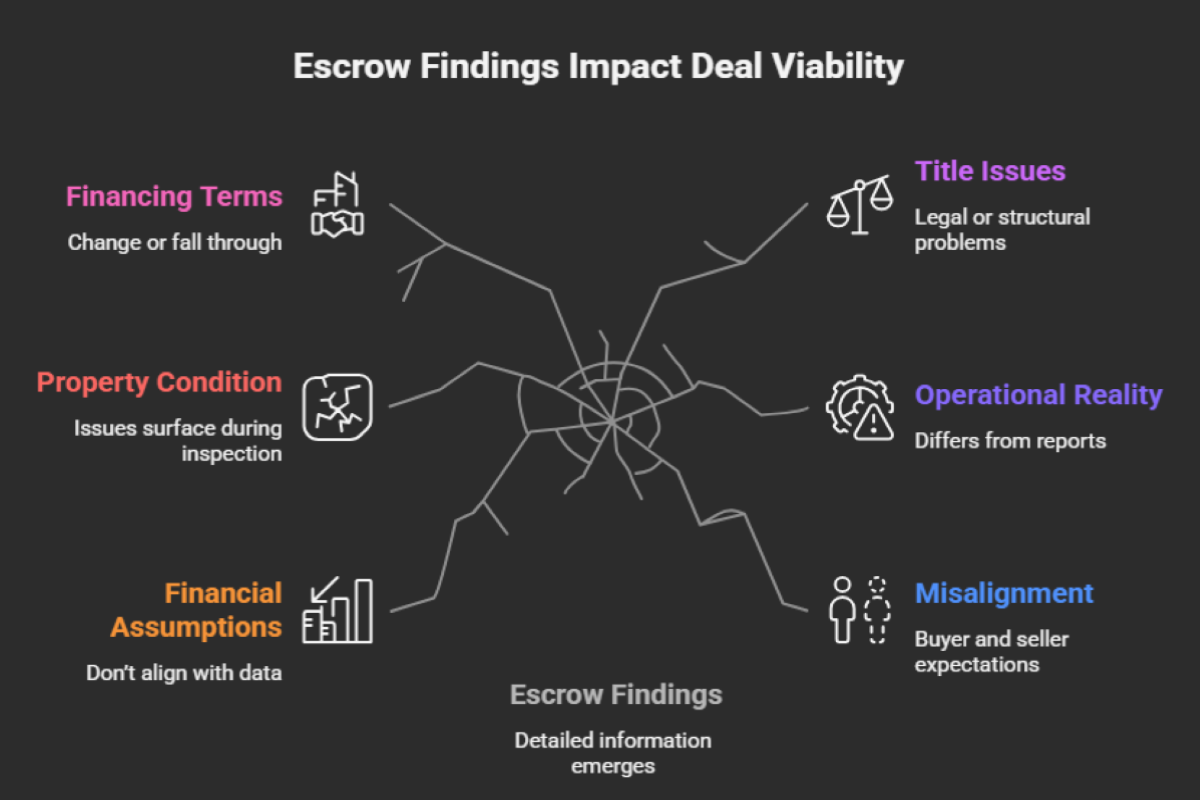
1. Financial Assumptions Don’t Hold Up
One of the most frequent issues arises when early financial assumptions do not align with verified data. Initial underwriting often relies on summarized operating statements, which may not fully reflect irregular expenses, timing differences, or one-time adjustments.
As detailed financials are reviewed, buyers may discover that operating costs are higher than expected, or that income is less stable than originally presented. Rent levels may not be as consistent across units as assumed, or collections may show variability that was not visible in high-level reports.
These discrepancies do not necessarily indicate a problem with the property itself, but they can materially affect how the deal performs under more conservative assumptions. When the numbers no longer support the original structure, the buyer must decide whether to adjust terms or step away.
2. Property Condition Issues Surface
Physical inspections often reveal aspects of the property that were not fully apparent during initial walkthroughs or based on listing materials. Deferred maintenance, aging systems, or inconsistencies across units can introduce additional capital requirements that were not included in early projections.
In some cases, these findings are manageable and can be incorporated into the business plan. In others, the scope or timing of required work may create uncertainty around execution or cash flow. When capital needs increase beyond what was initially anticipated, the overall risk profile of the deal can shift.
This is particularly relevant for properties that appear stable at a surface level but require deeper investment to maintain or improve operations.
3. Financing Terms Change or Fall Through
Financing is often a key component of how a deal is structured, and changes in lending terms can have a direct impact on feasibility. During escrow, lenders conduct their own underwriting, which may lead to different conclusions than the buyer’s initial model.
Loan proceeds may be lower than expected, interest rates may shift, or additional reserves may be required. In some cases, lenders may identify risks that cause them to revise terms or withdraw entirely.
When financing no longer aligns with the assumptions used to structure the deal, it can create gaps that are difficult to bridge without changing pricing, equity structure, or timing.
4. Title, Legal, or Structural Issues
Legal and title reviews can uncover issues that are not visible during the early stages of a transaction. These may include ownership disputes, easements, zoning limitations, or unresolved liens. While some of these issues can be addressed, others may introduce complexity or risk that was not initially considered.
In addition, structural or compliance-related findings such as code violations or permitting issues can require additional time and resources to resolve. These factors may not always prevent a deal from closing, but they can affect how it is structured and whether it remains aligned with the buyer’s criteria.
5. Operational Reality Differs from Reports
A property’s day-to-day operations are often more nuanced than what is reflected in summary reports. During escrow, buyers typically gain access to detailed tenant data, lease files, and collections history, which can reveal patterns not visible at a higher level.
Occupancy may appear stable overall, but fluctuate more than expected at the unit level. Tenant quality, lease terms, and payment behavior can vary in ways that impact operational consistency. In some cases, reported figures may not fully reflect concessions, delinquency, or turnover costs.
These insights help clarify how the property actually performs, which may differ from how it was initially presented.
6. Misalignment Between Buyer and Seller
Even when both parties enter a transaction in good faith, differences can emerge as new information is uncovered. Buyers may request adjustments based on findings during due diligence, while sellers may have different expectations around pricing or responsibility for certain issues.
Timing can also become a factor, particularly if financing, inspections, or documentation take longer than anticipated. If expectations are not aligned, negotiations can stall or break down.
In these situations, the deal does not necessarily fail because of a single issue, but because the parties are unable to reach a structure that works for both sides under the updated understanding of the asset.
Taken together, these factors illustrate a broader point: deals rarely break for a single reason in isolation. More often, they shift as multiple findings begin to affect the same set of assumptions.
The Gap Between Projections and Execution
At the early stage of a deal, projections are used to describe how a property is expected to perform under a defined set of assumptions. These projections provide a structured way to evaluate potential outcomes and compare opportunities. However, projections are not outcomes they are models built on inputs that have not yet been fully tested.
Execution is where those assumptions encounter real conditions.
This gap between projections and execution is one of the primary reasons deals that appear viable early on begin to shift during escrow. What looks consistent in a model often depends on variables that are difficult to control in practice.
For example, projections may rely on assumptions such as:
Rent growth occurring within a specific timeframe
Operating expenses remaining within a defined range
Renovations are being completed on schedule and within budget
Financing terms staying consistent through closing
Each of these may be reasonable in isolation. However, during escrow and beyond, they are tested against actual conditions.
As that testing happens, several realities tend to emerge:
Financial inputs become more precise as detailed records replace summarized data
Operational variability becomes visible, including tenant behavior, turnover, and collections
External constraints appear, such as lender requirements or regulatory considerations
Timing assumptions shift, particularly around renovations, leasing, or approvals
Even small changes in these areas can compound. A modest increase in expenses, combined with a delay in execution or a change in financing, can alter how the deal performs relative to the original model.
Another important distinction is that projections are typically built on normalized scenarios, while execution involves variability. Real properties operate with inconsistencies—maintenance needs arise unpredictably, occupancy fluctuates, and market conditions evolve. These factors are not always fully captured in early-stage models, but they become clearer as due diligence progresses.
This does not mean projections are unreliable. It means they are incomplete until they are tested.
Understanding this distinction helps explain why escrow is not simply a confirmation step. It is a process where assumptions are validated, adjusted, or challenged. When those adjustments materially affect the structure or risk profile of the deal, the path forward may need to change as well.
Why Walking Away From a Deal Is Sometimes the Right Outcome
When a deal does not close, it is often viewed as a negative outcome. However, within the context of a structured transaction process, that is not always the case. Escrow is designed to surface information that was not fully available at the outset, and part of that process involves reassessing whether the deal still meets the original criteria.
In some situations, the most appropriate decision is not to proceed.
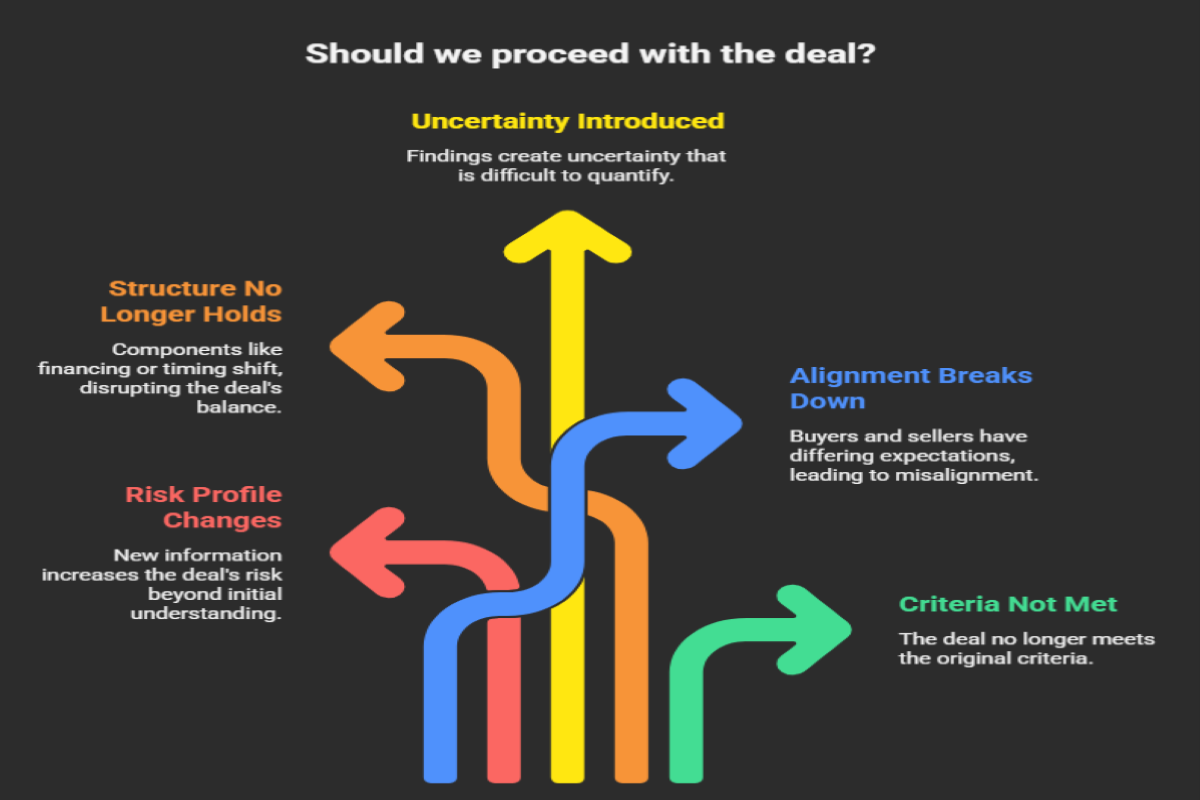
There are several reasons why stepping away from a deal may be the rational outcome:
1. The Risk Profile Changes
As new information becomes available, the overall risk of the deal may increase beyond what was initially understood. This can result from a combination of factors, including higher expenses, additional capital requirements, or variability in operations.
When these changes affect the underlying assumptions in a meaningful way, the deal may no longer align with the original framework used to evaluate it.
2. The Structure No Longer Holds
Deals are typically built around a specific structure that balances price, financing, and operational assumptions. If one of these components shifts, such as loan terms, required reserves, or timing, the structure may no longer function as intended.
In these cases, adjustments may be possible, but not always sufficient to restore alignment.
3. New Information Introduces Uncertainty
Some findings during escrow do not necessarily invalidate a deal, but they introduce uncertainty that is difficult to quantify. This may include incomplete records, inconsistent reporting, or issues that require further investigation without a clear resolution timeline.
When uncertainty cannot be reasonably bounded, it becomes difficult to assess the deal with confidence.
4. Alignment Between Parties Breaks Down
As due diligence progresses, buyers and sellers may interpret findings differently. Requests for adjustments, changes in timelines, or differing expectations around responsibility can lead to misalignment.
If both sides are unable to reach a structure that reflects the updated understanding of the deal, the transaction may not move forward.
5. The Deal No Longer Meets Defined Criteria
Most transactions begin with a set of criteria that guide decision-making. These may relate to financial assumptions, operational thresholds, or risk tolerance. As the deal evolves, it is reassessed against those same criteria.
If it no longer meets them, continuing forward would require changing the standards rather than the deal itself.
Taken together, these outcomes highlight an important point: not all deals are meant to close in their original form. The purpose of escrow is not only to complete transactions, but also to filter them based on a more complete understanding.
How Deals Can Be Evaluated More Carefully Upfront
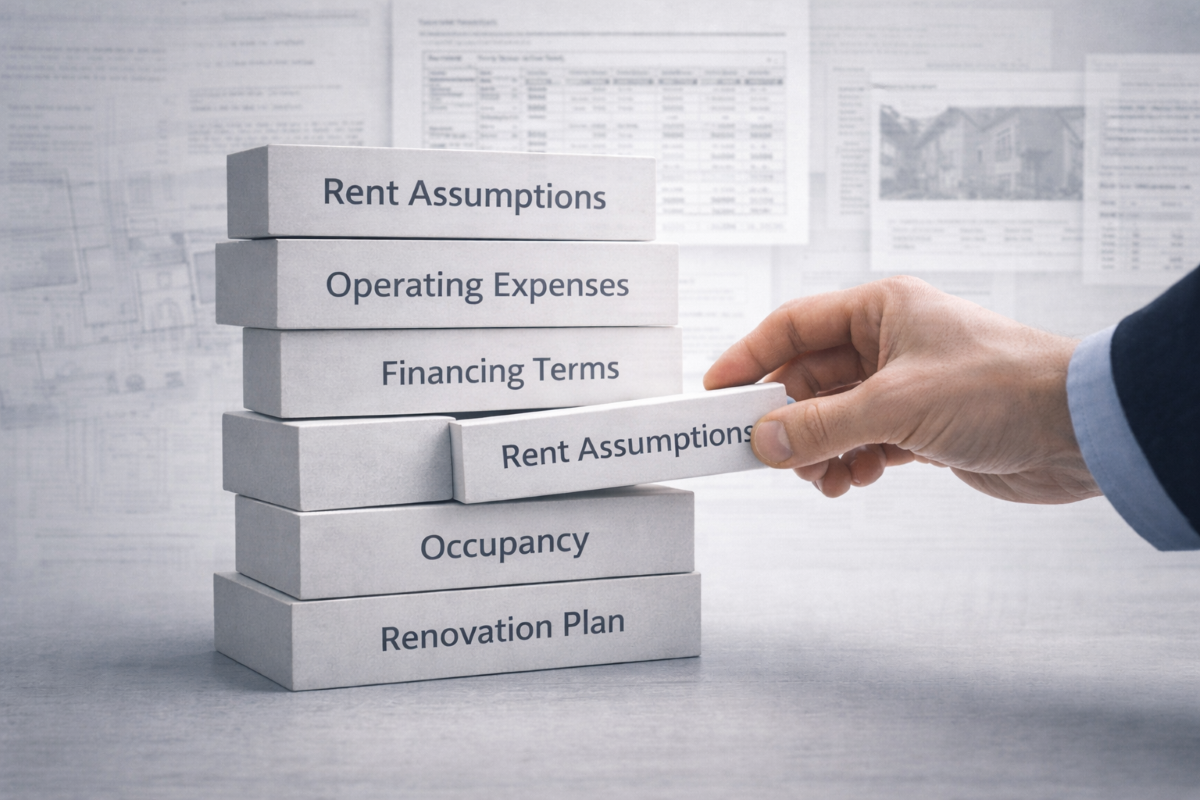
While not every issue can be identified before escrow, a more deliberate approach at the early stage can improve how a deal is understood. The objective is not to remove uncertainty, but to recognize where assumptions are most exposed and where additional verification is likely to change the picture. When that awareness is built in from the beginning, the transition into escrow tends to be more grounded and less reactive.
One of the most important shifts in early evaluation is focusing on assumptions rather than outcomes. Deal materials often emphasize projected performance, but those projections are driven by inputs that may not yet be fully verified. Income figures may be based on current rent rolls without accounting for collection variability. Expense estimates may reflect stabilized operations rather than actual historical fluctuations. By examining how those numbers are constructed, rather than simply accepting the results, it becomes easier to understand what conditions must hold true for the deal to perform as modeled.
It is also useful to identify where the model is most sensitive. Not all variables carry the same weight, and in many cases, a small change in a key assumption can have a disproportionate impact. Rent levels, occupancy consistency, operating costs, and financing terms often sit at the center of this sensitivity. When those variables move, even slightly, the overall structure of the deal can shift with them. Recognizing this early allows for a more realistic interpretation of how stable or fragile the projections may be.
Another layer of clarity comes from understanding what will actually be verified during due diligence. A significant portion of the deal is still provisional at the initial stage. Financial records, lease-level data, physical inspections, and third-party reports all serve to either confirm or challenge the early view of the asset. Approaching the deal with the expectation that these elements may introduce changes helps frame the initial underwriting as a starting point rather than a conclusion.
There is also a distinction between how a deal is presented and how it operates in practice. Summary materials are designed to provide clarity, but they often smooth over inconsistencies that exist at the property level. Day-to-day operations tend to involve variability in tenant turnover, maintenance cycles, and shifting occupancy patterns that are not always visible in high-level reporting. Asking how consistent the underlying performance is over time, rather than how it appears in a snapshot, can reveal a more accurate picture of the asset.
Finally, maintaining consistent evaluation criteria throughout the process plays an important role. As new information becomes available, there can be pressure to reinterpret earlier assumptions in order to keep a deal moving forward. A more disciplined approach involves applying the same standards from start to finish, even when that leads to a different conclusion than initially expected. This consistency helps ensure that decisions are based on the deal itself, rather than on a shifting set of expectations.
Common Misconceptions About Deals That Fall Apart
When a deal does not close, it is often interpreted at face value. However, many of the conclusions people draw about failed transactions are based on incomplete assumptions about how the process works. In practice, deals can fall apart for reasons that are more procedural than problematic.
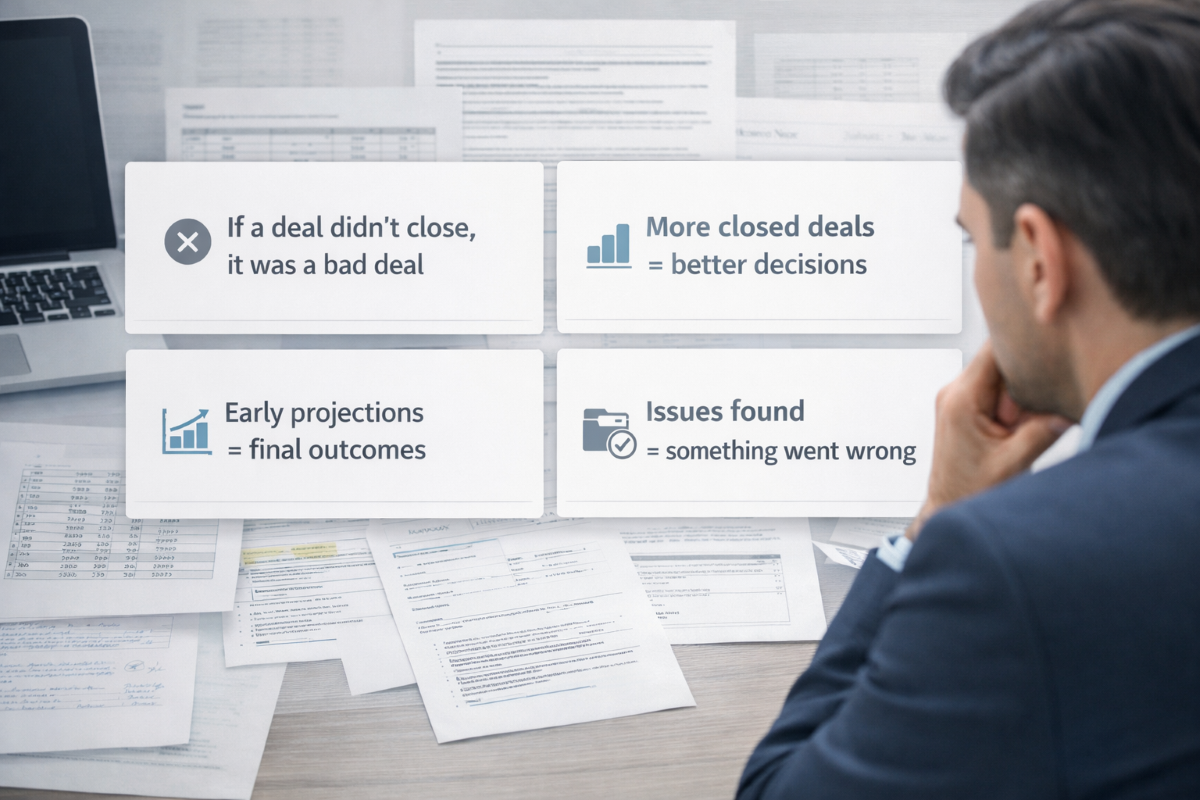
Several misconceptions tend to come up repeatedly:
1. “If a deal didn’t close, it must have been a bad deal.”
This is one of the most common assumptions, but it does not always hold. A deal can appear reasonable at the outset and still fail to meet criteria once additional information becomes available.
In many cases, the issue is not that the deal was fundamentally flawed, but that:
Key assumptions changed after a deeper review
New risks were identified that were not visible early on
The structure is no longer aligned with the original evaluation framework
A deal not closing often reflects a change in understanding, not necessarily a clear-cut defect.
2. “More closed deals mean better decision-making.”
It is easy to assume that a higher closing rate indicates stronger performance. However, closing every deal that enters escrow may also suggest that assumptions are not being meaningfully challenged.
In a structured process, some level of fallout is expected because:
Not all assumptions will hold under scrutiny
New constraints emerge during financing and due diligence
Some deals no longer meet the criteria once fully evaluated
A process that includes reassessment and occasionally results in walking away can indicate that decisions are being made based on updated information rather than momentum.
3. “Early projections are reliable indicators of final outcomes.”
Initial projections are often treated as if they represent a likely outcome, but they are better understood as a starting point. They reflect how a deal could perform under a specific set of assumptions, not how it will perform in practice.
During escrow, those assumptions are tested through:
Detailed financial verification
Operational review at the tenant and unit level
Independent third-party assessments
Lender underwriting and constraints
As this process unfolds, it is common for projections to be adjusted to reflect a more complete picture.
4. “Issues found during escrow mean something went wrong.”
Findings during escrow are sometimes interpreted as unexpected problems, but the process is specifically designed to uncover details that are not visible at the outset.
These findings may include:
Variations in financial performance
Physical conditions that require attention
Legal or structural complexities
Operational inconsistencies
Rather than signaling failure, these discoveries are part of how the deal is fully understood before a final decision is made.
Taken together, these misconceptions often come from viewing a deal as static, when in reality it evolves as more information becomes available. Escrow is not just a step in the process; it is where that evolution becomes visible.
Escrow as a Filter, Not a Failure Point
It is common to view escrow as a step that leads directly to closing, but in practice, it functions more as a filtering process. The purpose is not only to complete transactions, but to ensure that decisions are made with a more complete and verified understanding of the deal.
As information is tested and validated, the original view of the opportunity becomes more refined. In some cases, that refinement confirms the initial assumptions, and the deal proceeds with greater clarity. In others, it leads to adjustments in pricing, structure, or timelines. And in some situations, it results in a decision not to move forward.
These outcomes are all part of the same process.
What changes during escrow is not necessarily the deal itself, but the level of detail behind it. Early-stage materials provide a framework for evaluation, while due diligence fills in the gaps. That progression naturally introduces points where expectations are either confirmed or challenged.
Understanding escrow in this way helps reframe how deals are evaluated overall. Rather than viewing a deal as successful only if it closes, it becomes more accurate to see the process as one of continuous validation. Each stage adds information, and each decision reflects a more complete picture than the one before it.
In that context, deals that do not close are not interruptions to the process; they are outcomes of it.


