

Why Exit Strategy Planning Matters Before a Real Estate Acquisition
The Exit Is Not the Last Step
Many high-income professionals eventually realize that earning more income and building more wealth are not always the same thing.
A commission check comes in. A bonus hits. The income looks strong on paper. But taxes, market volatility, family expenses, and limited time can make the larger financial picture feel less clear than it should.
That is often when private real estate starts to get attention.
A colleague mentions a multifamily investment. A podcast talks about passive real estate. Someone in your network brings up depreciation, distributions, or private equity real estate. The numbers may look interesting. The property may sound credible. The sponsor may seem experienced.
But before focusing on projected returns, preferred returns, or potential tax considerations, there is one question worth asking early:
How does this investment plan return the investor's capital?
That question is the heart of a real estate exit strategy.
This article is for educational purposes only and should not be read as investment, tax, legal, or financial advice. Private real estate investments involve risk, including market risk, sponsor risk, financing risk, liquidity risk, execution risk, and exit risk. Investors should review offering documents and consult qualified tax, legal, and financial advisors before making any investment decision.
A real estate exit strategy is not something to figure out at the end of the investment. It should shape the acquisition from the beginning. It can influence the purchase price, financing, business plan, hold period, tax considerations, projected outcomes, and risk profile.
For passive investors, especially busy medical sales and healthcare professionals, understanding the exit strategy does not mean becoming the operator. It means knowing enough to evaluate the sponsor’s assumptions, ask better questions, and understand how the investment may fit within a broader wealth-building strategy.
What Is a Real Estate Exit Strategy?
A real estate exit strategy is the plan for how an investment is expected to return capital to investors.
In commercial real estate, the exit may happen through a sale, refinance, recapitalization, long-term hold, or another structure, depending on the asset, business plan, investor agreements, and market conditions. Each exit path can carry different timing, liquidity, tax, and risk considerations.
For passive investors, the important detail is this: You are usually not the person executing the exit.
The sponsor or operator is responsible for managing the asset, carrying out the business plan, monitoring market conditions, and evaluating when an exit may make sense under the terms of the investment structure. That is why investors should understand the sponsor’s exit plan before participating.
A clear real estate exit strategy helps answer practical questions:
What is the expected hold period?
Is the plan to sell, refinance, hold longer, or consider another option?
What has to happen before the property may be ready for exit?
What assumptions drive the projected exit value?
What risks could delay or change the plan?
How could the exit affect distributions, return of capital, and tax planning?
The exit strategy is not a guarantee. It is a plan based on assumptions. Actual outcomes may differ if property performance, interest rates, buyer demand, financing terms, or broader market conditions change.
That does not make the exit strategy less important. It makes it more important.
For investors evaluating a private real estate opportunity, the goal is not to become a full-time underwriter. The goal is to understand how the investment is supposed to work, where risk may show up, and what questions are worth asking before capital is committed
Why the Exit Strategy Should Be Considered Before Acquisition
A thoughtful real estate exit strategy starts before the acquisition closes.
That may sound backward at first. Many investors think of acquisition as the beginning and exit as the end. In practice, the two are connected. The way a sponsor plans to exit can influence what the sponsor pays for the asset, how the deal is financed, what improvements are prioritized, and how investor returns are projected.
A real estate acquisition is not only a purchase decision. It is a business plan.
Before acquiring a multifamily or commercial real estate asset, a sponsor should have a clear view of how value may be created and how that value may eventually be realized. The exit strategy helps connect those two points.
For example, a sponsor planning to sell after five years may underwrite the deal differently than a sponsor planning to hold the asset for long-term income. The renovation plan may be different. The debt structure may be different. The reserve strategy may be different. Even the purchase price may be different.
A well-considered exit strategy can help investors evaluate:
● What has to happen for the business plan to work?
● How long may capital be illiquid?
● Does the deal depend more on income growth, market appreciation, refinancing, or a sale?
● What assumptions are driving the projected outcomes?
● What could happen if market conditions change?
This is especially important for passive investors. You may not be managing tenants, negotiating with lenders, or deciding when to sell. But you still need to understand the logic behind the plan.
The goal is not to predict the future with certainty. No sponsor can do that. The goal is to evaluate whether the sponsor has thought through the path from acquisition to exit with discipline.
A strong exit strategy should not feel like an afterthought added to the end of a presentation. It should be visible throughout the investment thesis, including the acquisition price, financing approach, hold period, business plan, and risk discussion.
That is one reason Greener Path Capital emphasizes disciplined opportunity review. Before an opportunity is presented, the firm’s process includes reviewing the sponsor, operator, market, business plan, capital structure, assumptions, risks, fees, reporting standards, and exit strategy. This type of review can help reduce blind spots, but it does not remove investment risk.
Exit Strategy Influences the Purchase Price

The exit strategy can affect what a sponsor is willing to pay for a property.
That matters because the purchase price is one of the first risk points in a real estate acquisition. If the sponsor pays too much at the beginning, the business plan has less room for error later.
A sponsor usually does not evaluate a property based only on what it is worth today. They also consider what the property may be worth after the business plan is executed. That future value is often tied to assumptions about income growth, expense control, market demand, financing conditions, and the eventual exit.
For example, if a sponsor believes a multifamily property can increase net operating income through renovations, better management, higher occupancy, or improved expense controls, that may support a higher purchase price. The key question is whether those assumptions are reasonable.
This is where passive investors should slow down and look carefully.
If the projected exit value depends on aggressive rent growth, a favorable sale market, lower future interest rates, or a compressed exit cap rate, the projected returns may be more sensitive than they first appear. A small change in exit assumptions can affect the estimated sale price and investor outcomes.
Growth assumptions are not automatically a problem. Many real estate business plans are built around improving an asset over time. The issue is whether the purchase price leaves enough margin for the plan to absorb delays, cost increases, financing changes, or a softer exit market.
A disciplined sponsor should be able to explain why the acquisition price makes sense based on today’s conditions, not only a best-case exit scenario.
For passive investors, the practical question is:
Did the sponsor buy the asset with enough discipline to give the business plan room to work?
That question is more useful than asking whether the deal looks attractive on a slide.
Projections are based on assumptions and are not guarantees. Actual results may differ if property performance, financing conditions, expenses, or market demand change.
A thoughtful exit strategy helps reveal whether the sponsor is underwriting with discipline or relying too heavily on a future sale to make the acquisition look better today.
Exit Strategy Shapes the Business Plan
A real estate acquisition is not just about buying the property.
It is about executing a plan.
The exit strategy helps define that plan. A sponsor who plans to sell after improving the asset may make different decisions than a sponsor planning to hold the property for long-term income. The timeline changes. The renovation plan changes. The financing strategy changes. The way risk is managed may also change.
For example, in a multifamily investment, a shorter-term value-add plan may focus on improving operations within a defined window. That could include renovating units, increasing occupancy, adjusting rents where the market supports it, improving expense controls, or completing deferred maintenance.
A longer-term hold may focus more on durable cash flow, tenant retention, capital reserves, and steady property management.
Neither approach is automatically better.
Each approach has trade-offs.
A shorter hold period may create a clearer timeline, but it may depend more heavily on market conditions at the time of sale. A longer hold may give the sponsor more flexibility, but it can also keep investor capital illiquid for a longer period.
This is why investors should understand how the exit strategy connects to the business plan.
Questions worth asking include:
● What has to happen before the asset is ready for exit?
● Is the plan based mainly on operational improvements, market appreciation, or refinancing?
● What timeline is assumed?
● What could delay the plan?
● What happens if the property performs well, but the market is not attractive for a sale?
A strong business plan should not depend on one perfect outcome. It should explain the intended path and the risks that could affect it.
For passive investors, the goal is not to become the asset manager. The goal is to understand whether the sponsor’s plan is logical, disciplined, and clear enough to evaluate before investing.
The exit strategy gives you a better view of that plan.
Exit Strategy Affects Financing Decisions
Debt can support a real estate business plan, but it can also create pressure if the timing does not align with the exit strategy.
That is why financing should not be reviewed separately from the exit. The loan terms, maturity date, interest rate, reserve requirements, and refinancing assumptions can all influence whether the exit plan is realistic.
For example, a sponsor may plan to renovate and stabilize a multifamily property over five years. If the debt matures in three years, the sponsor may need to refinance or sell before the full business plan has had time to mature. That can create risk if interest rates are higher, lender standards are tighter, or the property has not performed as expected.
The same issue can appear when a deal depends heavily on refinancing.
A refinance may allow the sponsor to replace existing debt, adjust the capital structure, or potentially return some capital to investors. But refinancing is not guaranteed. It depends on property performance, market value, lender appetite, interest rates, and the broader capital markets.
Passive investors should understand whether the exit plan relies on a sale, refinance, or both.
Questions worth asking include:
● What type of debt is being used?
● When does the loan mature?
● Does the loan maturity match the expected hold period?
● Is the interest rate fixed or variable?
● What assumptions are being made about refinancing?
● What happens if refinancing is not available on attractive terms?
● What happens if the sponsor needs to hold the asset longer than planned?
These questions do not require you to become a debt expert. They help you understand whether the financing structure supports the business plan or adds pressure to it.
A disciplined sponsor should be able to explain how the debt fits the strategy and what risks investors should understand. The stronger answer is not “we are confident the refinance will work.” The stronger answer explains the assumptions, the backup options, and the factors being monitored.
Financing risk is part of real estate investing. It cannot be removed completely. But it can be evaluated before acquisition, and it should be considered before an investor commits capital.
Exit Strategy Sets Investor Expectations
A real estate exit strategy helps investors understand the expected timeline of the investment.
That matters because private real estate is usually illiquid. Unlike publicly traded investments, investors may not be able to sell their position whenever they want. Capital may be committed for several years, depending on the structure, business plan, market conditions, and sponsor decisions.
For busy professionals, this is practical. Capital tied up longer than expected can affect cash reserves, family planning, tax planning conversations, and other financial priorities.
A clear explanation should address:
● What is the expected hold period?
● Is the plan to sell, refinance, hold, or consider multiple paths?
● What milestones need to happen before the exit?
● What could delay the exit?
● How will investor updates be handled if the timeline changes?
● What risks could affect the return of capital?
This is where clarity matters more than optimism.
A sponsor may believe a five-year exit is reasonable. But investors should understand that five years is still an assumption, not a guarantee. The actual timeline may change if interest rates, lending conditions, property performance, buyer demand, expenses, or broader market conditions shift.
That does not mean a longer timeline is always negative. Sometimes holding longer may be more responsible than selling into a weak market. But investors should understand that possibility before committing capital.
A strong exit strategy gives investors a clearer view of the road ahead.
It does not promise a specific outcome. It helps set realistic expectations around timing, liquidity, risk, and decision-making. That is especially important for investors who want passive exposure to real estate without treating the investment like another full-time job.
The Risk of Treating the Exit as an Afterthought
A vague exit plan can make a private real estate opportunity harder to evaluate.
The issue is not that every detail must be known in advance. Real estate involves uncertainty. Market conditions, financing terms, and property performance can all change.
The issue is whether the sponsor has thought through those possibilities before acquisition.
When the exit is treated as an afterthought, several risks become harder to see.
Projected returns may depend too heavily on a favorable sale. A deal may look attractive because the final sale price assumes strong buyer demand, continued rent growth, lower future interest rates, or a more favorable cap rate environment. If those assumptions change, the projected investor outcome may change as well.
Timing can also become a problem. If the market is not ready when the sponsor wants to sell, the sponsor may need to hold longer, refinance, or adjust the strategy. That may be reasonable in some situations, but investors should understand that possibility before participating.
Debt can create another pressure point. If a loan matures before the property is ready for sale or refinance, the sponsor may face fewer options. That can affect distributions, capital return timing, and overall investment performance.
Tax planning may also become more complicated. A sale, refinance, or recapitalization can create different tax considerations. Commercial real estate may offer tax advantages for some investors, depending on the structure and the investor’s situation, but investors should not assume a specific result. A CPA or tax advisor should help evaluate how any opportunity may affect an investor’s specific tax picture.
For passive investors, the practical concern is simple:
If the exit plan is unclear, it becomes harder to understand the full risk of the investment.
A strong exit strategy does not remove risk. It helps bring the risk into view before capital is committed. That is the difference between being impressed by a projection and understanding the assumptions behind it.
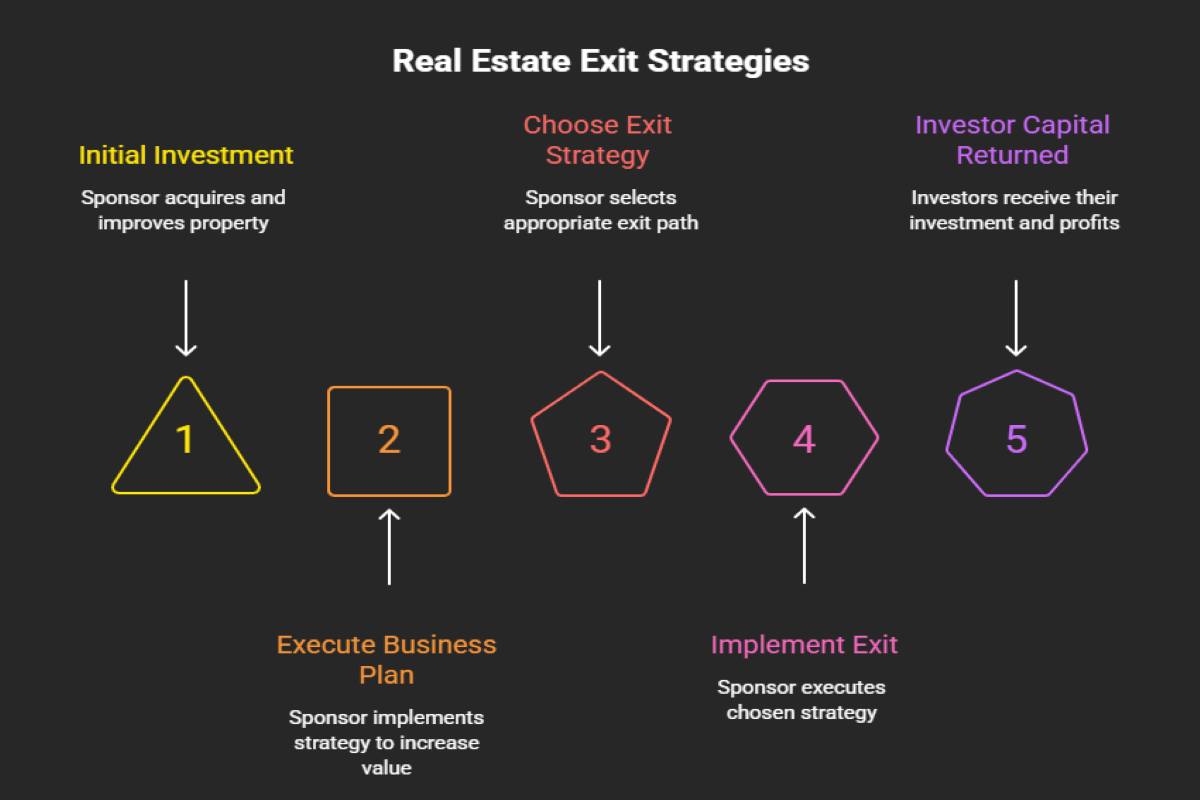
Common Real Estate Exit Strategies Investors Should Understand
Most real estate exit strategies fall into a few broad categories.
The right strategy depends on the asset, sponsor, financing structure, market conditions, investor agreements, and business plan. No exit path is automatically better than another. Each one carries different trade-offs around timing, liquidity, risk, tax considerations, and control.
For passive investors, the goal is not to choose the exit strategy personally. The goal is to understand what the sponsor is planning, why that path makes sense, and what could change along the way.
Sale
A sale is one of the most common exit strategies.
In this scenario, the sponsor executes the business plan and eventually sells the property to another buyer. That buyer might be another real estate operator, a private investor group, an institutional buyer, or another sponsor.
A sale may make sense when the asset has been improved, income has increased, occupancy has stabilized, or the market supports attractive pricing. It may also make sense if the sponsor believes investor capital can be returned and potentially redeployed into future opportunities.
The risk is that sale timing depends on market conditions. If buyer demand weakens, interest rates rise, financing becomes harder to obtain, or property performance falls short, the sale may take longer or happen at a lower price than originally projected.
Refinance
A refinance happens when the sponsor replaces existing debt with new debt.
In some cases, a refinance may allow the sponsor to return part of investor capital while continuing to hold the asset. This usually depends on property value, lender appetite, interest rates, loan terms, and the asset’s operating performance.
A refinance can be a useful tool, but it should not be treated as automatic. If interest rates are higher than expected or lenders become more conservative, the refinance may be less attractive than originally projected.
Passive investors should ask whether projected returns depend heavily on refinancing. If they do, the sponsor should explain the assumptions behind that plan and what happens if refinancing is not available on favorable terms.
Long-Term Hold
A long-term hold strategy means the sponsor keeps the asset rather than selling quickly.
This may make sense when the property generates stable income, the market has long-term strength, or selling in the current environment would not support the investment thesis. Holding longer can sometimes give the sponsor more flexibility, especially during uncertain markets.
The trade-off is liquidity.
If the asset is held longer than expected, investor capital may remain tied up longer as well. That may be acceptable for some investors and problematic for others, depending on their goals, cash needs, and time horizon.
A long-term hold should still be intentional. “We will hold if we cannot sell” is not the same as having a thoughtful long-term ownership strategy.
Recapitalization
A recapitalization changes the investment’s capital structure.
This may involve bringing in new equity, replacing part of the existing ownership, restructuring debt, or creating a path for some investors to exit while others remain invested.
A recapitalization can provide flexibility, but investors should understand the details clearly. Important considerations may include valuation, fees, investor rights, decision-making authority, tax considerations, and whether participation is optional or required under the investment documents.
Because recapitalizations can be more complex, investors should review the offering documents carefully and consult qualified advisors when needed.
Tax-Aware Reinvestment Strategies
Some real estate exit strategies may involve tax-aware planning, such as a 1031 exchange or another reinvestment approach, depending on the structure.
This area requires caution.
Not every private real estate investment gives each passive investor direct control over tax planning at exit. The structure of the investment matters. The entity documents matter. The investor’s personal situation matters.
Commercial real estate may offer tax advantages for some investors, depending on the structure and circumstances. But investors should not assume a specific tax outcome. A CPA or tax advisor should help evaluate how a sale, refinance, recapitalization, or reinvestment strategy may affect their specific tax picture.
The larger point is simple.
The exit strategy should be understandable before the investment begins. If a sponsor cannot clearly explain the intended exit path, the assumptions behind it, and the risks that could affect it, investors should slow down and ask more questions.
How Exit Strategy Planning Reveals Sponsor Discipline

For passive investors, the exit strategy can reveal a lot about the sponsor’s discipline.
A strong sponsor should be able to explain more than the property, the projected return, or the general market opportunity. They should be able to explain how the investment is expected to move from acquisition to execution to exit.
That explanation does not need to be complicated. In fact, the clearer it is, the better.
A disciplined sponsor should be able to explain:
● What is the intended exit strategy?
● Why does that exit strategy fit the asset?
● What buyer may want the property later?
● What operational milestones need to happen first?
● What assumptions drive the projected exit value?
● How does the debt structure support the timeline?
● What risks could delay the exit?
● What backup options may be available if the original plan changes?
This kind of clarity matters because passive investors are relying on the sponsor and operator to execute the plan. You may not be the one managing the property, negotiating with lenders, or deciding when to sell. But your capital is still exposed to the quality of those decisions.
A vague exit plan can be a warning sign.
That does not mean the sponsor must know exactly what the market will look like three, five, or seven years from now. No one can know that. But the sponsor should be able to explain the assumptions they are using and how they are thinking about risk.
For example, there is a difference between saying:
“We plan to sell in five years at a strong valuation.”
And saying:
“Our base case assumes a five-year hold. The exit value depends on increasing net operating income through occupancy improvements and expense management. We are underwriting a more conservative exit cap rate than today’s market, and if sale pricing is not attractive at that time, we may consider holding longer or evaluating refinancing options depending on debt terms and market conditions.”
The second answer gives investors more to evaluate.
It shows the sponsor is thinking through the relationship between operations, market conditions, debt, and investor outcomes. It also creates a more balanced conversation around what could go right and what could make the plan harder.
This is one reason sponsor due diligence should include exit strategy review. Greener Path Capital partners with carefully vetted multifamily and commercial real estate sponsors and operators who meet the firm’s due diligence standards. Before presenting an opportunity, that review may include the sponsor, operator, market, business plan, capital structure, assumptions, risks, fees, reporting standards, and exit strategy.
Sponsor review can help reduce blind spots, but it does not remove investment risk. Investors should still review offering documents, understand the structure, and ask questions before participating.
A good exit strategy does not guarantee a good outcome. But it can show whether the sponsor is approaching the acquisition with discipline, transparency, and a realistic view of the path ahead.
Key Exit Assumptions Passive Investors Should Review

A passive investor does not need to build the full underwriting model.
But you should understand the main assumptions that influence the exit strategy. These assumptions help explain how the sponsor expects the investment to work, what could affect projected outcomes, and where risk may appear if conditions change.
The goal is not to memorize every number. The goal is to understand which assumptions matter most.
Hold Period
The hold period is the estimated length of time the sponsor expects to own the asset before selling, refinancing, recapitalizing, or pursuing another exit.
Investors should understand whether the hold period is based on the business plan, debt maturity, market timing, tax considerations, or a combination of factors.
A five-year hold, for example, is not a promise. It is an assumption. The actual timeline may change if property performance, financing conditions, or buyer demand shift.
Exit Cap Rate
The exit cap rate is one of the most important assumptions in many commercial real estate projections.
A cap rate helps estimate property value based on net operating income. If the projected exit cap rate is too aggressive, the projected sale value may look stronger than it should.
Investors should ask whether the sponsor is using a conservative, reasonable, or aggressive exit cap rate compared with current market conditions and historical trends.
Net Operating Income Growth
Net operating income, or NOI, is the income a property generates after operating expenses, before debt service.
Many exit strategies depend on increasing NOI through better occupancy, rent growth, expense control, renovations, or improved management. Investors should understand what is expected to drive NOI growth and whether those assumptions are realistic.
If the business plan requires strong NOI growth, investors should also understand what happens if that growth takes longer than expected.
Buyer Demand
A sale depends on someone else being willing and able to buy the asset later.
Buyer demand can be affected by interest rates, lending conditions, asset performance, market sentiment, local supply, and broader economic conditions.
Investors should ask who the likely future buyer may be and why that buyer would want the property when the sponsor plans to exit.
Debt and Refinancing Conditions
Debt assumptions can affect both the business plan and the exit.
Investors should understand the loan maturity, interest rate structure, refinancing assumptions, and whether the debt timeline supports the expected hold period.
If the exit strategy depends on refinancing, investors should ask what happens if refinancing is not available on favorable terms.
Exit Costs
Selling or refinancing a property is not free.
Exit costs may include broker fees, legal expenses, lender fees, closing costs, taxes, reserves, and other transaction-related expenses. These costs can affect the amount of capital returned to investors.
Investors should understand whether exit costs are included in the projections and how sensitive the projected outcome may be if those costs are higher than expected.
The larger point is simple: exit assumptions deserve careful review because they can materially affect projected outcomes. Projections are based on assumptions and are not guarantees. Actual results may differ if property performance, market conditions, financing terms, expenses, or buyer demand change.
What Happens If the Original Exit Plan Does Not Work?
Not every exit plan works exactly as expected.
That does not automatically mean the investment has failed. It means the sponsor may need to evaluate the available options based on property performance, debt terms, market conditions, and investor agreements.
This is why contingency planning matters.
Before investing, passive investors should understand what alternatives may be available if the original exit plan changes. Depending on the structure and circumstances, the sponsor may consider:
● Holding the asset longer
● Refinancing the debt
● Adjusting the business plan
● Delaying a sale until market conditions improve
● Recapitalizing the investment
● Selling at a different valuation than originally projected
Each option comes with trade-offs.
Holding longer may give the sponsor more time, but it can also extend the period when investor capital is illiquid. Refinancing may create flexibility, but only if lender terms are available and support the business plan. A recapitalization may provide another path, but it can introduce additional complexity around valuation, fees, investor rights, and tax considerations.
The important question is not whether the sponsor has a perfect backup plan.
The important question is whether the sponsor has thought through realistic alternatives before capital is committed.
Investors should ask:
● What happens if the asset cannot be sold within the original hold period?
● What happens if refinancing is not available on favorable terms?
● What happens if the projected exit value is lower than expected?
● What happens if the sponsor needs to hold the asset longer?
● How will investors be updated if the exit plan changes?
● What decisions require investor approval under the operating documents?
A strong sponsor should be able to explain the intended exit path and the factors that could change that path. They should also be able to explain how decisions will be communicated if the original plan no longer fits the market.
Exit flexibility does not remove risk. But it can help investors understand how the sponsor may respond if the original plan needs to change.
Questions to Ask About Exit Strategy Before Investing
Before reviewing projected returns, investors should understand how the sponsor expects the investment to exit.
These questions can help make the exit strategy clearer:
Questions About the Exit Plan
● What is the intended exit strategy?
● Is the plan to sell, refinance, recapitalize, hold long term, or consider multiple options?
● Why does this exit strategy fit the asset and business plan?
● What needs to happen before the property is ready for exit?
● What could cause the sponsor to change the original exit plan?
Questions About Timing and Liquidity
● What is the expected hold period?
● How long may investor capital be illiquid?
● What could delay the exit?
● What happens if the sponsor needs to hold the property longer than planned?
● How will investors be updated if the timeline changes?
Questions About Assumptions
● What assumptions drive the projected exit value?
● What exit cap rate is being used?
● What level of net operating income growth is assumed?
● How sensitive are projected outcomes to changes in rent growth, expenses, cap rates, or interest rates?
● Are the projections based more on operational improvements or favorable market conditions?
Questions About Debt and Refinancing
● What type of debt is being used?
● When does the loan mature?
● Does the debt timeline support the expected hold period?
● Does the business plan depend on refinancing?
● What happens if refinancing is not available on favorable terms?
Questions About Risk and Backup Options
● What are the main risks that could affect the exit?
● What happens if buyer demand is weaker than expected?
● What happens if the projected sale price is lower than originally modeled?
● What backup options has the sponsor considered?
● Which decisions require investor approval under the operating documents?
Questions About Taxes and Advisors
● Could the exit create tax considerations investors should discuss with a CPA or tax advisor?
● Are there potential tax implications from a sale, refinance, recapitalization, or reinvestment strategy?
● What documents should investors review with their tax, legal, or financial advisors before making a decision?
These questions are not designed to predict the future. They are designed to reveal how clearly the sponsor has thought through the path from acquisition to exit.
A strong exit strategy should make the investment easier to understand, not harder. If the sponsor cannot explain the exit plan, the assumptions behind it, and the risks that could affect it, investors should slow down and ask for more clarity before committing capital.
How Exit Planning Fits Into a Broader Wealth-Building Strategy
Exit planning matters because private real estate is usually part of a longer-term wealth-building strategy, not a short-term transaction.
Before investing, investors should understand how the expected exit timeline fits with their broader financial picture. That includes liquidity needs, tax planning conversations, cash reserves, family priorities, investment goals, risk tolerance, and time horizon.
A real estate opportunity may look interesting on paper, but the hold period and exit strategy still need to fit the investor’s situation. Capital that may be illiquid for several years should be evaluated differently than capital needed for near-term expenses or flexibility.
This is especially important when an investment involves tax considerations.
Commercial real estate may offer tax advantages for some investors, depending on the structure and the investor’s circumstances. But tax outcomes are not automatic, and they can vary based on the investment structure, entity documents, timing of the exit, and the investor’s personal situation.
That is why investors should involve qualified advisors when evaluating a private real estate opportunity.
Questions worth discussing may include:
● How long can this capital remain illiquid?
● How does the expected hold period fit with broader financial goals?
● What role could passive real estate play within the overall investment strategy?
● What risks should be understood before investing?
● How could a sale, refinance, recapitalization, or reinvestment affect tax planning?
● What should be reviewed with a CPA, attorney, or financial advisor before making a decision?
The goal is not to treat the exit strategy as a prediction. The goal is to understand how the investment may work, what assumptions are involved, and how the exit plan fits within a larger financial framework.
A thoughtful exit strategy helps investors evaluate more than the potential outcome. It helps them understand timing, liquidity, risk, tax considerations, and whether the opportunity deserves further review.
A Better Exit Starts With Better Questions
A real estate exit strategy is not just the final step in an investment. It is part of the decision from the beginning.
Before a property is acquired, the sponsor should understand how value may be created, how that value may eventually be realized, and what risks could affect the path from acquisition to exit.
For passive investors, the exit strategy helps clarify important questions:
● How long may capital be illiquid?
● What has to happen for the business plan to work?
● What assumptions drive the projected exit value?
● What risks could delay or change the plan?
● What happens if the original exit strategy no longer fits the market?
These questions do not eliminate risk. They help investors evaluate the opportunity with more clarity.
For busy medical sales and healthcare professionals, that clarity matters. You may not have time to underwrite every deal yourself or manage real estate directly. But you can understand the sponsor’s plan, the assumptions behind it, and the questions worth asking before capital is committed.
At Greener Path Capital, exit strategy review is part of a broader commitment to disciplined opportunity evaluation, sponsor due diligence, risk awareness, and clear investor education. The goal is not to predict the future with certainty. The goal is to help investors understand how an opportunity is structured, where risk may appear, and whether the investment deserves further review.
If you are evaluating passive real estate investing and want a clearer way to understand sponsor strategy, risk, and exit planning, you can join the Greener Path Capital investor list or schedule an investor introduction call to learn more.
Private real estate investments involve risk, including market risk, sponsor risk, financing risk, liquidity risk, execution risk, and exit risk. Projected outcomes are based on assumptions and are not guarantees. This content is for educational purposes only and should not be read as investment, tax, legal, or financial advice. Investors should review all offering documents and consult qualified tax, legal, and financial advisors before making any investment decision.


