

How to Evaluate a Real Estate Fund-of-Funds Manager Before Investing
A real estate fund of funds can reduce the amount of research you have to do on individual properties, sponsors, and investment funds. But it does not remove the need for due diligence.
It changes where that due diligence needs to happen.
Instead of asking only, “Is this property a good investment?” you also need to ask, “Who is deciding which funds make it into the portfolio, and how are those decisions being made?”
That distinction matters because a fund-of-funds manager may be responsible for evaluating underlying fund managers, comparing strategies, reviewing risks and fees, constructing the portfolio, and monitoring those investments over time.
For a busy healthcare professional, that structure can make private-market investing easier to navigate. But delegation should not become blind trust.
Before investing, you should understand the manager’s process, incentives, responsibilities, and limits.
This article breaks down the key areas worth evaluating so you can ask better questions before considering a real estate fund-of-funds investment.
Why the Manager Matters in a Fund-of-Funds Structure

In a direct real estate investment, you may spend most of your time evaluating the property, market, operator, and business plan.
A fund of funds adds another layer.
If you want a broader explanation of how that structure works, read our guide to real estate fund-of-funds investing for healthcare professionals.
Your capital is invested through a fund that then allocates money to one or more underlying funds managed by other sponsors or investment managers. That means the fund-of-funds manager plays a central role in deciding where capital is placed, how different strategies fit together, and which risks are acceptable.
Their responsibilities may include:
Reviewing potential fund managers and sponsors
Evaluating investment strategies and fund structures
Comparing fees, leverage, liquidity, and expected hold periods
Assessing how each underlying fund fits within the broader portfolio
Monitoring managers and investments after capital has been allocated
Communicating material developments to investors
This is why evaluating a fund of funds is different from evaluating a single real estate deal.
You are still exposed to the risks of the underlying investments. But you are also relying on another team’s judgment to select, combine, and monitor those investments.
For investors with limited time, that delegation may be part of the appeal. The important question is whether the manager has a clear, disciplined process behind those decisions.
1. Understand What the Manager Is Actually Responsible For
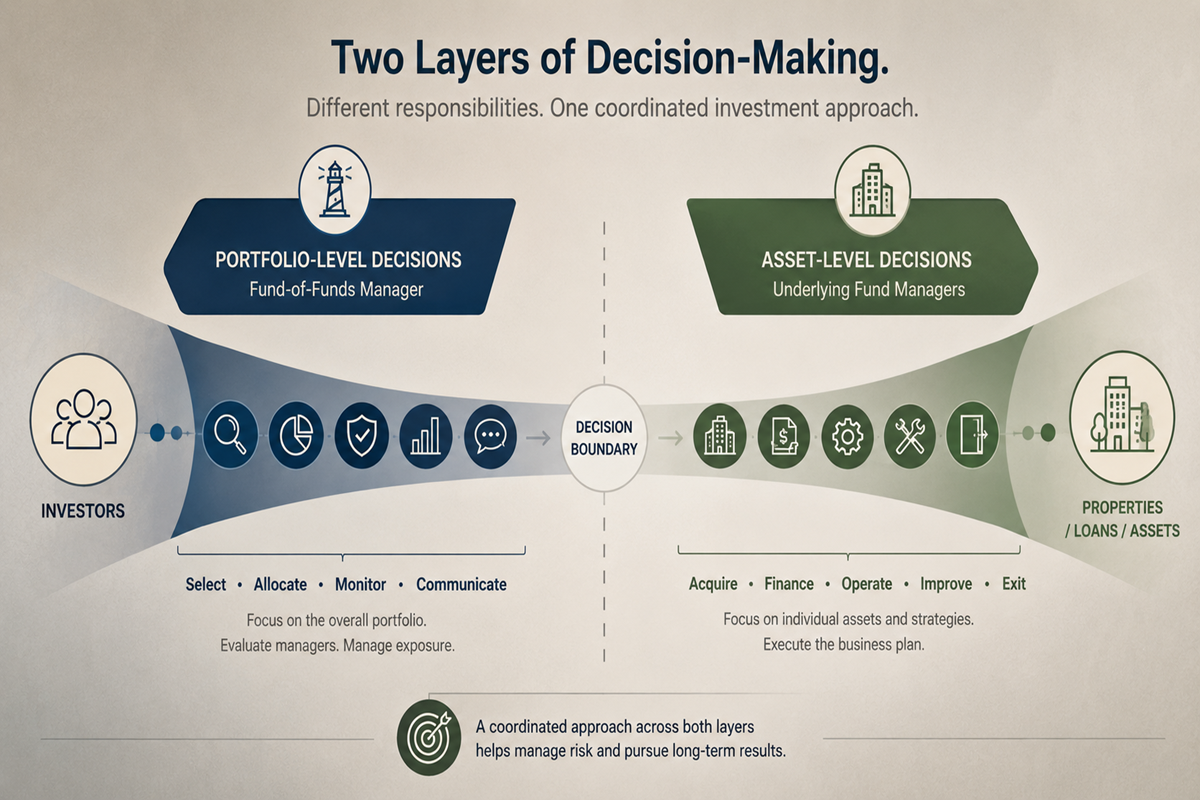
Before evaluating a fund-of-funds manager, make sure you understand what that manager controls and what remains in the hands of the underlying fund sponsors.
A fund-of-funds manager may be responsible for selecting underlying funds, deciding how capital is allocated, reviewing sponsor quality, monitoring portfolio exposure, and communicating updates to investors.
But that does not mean the manager controls every property-level decision.
The underlying sponsors or fund managers may still be responsible for decisions such as acquisitions, financing, operations, leasing, capital improvements, refinancing, or asset sales.
That separation matters.
You are evaluating two layers of decision-making:
How well the fund-of-funds manager selects and monitors underlying investments.
How well the underlying sponsors execute their own strategies.
A strong evaluation starts by asking where responsibility begins and ends at each level.
Questions worth asking include:
What decisions does the fund-of-funds manager make directly?
What decisions are delegated to underlying sponsors?
How are underlying funds selected?
How often are those investments reviewed after capital is committed?
What happens if a manager or strategy begins to underperform expectations?
The goal is not to eliminate uncertainty. Every private investment carries risk.
The goal is to understand who is responsible for what before you decide whether the structure deserves further consideration.
2. Ask How Underlying Funds and Sponsors Are Selected
A fund-of-funds strategy depends heavily on the quality of the underlying managers it selects.
That makes the selection process one of the most important areas to understand.
Look beyond broad statements such as “we vet our sponsors.” Ask what that actually means.
A disciplined review process may consider:
Sponsor and leadership experience
Investment strategy
Historical performance, where available
Use of leverage
Fund structure and fees
Reporting standards
Risk controls
Alignment of interests
Liquidity and expected hold periods
How the investment fits within the broader portfolio
It is also worth asking what would cause the manager to reject an otherwise attractive fund.
That question can reveal a lot.
A manager who can clearly explain both what they look for and what makes them walk away gives you a better view of how decisions are made.
Due diligence cannot remove investment risk. But it can help investors understand whether the selection process is thoughtful, repeatable, and consistent with the fund’s stated strategy.
3. Look at How the Manager Builds the Portfolio
Selecting strong underlying funds is only part of the job.
The manager also has to decide how those funds fit together.
Two individually attractive investments can still create unnecessary concentration if they rely on the same markets, asset types, financing conditions, or economic drivers.
That is why portfolio construction matters.
Questions worth asking include:
How is capital allocated across underlying funds?
Are multiple managers using similar strategies?
Is the portfolio concentrated in one asset class or market?
How does the manager think about different sources of risk?
What role is each underlying fund meant to play?
The goal is not diversification for its own sake.
The goal is to understand whether the portfolio has been constructed intentionally rather than assembled from a collection of opportunities that happened to be available.
A fund-of-funds manager should be able to explain why each allocation belongs in the portfolio and what risks it adds alongside its potential benefits.
4. Understand How the Manager Evaluates Risk
A good fund-of-funds review should not stop at the upside case.
It should also examine what could make the strategy harder to execute.
That may include:
Sponsor or manager risk
Leverage and financing risk
Liquidity limitations
Market and asset-class exposure
Execution risk
Concentration risk
Exit risk
Changes in the assumptions supporting the business plan
The important question is not whether the manager claims to have “mitigated” every risk.
No manager can remove investment risk entirely.
A better question is how risks are identified, compared, monitored, and weighed before capital is allocated.
You should also understand which risks exist at the fund-of-funds level and which sit inside the underlying funds.
That distinction helps you see where exposure actually comes from and how much of the investment outcome depends on decisions made by different managers.
5. Review the Fee Structure and Potential Conflicts
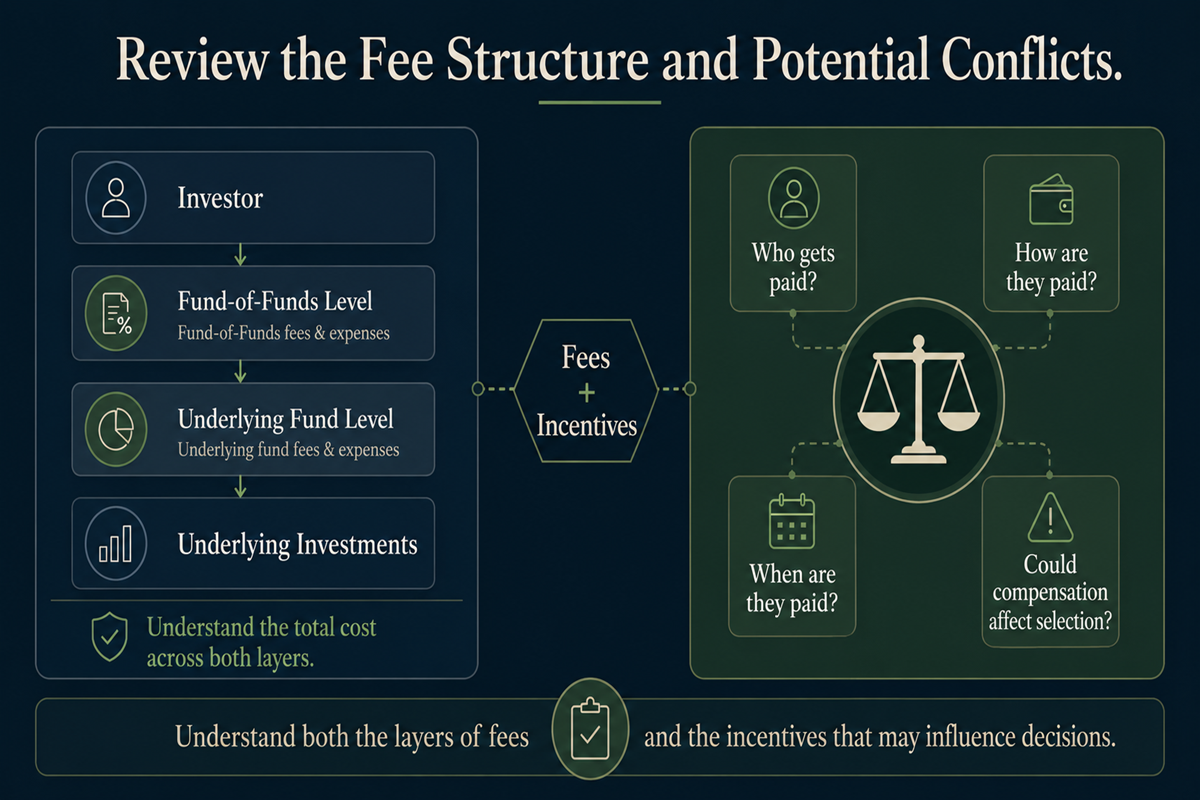
A fund-of-funds structure can include more than one layer of fees.
There may be fees at the Greener Path Capital fund level, fees charged by the underlying funds, or both. The exact structure depends on the offering documents.
That makes fee transparency an important part of due diligence.
Ask:
What fees are charged at each level?
Are there management fees, performance-based compensation, or other expenses?
How are those fees disclosed?
Could compensation influence which underlying funds are selected?
How do the total fees affect the investor’s economics?
The point is not to assume that layered fees are automatically a problem.
The point is to understand what you are paying for, who is being compensated, and whether the structure creates incentives that deserve closer review.
A clear manager should be able to explain the fee structure in plain English and show where each layer fits into the overall investment.
6. Ask What Happens After Capital Is Allocated
Due diligence should not end when an underlying fund is selected.
A fund-of-funds manager also needs a process for monitoring what happens next.
That may include reviewing:
Fund performance and reporting
Changes in leverage or financing conditions
Material changes to the sponsor or management team
Delays in the business plan
Distribution changes
Portfolio concentration
Market conditions that affect the underlying strategy
Ask how often the manager reviews each underlying fund and what information they receive from the sponsor.
It is also worth asking what happens when results begin to move away from the original assumptions.
The manager may not control the day-to-day decisions inside an underlying fund, but they should still have a clear process for identifying changes, assessing their significance, and communicating material developments to investors.
Selection matters.
Ongoing oversight matters too.
7. Evaluate How the Manager Communicates Problems
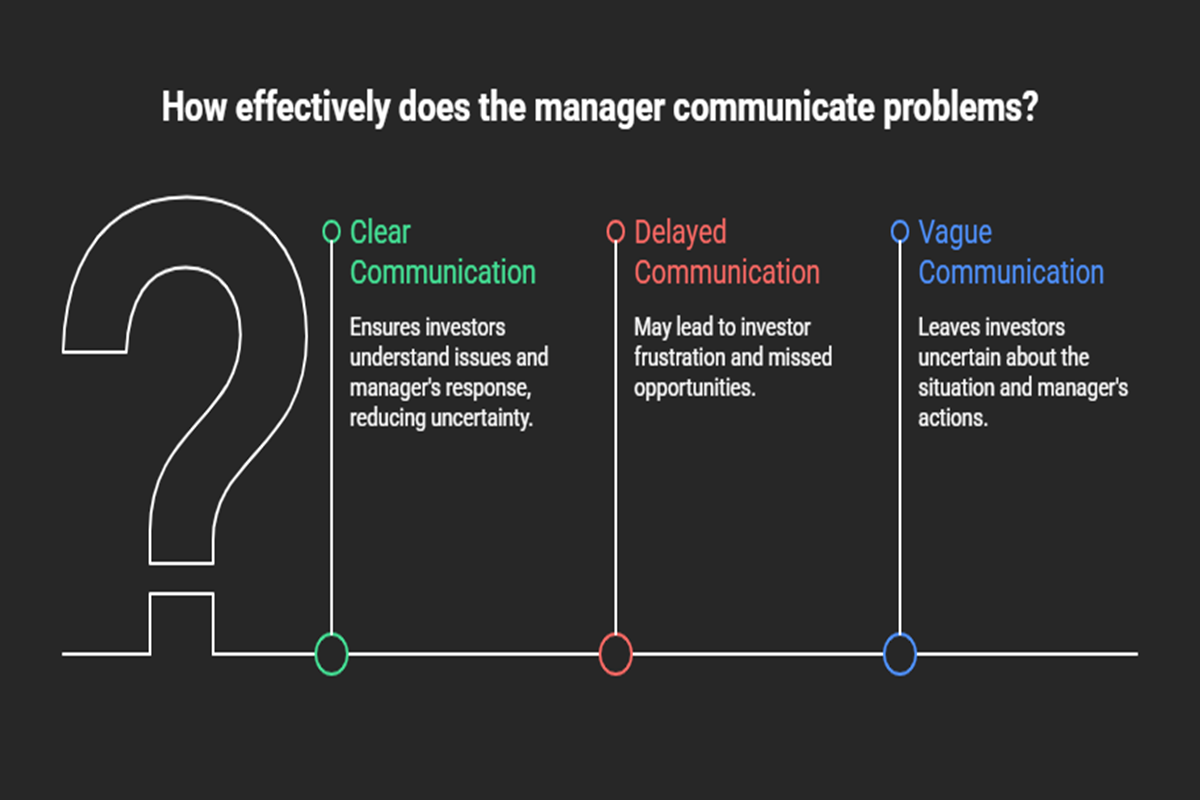
Good communication matters most when an investment is not moving exactly as planned.
It is easy to report positive developments. The harder test is how the manager handles delays, underperformance, changes in assumptions, or problems at an underlying fund.
Ask questions such as:
How are material issues communicated to investors?
How quickly are important changes shared?
Does the manager explain what changed and why it matters?
Are investors told what is known, what is still uncertain, and what is being monitored?
How does the manager communicate when an underlying sponsor misses expectations?
Clear communication does not eliminate risk.
It does help investors understand what is happening and how the manager is responding.
For a fund-of-funds investor, that visibility matters because you may be relying on several layers of management between your capital and the underlying assets.
8. Understand the Limits of the Manager’s Role
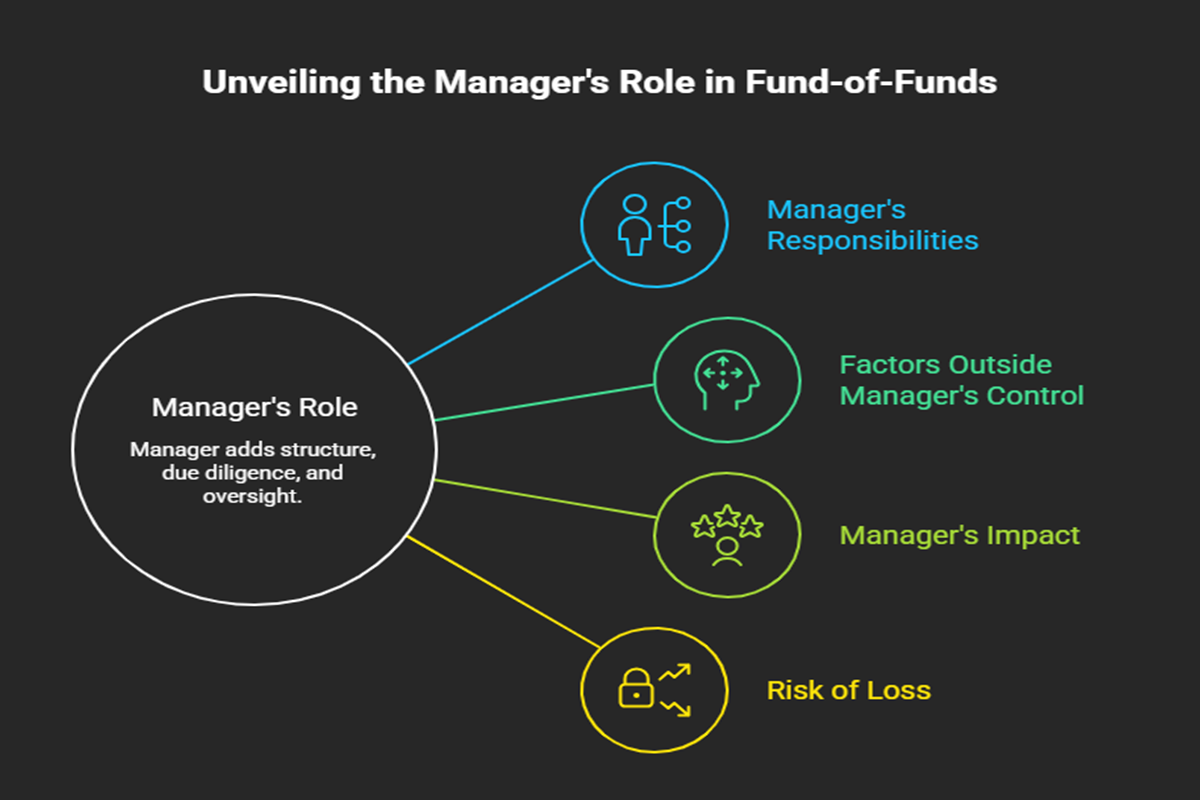
A fund-of-funds manager can add structure, due diligence, portfolio oversight, and another layer of review.
That does not mean the manager can control every outcome.
Underlying fund performance may still be affected by:
Market conditions
Sponsor execution
Financing changes
Property-level performance
Delayed exits
Changes in interest rates
Liquidity constraints
Assumptions that do not play out as expected
This is an important distinction.
A disciplined manager can improve the investment process by asking better questions, selecting carefully, monitoring consistently, and communicating clearly.
But those steps do not remove the possibility of loss.
Before investing, make sure you understand both what the manager is responsible for and what remains outside their control.
That is one of the clearest ways to evaluate the structure without confusing good process with guaranteed results.
Questions to Ask a Fund-of-Funds Manager Before Investing
By this point, the goal is to turn due diligence into a practical conversation.
Useful questions include:
How do you select underlying fund managers?
What causes you to reject an opportunity?
How do you evaluate leverage, liquidity, and concentration risk?
How do you decide how much capital to allocate to each fund?
What fees exist at each level of the structure?
How often do you review underlying managers after investing?
What happens when a fund falls behind its original business plan?
How are material problems communicated to investors?
Where does your responsibility end and the underlying sponsor’s responsibility begin?
What risks do you believe investors should understand before committing capital?
You are not looking for perfect answers.
You are looking for clear answers.
A manager should be able to explain how decisions are made, what tradeoffs exist, and where uncertainty remains.
That level of clarity can help you evaluate the process behind the investment instead of relying only on the opportunity being presented.
What Matters Most When Evaluating a Fund-of-Funds Manager

A real estate fund of funds can simplify part of the investment process by placing manager selection, portfolio construction, and ongoing monitoring in the hands of a dedicated team.
That convenience does not remove your responsibility to understand the structure.
Before investing, focus on how the manager makes decisions, how they evaluate underlying funds, how they think about risk, how fees are structured, and how they communicate when conditions change.
You do not need to become an expert in every property or sponsor.
You do need enough clarity to understand what is being delegated, what is being monitored, and what remains outside the manager’s control.
That is the real purpose of due diligence.
It helps you make a more informed decision about whether the manager’s process, judgement, and investment approach align with what you are comfortable with as an investor.
If you would like to discuss how fund-of-funds due diligence works or have questions about the topics covered in this article, you can reach out to the Greener Path Capital team to continue the conversation.


