

Why Most Investors Confuse Rent Growth With Risk Control
Most multifamily deals don’t fail because the property is bad. They fail because the assumptions behind them don’t hold.
On paper, everything looks solid. The underwriting shows steady rent growth, clean projections, and attractive returns. The numbers tell a coherent story, and it’s easy to believe it.
But the moment rent growth slows down or doesn’t materialize the way it was projected, the entire structure starts to shift. Returns compress, refinance options narrow, and exit assumptions become less certain.
The deal didn’t suddenly break. It was built on something fragile from the start.
At the center of that fragility is a simple belief: If rents grow, the deal works.
This assumption shows up in almost every model. Rent growth drives income, income drives valuation, and valuation drives returns. The entire investment starts to lean on that upward trend.
It feels reasonable. Many markets have grown over time, and historical data seems to support it. But there’s a structural flaw in how this assumption is used.
Rent growth is not something you control. It is something you hope happens.
That distinction is where most investors get it wrong.
Because once a deal depends on rent growth to perform, you are no longer evaluating a stable investment. You are accepting a condition that must go right for the deal to succeed.
Most investors never stop to question that shift. The projections look clean, the returns look attractive, and the downside is rarely examined with the same discipline.
This is how deals become fragile without appearing risky.
What Investors Think Rent Growth Does

Most investors don’t explicitly say that a deal depends on rent growth. But if you look closely at how deals are evaluated, that’s often the underlying logic.
They review a model where rents increase year after year, and they interpret that growth as a sign of strength. As rents rise, income improves. As income improves, the property’s value increases. That increase in value then supports the projected returns and the exit strategy. The entire investment starts to feel predictable and well-supported.
This is why deals with stronger rent growth projections tend to look more attractive. The returns appear higher, the upside seems clearer, and the path to success feels more certain. For many investors, this creates a sense of confidence, even when the assumptions behind those projections are not fully examined.
Over time, this leads to a subtle but important shift in thinking. Rent growth is no longer viewed as potential upside. It begins to function as a built-in cushion. Investors start to believe that even if parts of the business plan don’t go exactly as expected, rent increases will help carry the deal forward.
That belief is where the problem begins.
Rent growth does not stabilize a deal. It does not protect against mistakes, delays, or changing market conditions. It simply improves performance if it happens.
When investors treat it as a form of protection, they overestimate how resilient the deal actually is. What looks like a strong investment on paper may, in reality, depend on a single assumption continuing to hold true.
The Assumption Behind Most Deals
Every deal follows a similar path. Stabilize the property, increase rents, grow NOI, then exit at a higher value. On paper, it feels straightforward.
The issue is what this structure depends on.

There’s one question that reveals it immediately:
What happens if rents don’t grow?
Not slower than expected. Not slightly below projections. What if they simply don’t grow?
When you look at the deal through that lens, the structure starts to shift. Returns compress, refinancing becomes tighter, and the exit loses support. In some cases, the margin disappears entirely.
You start to see the pressure points:
Returns rely on future income that hasn’t happened yet
Exit value depends on higher rents being achieved
The business plan assumes favorable market conditions
None of these is inherently wrong on its own. But together, they create a single condition.
The deal needs rent growth to perform. That’s the “hidden” assumption.
And once performance depends on something outside your control, the investment becomes more fragile than it appears. Because rent growth is not created by the model. It is determined by the market.
A deal that only works if the market cooperates is not stable. It’s conditional.
Why This Mistake Is So Common
This confusion doesn’t happen by accident. It shows up consistently because several forces push investors in the same direction.
1. Rent growth feels familiar
Most investors have seen markets grow over time. They’ve watched rents increase across cycles, especially in strong markets. That history creates confidence.
It leads to a simple conclusion: growth is normal.
But what’s normal over long periods is not guaranteed in a specific deal timeline. A five-year hold is not the same as a twenty-year trend. Still, investors often treat them as if they are.
2. Projections make growth look controlled
Underwriting models present rent growth as clean and predictable. It’s built into neat yearly increases, often with precise percentages.
That presentation changes perception.
What is actually uncertain starts to look engineered. Investors begin to feel that growth is part of the plan, not a variable that may or may not happen.
3. Stronger projections make deals more attractive
Higher rent growth leads to higher returns on paper. That naturally draws attention.
When comparing deals, the one with stronger projected growth often looks like the better opportunity. The upside is clearer, and the numbers feel more compelling.
But this creates a bias. Investors start favoring deals that assume more, not necessarily deals that are more resilient.
4. Downside scenarios are rarely stressed
Most deal presentations focus heavily on the upside case. They show what happens if the plan works.
What’s often missing is equal attention to what happens if it doesn’t.
If rent growth slows, stalls, or reverses, many models are not tested with the same level of detail. As a result, investors don’t fully see how sensitive the deal is to that one assumption.
5. It’s easier to believe in growth than to analyze risk
Evaluating downside requires more effort. It forces harder questions and less comfortable answers.
Growth, on the other hand, is easy to accept. It aligns with optimism and with how deals are typically presented.
So most investors don’t challenge it deeply. They accept it.
This is why the mistake persists. Not because investors lack intelligence, but because the system around them reinforces the same assumption from multiple angles.
Is Rent Growth a Reliable Assumption in Multifamily Investing?
Rent growth is real. It happens across markets and over time. But the key question is not whether it exists. It’s whether it can be relied on within the timeframe of a specific deal.
Most multifamily investments operate on a fixed horizon, often five years. Within that window, rent growth is influenced by factors that are difficult to predict with precision. Supply can increase faster than expected. Demand can soften. Interest rates can shift the entire landscape. Even strong markets experience periods where growth slows or stalls.
Because of this, rent growth should be treated as uncertain by default. It is not something an operator controls. It is something the market allows.
The problem begins when that uncertainty is ignored or minimized. In many models, rent growth is treated as a steady, expected progression. It becomes part of the foundation rather than a variable layered on top.
That shift changes how risk is perceived.
A deal that assumes rent growth is not inherently flawed. But a deal that depends on it to meet its return targets carries a different risk profile. The outcome is no longer driven primarily by execution. It is tied to external conditions aligning with the plan.
Experienced investors make a clear distinction here. They separate what must happen from what would be beneficial if it happens.
Rent growth belongs in the second category.
It can improve a deal. It should not be required to make the deal work.
What Is Rent Growth vs Risk Control?
These two ideas often get blended together, but they serve completely different roles in a deal.
Rent growth is about potential. Risk control is about protection.

When you separate them clearly, the difference becomes obvious.
Rent Growth
Driven by market conditions, not operator control
Improves returns if it happens
Typically projected based on historical trends
Uncertain within a short hold period
Adds upside, but does not protect downside
Rent growth is a bonus. It enhances performance when conditions are favorable.
Risk Control
Built into the deal structure from day one
Focused on protecting downside scenarios
Based on conservative assumptions
Holds up even when conditions are not ideal
Determines whether the deal survives under pressure
Risk control is what keeps the deal intact when things don’t go as planned.
The mistake is treating these as interchangeable.
When rent growth is used as a substitute for risk control, the deal becomes exposed. It may look strong in a favorable scenario, but it lacks protection when reality diverges from the model.
Experienced investors don’t rely on what might happen. They build around what must hold true.
What Real Risk Control Looks Like in Multifamily
Once you separate rent growth from risk control, the next question becomes practical:
What does real risk control actually look like in a deal?
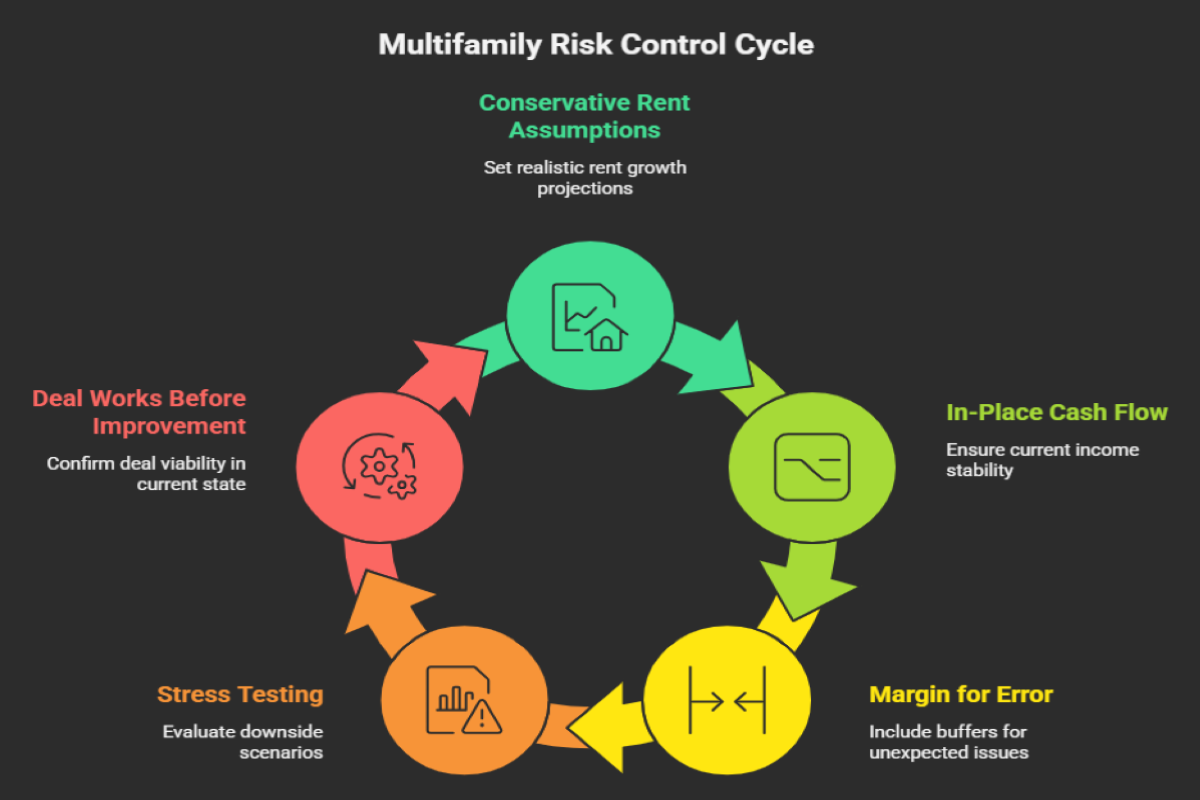
It’s not a single tactic. It’s a set of decisions made early, before the deal is ever presented.
1. Conservative rent assumptions
Strong deals don’t rely on aggressive projections. They assume modest growth or, in some cases, no growth at all. This approach is part of a broader discipline often referred to as conservative underwriting, which focuses on building deals that work under pressure, not just in favorable conditions.
This creates a base case that can hold without favorable conditions. If rent growth happens, it improves returns. If it doesn’t, the deal still functions.
2. In-place cash flow matters
A deal should generate enough income today, not just in the future.
When a property depends heavily on future rent increases to produce meaningful cash flow, it introduces timing risk. Delays, market shifts, or execution issues can all impact performance.
Stable, in-place income reduces that exposure.
3. Margin for error is built in
Every deal will face friction. Expenses come in higher, renovations take longer, and leasing is slower than expected.
Risk-controlled deals account for that.
They include buffers that absorb pressure without breaking the structure. That margin is what allows the deal to remain stable even when multiple variables move in the wrong direction.
4. Stress testing is taken seriously
Strong underwriting doesn’t just model the upside. It actively tests the downside.
What happens if rents stay flat?
What happens if expenses rise?
What happens if the exit cap rate expands?
These scenarios are not edge cases. They are part of a disciplined evaluation.
5. The deal works before it improves
This is the simplest way to identify real risk control.
A strong deal works in its current state or under conservative assumptions. Improvements, including rent growth, are layered on top.
Not the other way around.
Real risk control is not about predicting the future accurately.
It’s about building a deal that doesn’t depend on being right.
The No-Growth Test: A Simple Way to Evaluate Any Deal
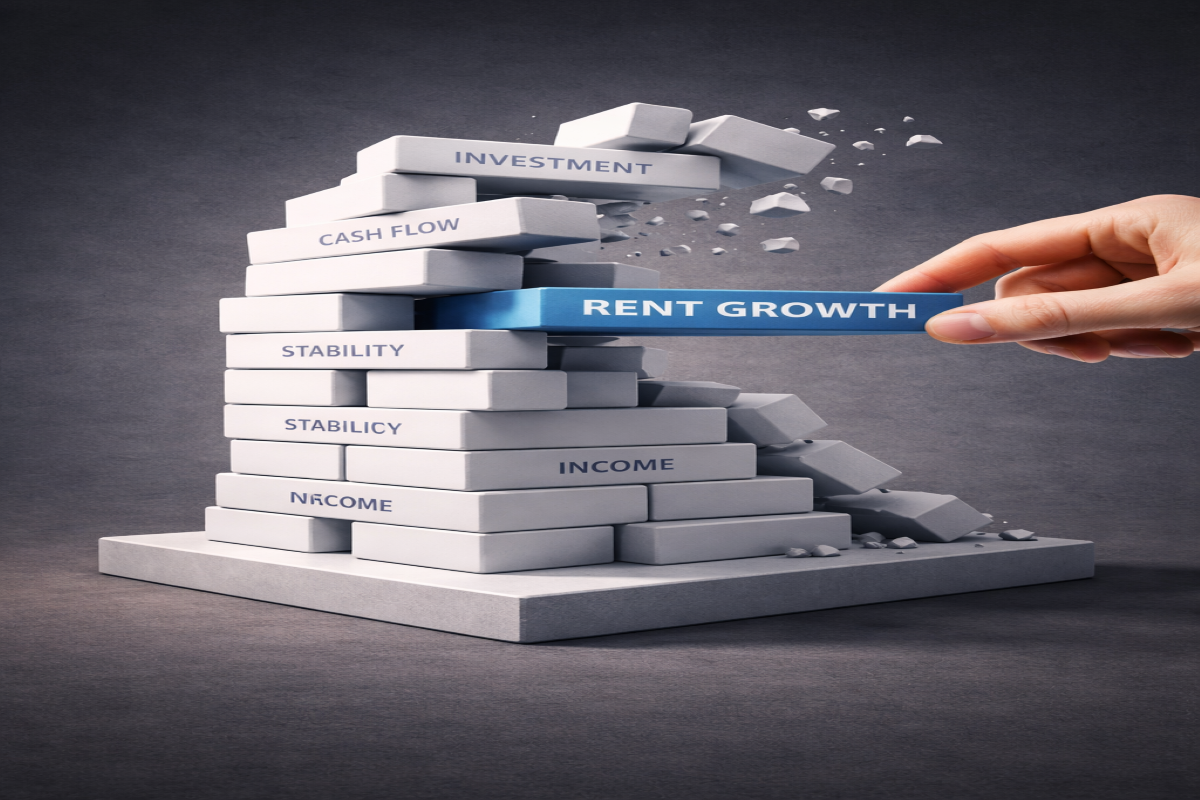
Once you understand how often deals depend on rent growth, the next step is having a simple way to evaluate that risk.
You don’t need a complex model to do it. You just need to remove one assumption and see what remains.
The test is straightforward:
What happens if rents do not grow at all?
Not slower. Not below projections. Just flat for the entire hold period.
When you run a deal through that lens, the real structure becomes visible. You can see whether returns are driven by actual performance or by future expectations. You can see whether the deal produces enough income to support itself, or whether it needs growth to justify the investment.
This is where many deals start to separate.
Some still hold together. Returns may be lower, but the deal remains stable. Cash flow continues, debt can be managed, and the exit still works within a reasonable range.
Others begin to weaken quickly. Without rent growth, the numbers no longer support the original thesis. The margin disappears, and the deal becomes highly sensitive to timing and external conditions.
That difference is what matters.
The goal is not to eliminate upside. It is to understand whether the deal depends on it. When rent growth becomes optional, the investment becomes more resilient. When it is required, the risk increases, even if it isn’t obvious at first.
This is why experienced investors don’t start by asking how much a deal can make. They start by asking what happens if key assumptions don’t materialize.
A deal that passes this test is built on something solid. A deal that fails it is built on expectation.
Common Mistakes Investors Make
Most investors don’t intentionally take on fragile deals. The problem is how they interpret what they’re seeing.
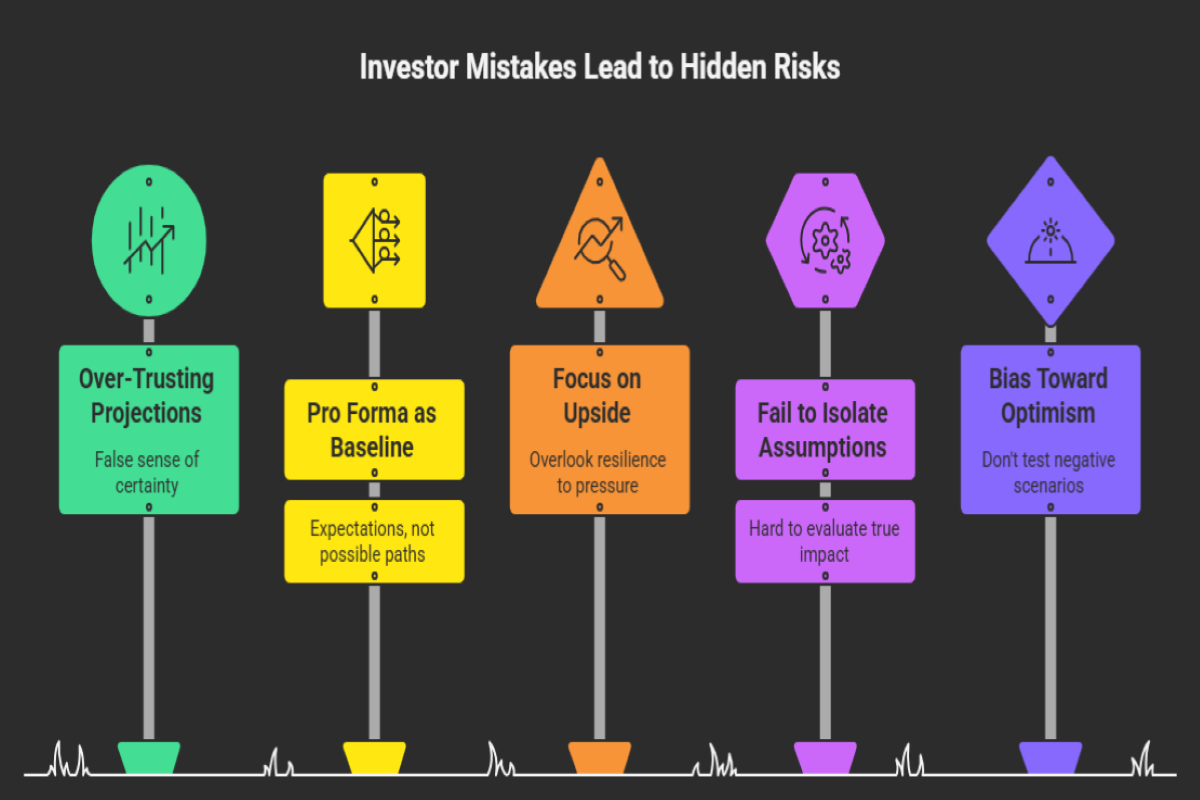
Certain patterns show up again and again.
The first is over-trusting projections. Clean models create a false sense of certainty. When numbers are presented clearly, with consistent growth and strong returns, they feel reliable. But clarity in presentation is not the same as certainty in outcome.
Another common mistake is treating the pro forma as a baseline instead of a scenario. The projections become the expectation, not one possible path. Investors begin to anchor on those numbers, even though they are built on assumptions that may not hold.
There is also a tendency to focus more on upside than on resilience. A deal that shows higher returns naturally draws attention, even if those returns depend on favorable conditions. In the process, investors overlook whether the deal can withstand pressure when those conditions change.
Many investors also fail to isolate key assumptions. Rent growth is often bundled into the model alongside everything else, which makes it harder to evaluate its true impact. Without separating it, it’s difficult to see how much of the deal depends on that single variable.
Finally, there is a bias toward optimism. Real estate is often presented as a long-term growth story, and that narrative shapes how deals are perceived. Investors expect things to improve over time, so they don’t always test what happens when they don’t.
None of these mistakes comes from a lack of intelligence. They come from how deals are structured, presented, and compared.
But over time, these small misinterpretations compound. They lead investors to favor deals that look stronger on paper, while quietly carrying more risk underneath.
How This Changes the Way You Evaluate Deals
The difference between a strong deal and a fragile one is not always visible in the returns.
On the surface, many deals look similar. They show growth, solid projections, and a clear path to exit. But once you start removing assumptions, the structure underneath becomes easier to judge.
Instead of asking how much a deal can make, you start asking what it depends on.

You look at whether the deal still works under conservative conditions. You pay closer attention to in-place performance, not just projected improvements. You question how much of the return is driven by execution versus how much is driven by the market.
This shift changes your filter.
Deals that once looked attractive may no longer pass. Others, which seemed less exciting at first, start to stand out because they are built on stronger fundamentals.
Over time, this approach compounds in a different way. Not by maximizing upside in each deal, but by consistently avoiding structures that break when conditions change.
Rent growth still plays a role. But it is no longer something you rely on to justify the investment.
It becomes what it should have been from the start.


